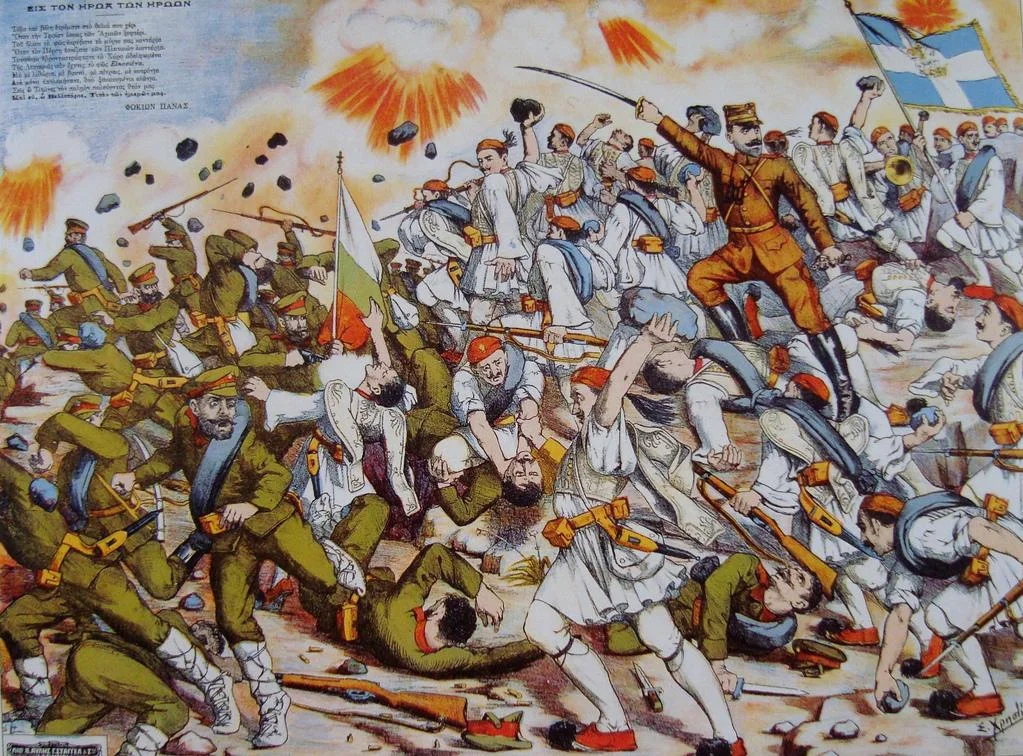

Battle of Kresna Gorge
The Struma River cuts a narrow canyon through the Pirin and Maleshevo mountains in what is today southwestern Bulgaria. The walls are steep, the road runs along the riverbank, and there are points where a single machine gun could hold a brigade for half a day. In July of 1913, the Greek army marched into the gorge from the south on its way to Sofia. The Bulgarian army that was waiting for them had been pulled overnight from the Serbian front, two hundred kilometres to the northwest. For eleven days, in the maze of forests and ridges around the gorge, the Second Balkan War reached its bloody conclusion.
The wars that ate themselves
The First Balkan War of 1912 had been a coalition victory: Serbia, Bulgaria, Greece and Montenegro had broken Ottoman rule across most of the Balkans in months. The treaties that followed left Macedonia divided in ways that satisfied no one, and especially not Sofia, which felt it had borne the heaviest fighting and received the smallest share. In June 1913 Bulgaria attacked its former allies and the Second Balkan War began. The Greek army drove north from Thessaloniki, defeated the Bulgarians at Kilkis-Lachanas and at Doiran, and by mid-July had pushed across what is now North Macedonia into Bulgaria proper. King Constantine I of Greece, freshly crowned after his father's assassination the previous year, wanted Sofia. His prime minister Eleftherios Venizelos privately argued that the Serbs were happily letting the Greeks finish the war for them. Constantine pressed on anyway.
Into the gorge
On 18 July the 1st Greek Division drove the Bulgarian rear guard out of the southern end of the Kresna Pass. Inside the canyon, the Greeks discovered why the rear guard had been so easy to move: the Bulgarian Second and Fourth Armies, freshly arrived from the Serbian front, had taken positions on the high ground above the road and were waiting. The Greeks fought through the ambush and broke out of the gorge after bitter close fighting. On 25 July they captured the village of Krupnik north of the pass; on the 26th, Simitli; and during the night of 27–28 July they pushed the Bulgarians back to Gorna Dzhumaya — the modern town of Blagoevgrad — only seventy-six kilometres from Sofia. Meanwhile the Greek army's right hand swept east across the plain into Western Thrace, taking Xanthi on 26 July and Komotini on 27 July without a fight. On the map it looked like a country falling open.
Constantine's letter
Then the map turned. Bulgarian forces dug in north and east of Gorna Dzhumaya, and on 29 July they tried to encircle the outnumbered Greeks in what their commanders openly described as a Cannae-style double envelopment. Greek counter-attacks at Razlog and west of Kresna held the line, but only just. On the western flank, a Greek thrust toward Charevo Selo to link up with the Serbs failed; the Bulgarians cut the Greek line of retreat through Berovo and Strumica, leaving the Greek army with one route home. Three days of fighting at Pehčevo and Razlog ended in stalemate. On 30 July, with another attack already planned, King Constantine wrote to Venizelos that his army was 'physically and morally exhausted' and asked for a truce. Romania mediated. The Treaty of Bucharest was signed on 10 August. The Second Balkan War was over.
Whose victory
The two governments told the story differently and they still tell it differently. The Greek view: after eleven days of fighting, the Bulgarians had failed to turn the Greek flanks, the Greeks had not been encircled, and the line they held when the truce began was deeper inside Bulgaria than the line on which they had started — a defensive victory at the end of an offensive. The Bulgarian view: their counter-attack stopped the Greek march on Sofia, threatened the Greek army with destruction, and forced Athens to accept terms — an offensive victory at the end of a war they had begun. Most historians since have leaned toward the Bulgarian reading. By the time of the truce, Greek supply lines were stretched, the Bulgarians had committed every reserve they had, and another week of fighting could have ended badly for either army. What is harder to argue is the cost: thousands of soldiers on both sides dead in a canyon, in a war that had been declared with two months' planning and ended without solving any of the questions it had been declared to solve.
What the gorge keeps
Outside the museum in Athens, in the Polemiko Mouseio, sits a brass shell casing engraved in Greek: 'Kresna. Treshkovon 1050. 13 July 1913.' Some Greek artilleryman cut those words into the brass after the gun had fired its last round in the gorge. The Treaty of Bucharest gave most of Macedonia to Greece and Serbia and most of Western Thrace to Bulgaria; a year later, in the redrawing that came with World War I, the lines moved again. The road through Kresna Gorge is now part of the European E79 motorway. Trucks roll down it from Sofia to Thessaloniki at all hours. The river runs through, the cliffs above are streaked with the same scrub and pine that would have given a 1913 sniper good cover, and the Pirin mountains to the east still hold snow into May. Cars passing through rarely know what happened in the trees on either side.
From the Air
41.80°N, 23.16°E, in the Struma River valley about 110 km south of Sofia. The Kresna Gorge is a 17-km canyon between the Maleshevo and Pirin mountain ranges. From altitude the river road snakes through visibly, with the Pirin range rising to over 2,800 metres just east of the gorge. Nearest airports are Sofia (LBSF) to the north, Plovdiv (LBPD) to the east, and Thessaloniki (LGTS) about 130 km south. Snow can close the surrounding peaks late into spring; midsummer is hot and clear.
Nearby Stories
- Battle of Kleidion 13 km away
- Battle of Plovdiv (1878) 46 km away
- Battle of the Gates of Trajan 49 km away
- Boyana Church 73 km away
- Archaeological Museum of Amphipolis 77 km away
- Old Bazaar, Skopje 92 km away
- Vergina 112 km away
- Sveti Stefan 299 km away