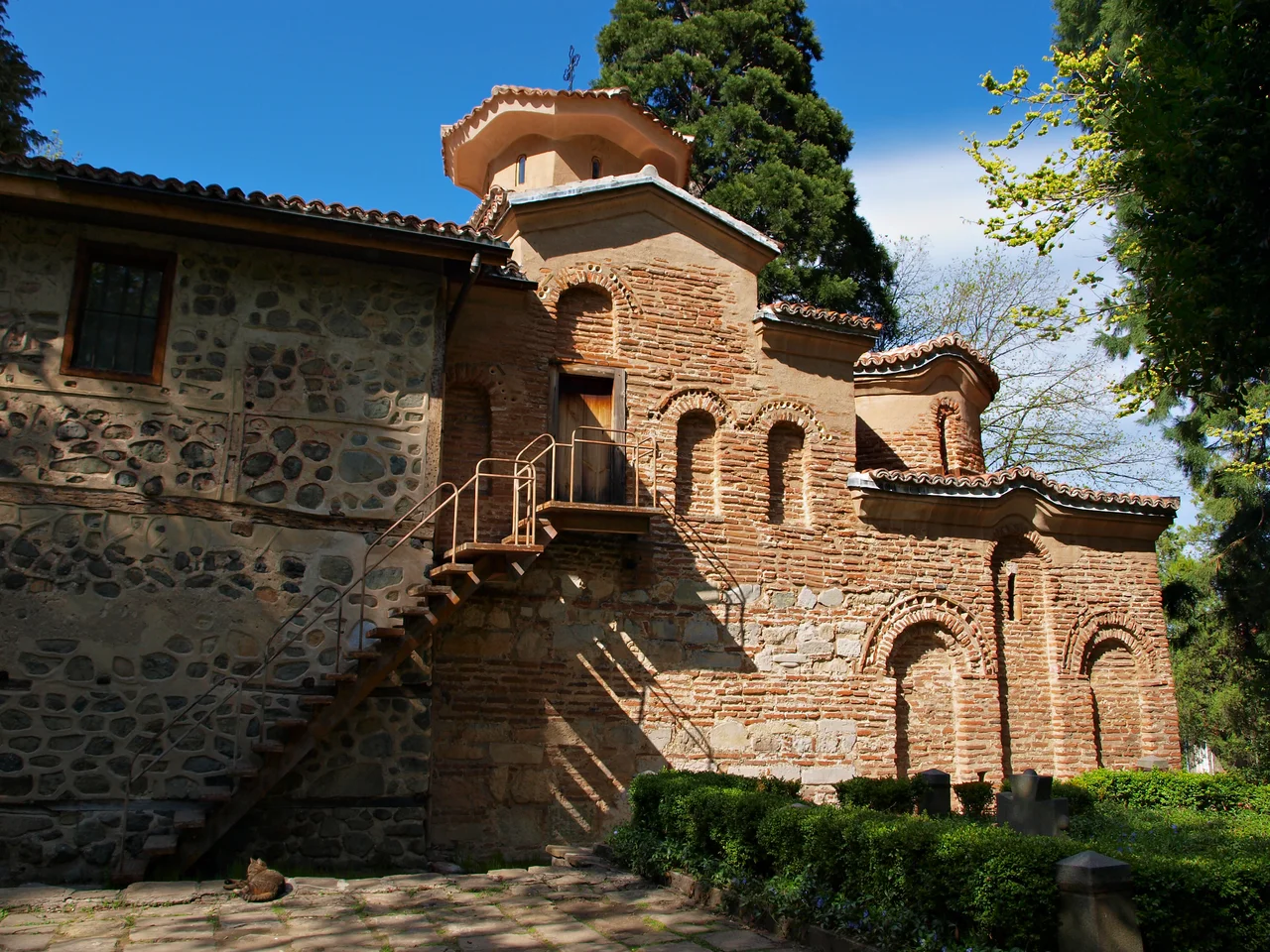

Boyana Church
In 1259, on a wooded slope at the edge of what is now Sofia, an unknown painter looked at a Bulgarian noblewoman named Desislava and painted what he saw. Not a saint with a borrowed face. Not a stylized icon. He painted the woman herself - the slight tilt of her head, a quiet intelligence in the eyes, the particular way her veil fell. The result hangs on the north wall of the Boyana Church to this day, and scholars who study medieval art keep returning to it with the same uneasy thought: this looks like the Renaissance, and it was painted eight years before Giotto was born.
Three Buildings, One Story
The Boyana Church is really three churches stitched together across nine centuries. The eastern wing went up first, sometime in the late tenth or early eleventh century - a tiny cross-vaulted chapel built when Bulgaria was still a young kingdom. In the mid-thirteenth century, the Sebastocrator Kaloyan and his wife Desislava commissioned a second wing pressed up against the first, a two-story tomb-church meant to hold their family. The third and final addition came in the mid-nineteenth century, paid for by villagers from the Boyana quarter on the slopes of Mount Vitosha. Each addition kept the previous building's modest scale, so the whole compound feels intimate even now - a place built to be entered, not admired from across a plaza.
The Frescoes That Looked Forward
What the Boyana Master and his team painted in 1259 broke quietly with everything Byzantine art was supposed to be. The 89 scenes and 240 figures still follow the canon set by the Seventh Ecumenical Council in 787, but the people inside them refuse to behave like icons. Saint Nicholas saves a ship whose hull and sailors' caps recall the Venetian fleet of the painters' own century. Eighteen scenes from his life unfold like a story book. And on the north wall, the patrons themselves - Kaloyan, Desislava, Tsar Constantine Tikh, Tsaritsa Irina - look out with faces specific enough that an art historian named Elka Bakalova has called Desislava's portrait the most remarkable achievement of thirteenth-century painting, foreshadowing the Italian Renaissance. Giotto, born in 1267, was still eight years away when these brushes were laid down.
A Painter Who Signed
Orthodox tradition forbids the painter from claiming authorship. The icon is God's work; the human hand is only a vessel, and humility demands silence. So when restorers in 2006 lifted a layer of plaster from a wall in the Boyana Church and found the words I, Vasiliy inscribed, they were looking at something rare. The restorer Grigoriy Grigorov put it plainly: this painter knew that believers could not see his name, and inscribed it anyway. Whether Vasiliy was the master or one of his assistants, scholars still debate. But somebody, on a wooden scaffold by candlelight, decided his work deserved a name. The team itself is now called the Boyana Master, and their studio is associated with the Turnovo School - the artistic flowering of the Second Bulgarian Empire, of which this small church is the only fully preserved monument.
The Long Quiet
After the Ottomans absorbed Bulgaria in the late fourteenth century, the church survived the way small things survive - by being unimportant. Frescoes were touched up in the 14th century, then again in the 16th and 17th, and once more in 1882. In 1979 UNESCO added the church to the World Heritage List. Then in 1954, alarmed by what centuries of soot, breath, and humidity had done, conservators closed the building entirely. It stayed closed for half a century. When the Culture Minister reopened it in October 2008, it came with strict rules: groups of no more than eight visitors, ten minutes inside, the temperature held at 17 to 18 degrees Celsius, the lighting dialed low so that no warmth would lift from the lamps to disturb the paint. You stand close enough to see Desislava's eyes. Then your ten minutes are up.
What Survives
Above the dome, Christ Pantocrator presides over a host of angels. Below him, the Four Evangelists stand in the pendentives. There are church fathers, warrior saints, the Virgin enthroned, the deacons Laurentius and Stephen and Euplius. There is the oldest known image of Saint John of Rila, Bulgaria's patron monk, painted while his cult was still young. None of this is what makes Boyana famous. What makes it famous is the human faces - the artist who looked at real people in his own century and decided their faces were worth the wall. Eight centuries later, on a slope of Mount Vitosha just south of Sofia's sprawl, those faces are still there, still specific, still patient with the few visitors allowed near enough to meet their eyes.
From the Air
Boyana Church sits at 42.6447 N, 23.2662 E on the lower slopes of Mount Vitosha (2,290 m) at the southern edge of Sofia. Sofia Airport (LBSF) lies about 12 km northeast; the church is best identified from above by Vitosha's distinctive massif looming over the city's southern suburbs. Recommended viewing altitude 2,500-4,000 m AGL in clear conditions; the church itself is small and tucked among trees, so use Vitosha as your visual anchor.
Nearby Stories
- Battle of the Gates of Trajan 1.3 km away
- Battle of Kresna Gorge 65 km away
- Battle of Plovdiv (1878) 70 km away
- Battle of Kosturino 114 km away
- New Europe Bridge 129 km away
- Old Bazaar, Skopje 136 km away
- Trapezitsa Fortress 142 km away
- Trajan's Bridge 193 km away