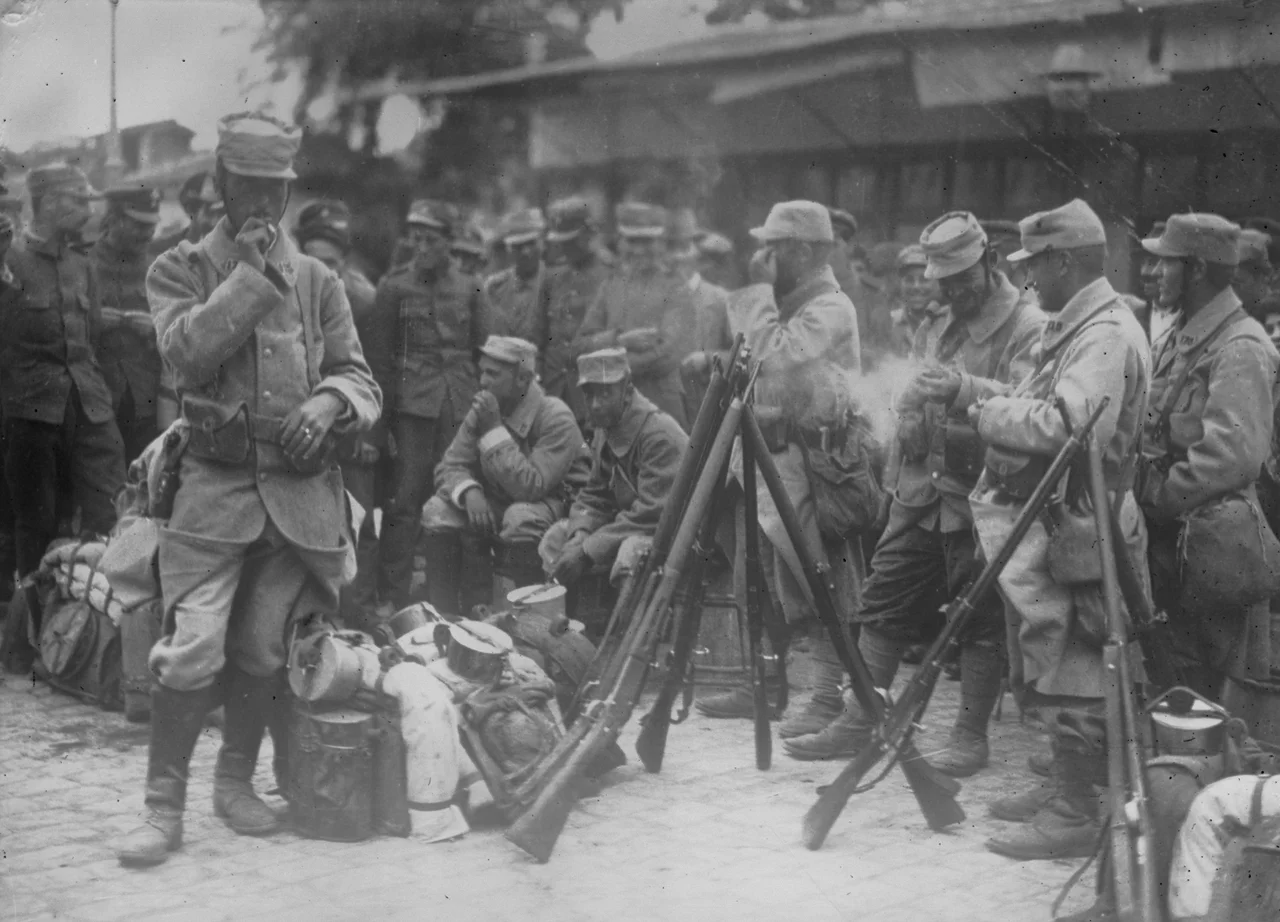

Battle of Kosturino
By the first week of December 1915 the Connaught Rangers had been on a ridge above the village of Kosturino for nearly three weeks. The greatcoats they had brought from Ireland were ruined. A blizzard had come and gone; the next gale had soaked their new coats and the next gale had frozen them. Twenty-three officers and over sixteen hundred soldiers of the 10th (Irish) Division had already been evacuated to Salonika with frostbite or exhaustion. They had been sent here to save Serbia. Serbia was already lost. They were now waiting for the Bulgarian Second Army to come down the slope.
A march that came too late
The Allied expedition to Macedonia had its origins in something Serbia had been begging for since 1914: a French and British force to hold the southern flank of the Serbian army against Bulgaria. It was finally sent in October 1915, two divisions under General Maurice Sarrail of France and General Bryan Mahon of Ireland, by which time it was already too late. By the time French troops reached Krivolak on the Vardar and the British dug in along the Kosturino ridge, the Serbian army had already been broken at home by a coordinated German, Austro-Hungarian and Bulgarian offensive. Serbian Marshal Radomir Putnik, too sick to walk, had ordered a full retreat. His soldiers and tens of thousands of civilians were already crossing the Albanian mountains in winter, dying as they went. The men on the Kosturino ridge were now the Allied left flank of a flank that no longer existed.
The ridge in the snow
The Bulgarian Second Army under General Georgi Todorov had concentrated at Strumica, twelve kilometres north. Bulgaria came into the war for territorial reasons most British soldiers did not fully understand: in the Second Balkan War of 1913 it had lost lands it considered rightfully its own to Serbia, and Berlin was now offering to give them back. Todorov had a hundred and twenty battalions to push west and south. The Allies on the ridge had fifty. On 4 December the Bulgarian artillery opened up. By 6 December it was raking the trench held by the Connaughts at a feature the British called Rocky Peak. Small bands of Bulgarian infantry crawled forward through the gunfire and were cut down at sixty yards. The Royal Irish Fusiliers retook a briefly lost trench in hand-to-hand fighting. Half a company and a single machine gun were sent up to reinforce.
Fog at dawn
The Bulgarian assault on the morning of 7 December came up through a heavy fog. Both sides wore similar greatcoats; the defenders could not make out who was who until bayonet length. The Connaughts and the Royal Hampshires were forced back from Rocky Peak, to a line called Crete Simonet, where two more attacks broke against them with sixty-four casualties before the position became untenable. By that evening the Royal Munster Fusiliers, who had held their own ground all day, fell back too rather than be cut off. The 31st Brigade abandoned the village of Prsten for high ground at Tatarli. French General Maurice Bailloud sent a mountain battery and two battalions to plug the line. On 8 December at 5:45 in the evening the Bulgarians took Crete Simonet, captured ten artillery pieces, and blew bugles in the dark to announce the win.
Walking back into Greece
Through 9, 10 and 11 December the Allies fell back south down the Vardar valley toward the Greek frontier. The 11th Bulgarian Division took the village of Bogdanci, cut the local telephone line, and seized an ammunition depot. The 9th King's Own Royal Regiment, isolated on the wrong side of the line, did not begin its withdrawal until 12 December — and an hour later, marching in the dim morning light, walked straight into a battalion of Bulgarian infantry resting at the roadside. The bayonet charge that followed killed or captured 122 of them. By the evening of the same day the last of the British and French — the 10th Irish Division and the 57th, 122nd and 156th French Divisions — had crossed into officially neutral Greece. The Greek border guards stood aside. The Bulgarians halted two kilometres from the frontier, exactly as their secret orders had said they would. British losses for the battle came to about 1,209, including 99 killed; French losses about 1,804. Bulgarian losses, especially around the failed counter-attack on 9 December, were probably much higher.
The line that became Salonika
The strategic consequences ran in both directions. The Central Powers had now opened the railway between Berlin and Constantinople, prying it free of Allied threats and finally able to ship arms to the Ottomans on a regular schedule. The Allies had failed to save Serbia, but they had drawn a new front line: the Macedonian Front, around the great entrenched camp at Salonika, in officially neutral Greek territory. Greece would be dragged into the war, and the Macedonian Front would become an active theatre for almost three more years. In late September 1918 it would be from those same hills around Salonika that the offensive that finally cracked Bulgaria — and triggered the collapse of the Central Powers — would begin. The men of Kosturino, frozen and exhausted in the rain, did not know any of that. They walked south, found Greek customs men, and slept where they fell.
From the Air
41.36°N, 22.61°E, on the present-day border between North Macedonia and Greece, about 15 km north of the Greek town of Polykastro and 12 km south of Strumica. The terrain is rolling Balkan hill country, low ridges climbing toward the Belasitsa range to the east. Nearest airfield is Thessaloniki (LGTS) some 80 km south. Visibility through the valleys is reliable in clear winter weather; the mist that hid the December 1915 attacks is a common dawn condition.
Nearby Stories
- Battle of Kilkis (1944) 23 km away
- Battle of Kresna Gorge 43 km away
- Battle of Amphipolis 64 km away
- Old Bazaar, Skopje 70 km away
- Battle of Plovdiv (1878) 76 km away
- Archaeological Museum of Amphipolis 83 km away
- 1963 Skopje Earthquake 90 km away
- Ohrid 113 km away