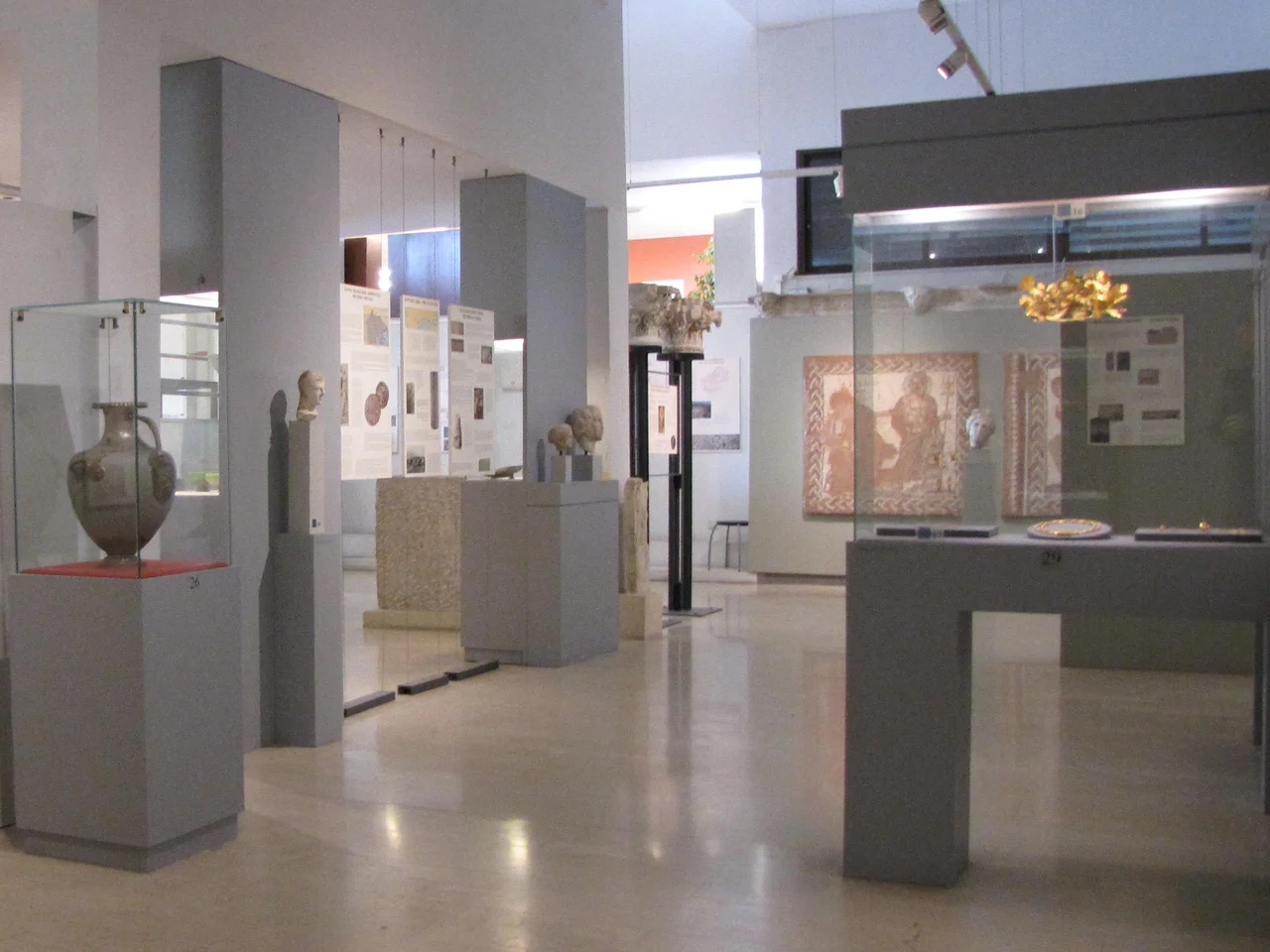

Archaeological Museum of Amphipolis
Amphipolis is one of those Greek place-names that scholars know well and tourists barely register. The modern village sits beside the Strymon River, six hundred meters south of a low, rounded hill that holds the ruins of an ancient acropolis. The Archaeological Museum of Amphipolis stands at the entrance to the village, near the highway that runs from Thessaloniki to Kavala - a quiet two-story building, opened in 1995, where a Macedonian gold wreath, the coinage of Philip II, and the gold jewelry of the Kasta Tomb are arranged in cool, well-lit cases. It is not a famous museum, but it is the one place in Greece where you can stand in front of the small things that came out of one of the largest tombs ever excavated in the Hellenic world - and consider, while looking at them, who they may have been intended to commemorate.
The Athenian Colony
Amphipolis was founded in 437 BC by Athenian colonists who needed access to the silver and gold of the Pangaion mountains and to the dense forests of Macedonian timber the Athenian fleet was always hungry for. The city sat on a strategic curve of the Strymon, ten kilometers inland from the sea, with a land bridge that allowed control of the road east. The Athenians did not hold it long. By 424 BC, the Spartan general Brasidas had taken Amphipolis from them - and although Brasidas died in the battle that secured it, the Athenians never managed to win the city back. A silver ossuary thought to belong to Brasidas himself, with a gold crown still resting on top of his cremated remains, sits today in the museum's basement gallery. Around 422 BC the historian Thucydides was exiled from Athens, in part for failing to relieve the besieged city; he spent twenty years writing his great history while the world he had failed to save went on without him.
The Coinage of Macedon
The Pangaion mountains and the peninsula of Halkidiki contained the precious-metal mines that made Macedonian power possible. In the early fifth century BC, Alexander I of Macedon - not the Great, but his ancestor four generations removed - introduced coinage to the kingdom, and as he expanded eastward he brought the mines near Philippi under his control. At their peak, those mines reportedly yielded a talent of silver per day - about 26 kilograms. Two parallel currencies developed: heavy, valuable coins for foreign trade and lighter ones for everyday transactions inside Macedonia. By the late fifth century, smaller bronze coins replaced the smallest silver. Then came Philip II, whose conquests pushed the kingdom outward in every direction, and who built a new mint at Amphipolis to complement the older one at Pella. Gold coins appeared, struck to the Attic standard. The museum holds examples - a stater of Alexander the Great, a Justinian coin from a thousand years later - small bright disks that fit in a hand and explain how a regional kingdom on the edge of the Greek world became, briefly, the largest empire the West had ever known.
The Tomb on the Hill
In 2012, a few kilometers north of the museum, archaeologists working on the Kasta Mound began to uncover what turned out to be the largest ancient tomb ever found in Greece - a circular monument 158 meters in diameter, ringed by a marble wall, sealed with three successive chambers, guarded by paired sphinxes and caryatids carved with extraordinary skill. The Lion of Amphipolis, a four-meter marble lion that had been excavated in 1913 and reassembled by the roadside, almost certainly once crowned the mound. Inside the third chamber, archaeologists found a vaulted cist grave containing the bones of five people: a woman over sixty, two men in their thirties or forties, an infant, and the cremated fragments of a fifth. The gold jewelry recovered from the tomb is now in the Archaeological Museum of Amphipolis - delicate, beautiful, and far more questions than answers.
Whose Memory, Whose Bones
The Kasta Tomb is unfinished. Construction stopped abruptly, and the building was never used as the burial it was intended to be - which leaves the question of intention. The lead excavator argued for years that the tomb was a memorial built on Alexander the Great's order for his closest companion, Hephaestion, who had died unexpectedly in Ecbatana in 324 BC and whose grief had driven Alexander into one of his strangest periods. Three inscriptions found at the site read PARELABON ('I received') beside what appears to be a monogram of Hephaestion. A 2025 archaeoastronomical study showed that the tomb's main axis is aligned with the winter solstice sunrise, an alignment that would have made sense for a hero cult. Other scholars have argued for Olympias, Alexander's mother, or for one of his wives. The five people whose bones rest in the chamber were probably not Hephaestion himself, whose remains likely never traveled this far west. They were, however, somebody - real people, family members or attendants, whose lives ended in or near this monument. Their grave goods, their gold, the small intimate objects they were buried with, are what the museum holds. A visit there is in part an admission that ancient history sometimes hands you treasure and ambiguity in the same display case.
From the Air
The Archaeological Museum of Amphipolis sits at 40.83°N, 23.85°E in central Macedonia, Greece, beside the modern village of Amfipoli on the eastern bank of the Strymon River. From the air, the geography is the broad lower Strymon valley opening southward toward the Aegean, with the rounded mass of Mount Pangaion visible to the southeast. The Kasta Tomb mound is a few kilometers north of the museum. Best viewed at 5,000-12,000 feet. Nearest airports are Thessaloniki (LGTS) about 80 km west, Kavala Megas Alexandros (LGKV) closer to the east, and the smaller field at Drama (Chrysoupoli area).
Nearby Stories
- Byzantine Empire under the Palaiologos Dynasty 15 km away
- Battle of Philippi 16 km away
- Battle of Kleidion 30 km away
- Battle of Kilkis (1944) 31 km away
- Battle of Pydna (148 BC) 59 km away
- Battle of Athos 83 km away
- Battle of Doiran (1917) 85 km away
- Roman Forum of Philippopolis 120 km away