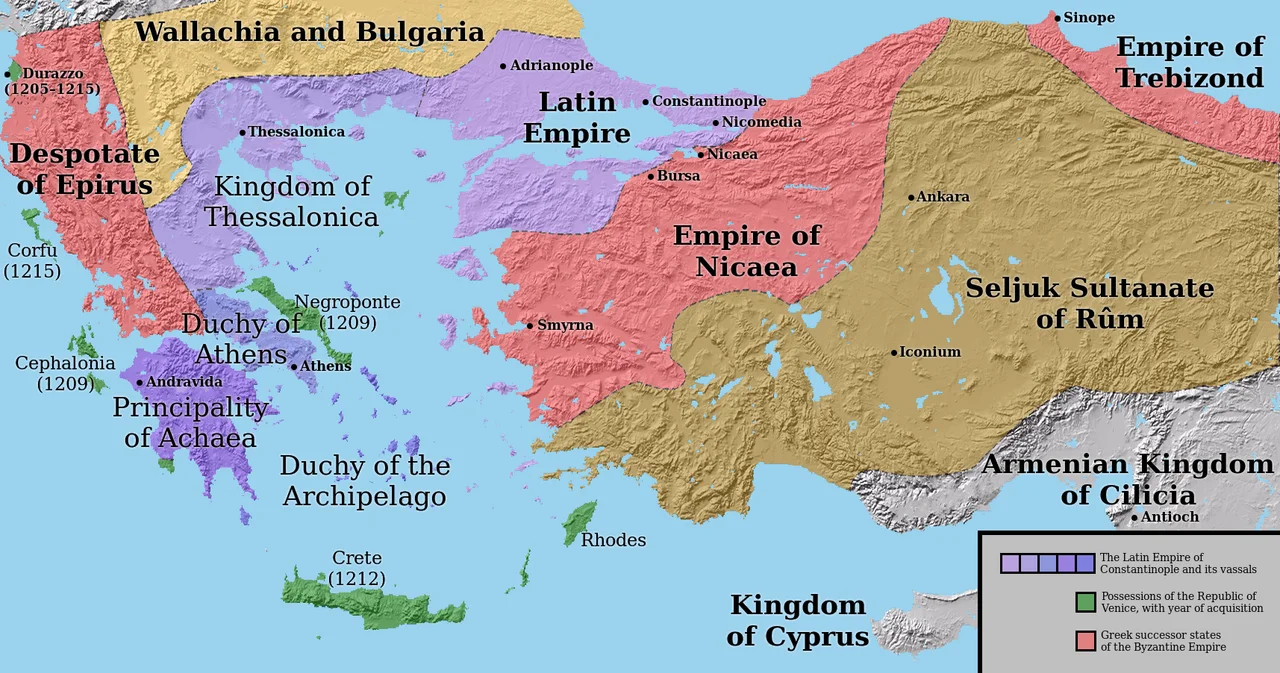

Byzantine Empire under the Palaiologos Dynasty
On 25 July 1261, a Byzantine general named Alexios Strategopoulos approached the walls of Constantinople with a small force and discovered that the Latin garrison was elsewhere. He walked in. The empire that had ruled from this city for nine centuries, lost it to the Fourth Crusade in 1204, and survived in exile in Nicaea for fifty-seven years had its capital back. The man whose dynasty would inherit this restored empire, Michael VIII Palaiologos, blinded the rightful young heir to make his own claim secure - a brutal opening note for what would become the longest twilight in European history. The Palaiologoi held Constantinople for 192 more years. Most of that time was spent losing.
The Empire That Was Returned
The Byzantium Michael VIII recovered in 1261 was a fragment. The Fourth Crusade had broken the empire into pieces; the Greek successor state of Nicaea had reassembled some of those pieces, but not enough. The city itself was half-ruined, stripped of treasure and population. The Hagia Sophia had been looted in 1204 and needed reconsecration. Michael set about restoring monasteries, mending the Theodosian walls, rebuilding the Kontoskalion harbour against the next western expedition that he correctly assumed was coming. He paid Peter III of Aragon to invade Sicily and tear up Charles of Anjou's plans for a new Latin crusade against Constantinople - the resulting Sicilian Vespers of 1282 cost the Angevins their southern Italian kingdom and bought Byzantium another decade. Michael was a brilliant diplomat. He needed to be. The army he had inherited was already too small to hold what was left, and the Turkish raiders pressing on Anatolia were beginning to organize themselves into something more dangerous than raids.
Anatolia Slips Away
Anatolia had been the heartland of the Byzantine Empire for a thousand years - Constantinople fed itself from Anatolian wheat, raised its armies from Anatolian villages. By 1263, two years after Michael's restoration, Turkic ghazis - frontier warriors driven west by the Mongol pressure that had crushed the Sultanate of Rum at Kose Dag in 1243 - were moving systematically across Byzantine territory in Asia Minor. One of those ghazi groups, in a forgotten frontier district called Bithynia, was led by a man named Osman. By 1326 his son Orhan had taken the city of Prusa - Bursa - and made it his capital. By 1331 Nicaea, the city where the empire had survived in exile, fell to Orhan. By 1337 Nicomedia followed. The Palaiologan emperors tried to buy time with tribute, with diplomacy, with hired Catalan mercenaries who turned on their employers. Nothing worked. Within a century of Michael VIII's restoration, the Anatolian heartland was gone. The empire was now a European city-state with a few outlying islands, ruled by a man who still called himself Emperor of the Romans.
Civil War and Plague
Twice in the fourteenth century, Palaiologan emperors fought one another for the throne while the Ottomans grew. The first civil war pitted Andronikos II against his grandson Andronikos III. The second, far more destructive, broke out in 1341 between the regency of the boy emperor John V and the senior statesman John Kantakouzenos. Both sides hired Turkish mercenaries. Kantakouzenos married his daughter Theodora to the Ottoman sultan Orhan, in 1345, in exchange for troops. Those troops would eventually never go home. In 1347 the Black Death arrived; over the next eighty years, eight further waves of plague swept the diminished empire. A 1354 earthquake at Gallipoli let the Ottomans cross into Europe permanently. By 1380 the Byzantine Empire effectively consisted of Constantinople, the Despotate of the Morea in the Peloponnese, and a few isolated islands. The emperors went on pilgrimage through Western Europe begging for help. Manuel II made a famous tour in 1399 to 1403 - Venice, Padua, Milan, Paris, London, where he met Henry IV. Western princes were sympathetic. Western armies did not come.
The Final Siege
On 6 April 1453, the cannon of Sultan Mehmed II began firing on the Theodosian walls. The defenders inside were perhaps 7,000, including 2,000 Italian volunteers; the besieging Ottoman army numbered 80,000 or more. The siege lasted fifty-three days. On the evening of 28 May the city's citizens, Greek and Latin together, gathered in the Hagia Sophia for a final liturgy that combined the Orthodox and Catholic rites - a reconciliation forced by extremity, decades after a similar formal union had been rejected by the Orthodox population. At dawn on 29 May the walls were breached at the Romanos Gate. The last emperor, Constantine XI, removed his imperial insignia, drew his sword, and charged into the oncoming Ottoman line. His body was never identified, and Greek tradition turned him into the Marble Emperor - sleeping under the city, waiting to return. Civilians who took refuge in Hagia Sophia were enslaved when the doors gave way. Others fled by sea or hid in the city's rural fringes. The Despotate of the Morea fell in 1460; the Empire of Trebizond, a separate Greek successor state on the Black Sea, in 1461. After eleven centuries, the Roman Empire was over.
What the Refugees Carried
The strangest thing about the Palaiologan period is that, while the empire shrank and starved, its scholars and painters produced what historians now call the Palaeologan Renaissance - a quiet flowering of icon painting, manuscript illumination, mathematics, and classical scholarship. At the Chora monastery in Constantinople, the statesman Theodore Metochites commissioned mosaics in the early 1300s that still rank among the finest Byzantine art. Scholars like Maximos Planudes, Demetrius Triclinius, and Manuel Moschopoulos produced new editions of Sophocles, Euripides, Hesiod, and Pindar - texts that would not exist today without their work. Persian astronomical tables entered Greek scholarship around 1300, supplementing Ptolemy's. As the empire collapsed, these scholars increasingly fled west. John Argyropoulos, Manuel Chrysoloras, and others taught Greek in Florence, Padua, Rome, Pavia, Milan. They brought the manuscripts with them. The Italian Renaissance was already underway - Petrarch was a century dead by 1453 - but the wave of Greek refugees and the wave of Greek manuscripts they carried gave it a sudden, accelerating push. The empire ended. Its books did not. The story of the Palaiologoi is, in the end, the story of a civilization that lost its city and gave its language to the world it left behind.
From the Air
The article anchors at 40.56 N, 23.57 E in northern Greece, a representative location for the late Byzantine geography centered on the Aegean. The empire's final centuries played out across modern Turkey, Greece, and the Balkans. Thessaloniki Airport (LGTS) lies about 30 km south of these coordinates; Istanbul Airport (LTFM) and Sabiha Gokcen (LTFJ) serve the former imperial capital. Recommended viewing altitude 5,000-9,000 m AGL for the broader regional context. Key landmarks for visualizing the era include the Theodosian walls of Istanbul, the Hagia Sophia, and the rugged Peloponnesian terrain of the Despotate of the Morea.
Nearby Stories
- Battle of Amphipolis 11 km away
- Yeni Mosque, Thessaloniki 24 km away
- Battle of Philippi 26 km away
- Battle of Potidaea 34 km away
- Battle of Kilkis (1944) 36 km away
- Battle of Athos 61 km away
- Tempi Train Crash 74 km away
- Massacre of Samothrace (1821) 93 km away