
Tempi Train Crash
Most of the dead were going home from Carnival. The Intercity 62 left Athens on the evening of 28 February 2023, carrying around 350 passengers up the spine of Greece toward Thessaloniki - students returning to university, workers to families, young people whose break had ended. Just before midnight, where the line cuts through the Tempi gorge in the Vale of Tempe, the passenger train collided head-on with a southbound freight train at a closing speed of around 250 kilometres per hour. A station master in Larissa, working alone on a network whose automated signalling had not functioned for years, had directed the Intercity onto the wrong track. Fifty-seven people died. The first six carriages caught fire so intensely that some bodies could only be identified through DNA, and one young woman, Erietta Molchova, left no remains at all.
Who They Were
The Greek public learned the victims' names slowly, over weeks. Most were between 18 and 30. There were 20-year-old twins from Larissa traveling with their cousin. There was the ticket inspector, whose family later won an 800,000-euro civil judgement against the rail operators for the failure of the signalling system that killed him. There were students from Cyprus and Albania, a 33-year-old from Bangladesh, a Romanian, a Syrian whose brother in the Netherlands was the one who came forward to identify him. The youngest victim was 16. Some survivors are still in hospital years later. One man, Gerasimos, has been in a coma since the night of the crash; in 2024 his family flew him back from American treatment to Greece because they could not afford to keep him abroad. The Association of Families of Victims of the Tempi Disaster, led by Maria Karystianou - whose 20-year-old daughter died in the fire - has become one of the most disciplined civic forces in modern Greek life.
The Fireball Question
What killed many of the passengers was not the collision but what came after. A massive fireball erupted seconds after impact and burned at temperatures hot enough to melt the cafeteria car. The Hellenic Railways Organisation initially attributed it to silicone oils in the locomotive. Independent technical experts working for the families - and later the Greek aviation and rail safety authority's own February 2025 report - concluded the fire was almost certainly fed by an undeclared cargo of flammable solvents on the freight train, possibly xylene or toluene of the kind used to adulterate gasoline. Audio recordings from passengers' final 112 emergency calls, in which one survivor can be heard saying "I have no oxygen," became evidence and slogan together. "I have no oxygen" is now painted on walls across Greece. The freight train's manifest has never been satisfactorily reconciled with what burned at the scene.
The Crime Scene That Was Paved Over
Within days of the collision, before the search for human remains was complete, work crews moved in. Rails were repaired, debris cleared, and roughly two hectares of the site were covered with quarry gravel and a thin layer of tar. The official explanation was that the local district wanted to build a memorial chapel and access had to be restored. The decision to end the search appears in no written order from the responsible Larissa investigator. On 31 May 2023 a private investigator found a forgotten human fragment in the wreckage of the restaurant car; it matched one of the 56 victims (the toll later rose to 57). The families' technical expert concluded the soil had been compromised so thoroughly that no further forensic recovery would be possible. In Greek the word for what happened to the site is bazoma - a burial-over - and it has become shorthand for what families argue was a state-organised obstruction of evidence.
Streets That Will Not Forget
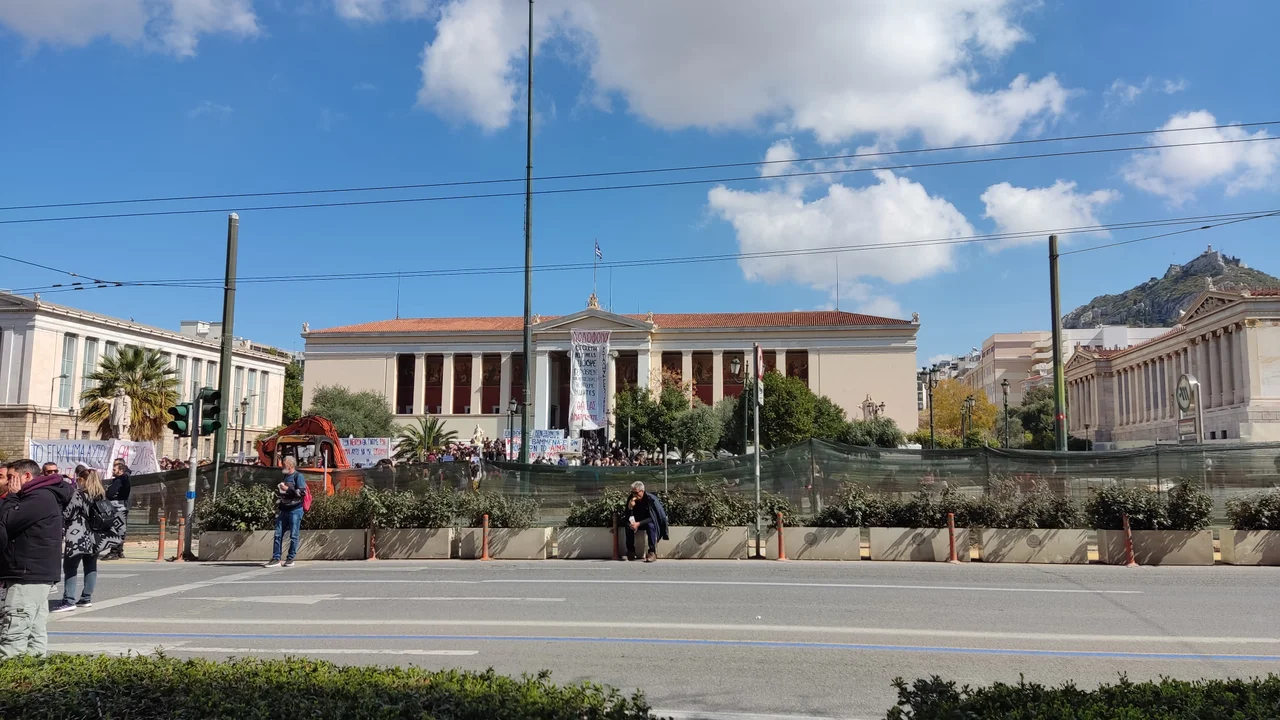
On the second anniversary, 28 February 2025, more than a million people marched in Athens alone. Demonstrations took place in 262 cities and villages across Greece and abroad - in Greek life this is generally considered the largest civil protest of the post-1974 democratic era. Church bells in every diocese tolled 57 times. Maria Karystianou, addressing the crowd at Syntagma Square, called the politicians she holds responsible "the murderers of our children." A criminal trial of 36 defendants - station masters, rail company managers, transport ministry officials - opened in a specially built courtroom in Larissa on 23 March 2026. Thirty-three of them face felony charges that can carry life imprisonment. With over 350 witnesses to be heard, the trial is expected to run for years. Days into proceedings, hearings were paused after complaints about cramped conditions and have since been restarted under a different judge. Whatever the verdict, the parents who write the names of 57 young people in red paint at the Tomb of the Unknown Soldier each February will be back next year, and the year after that.
From the Air
The Tempi gorge sits at 39.85°N, 22.52°E in northern Thessaly, where the Pineios River cuts a narrow valley between Mount Olympus to the north and the Ossa massif to the south. The crash site lies on the Athens-Thessaloniki main line just south of the gorge mouth. From the air, Olympus dominates the view at 2,917 m. Nearest airport is Larissa National (LGLR) about 25 km south; Volos (LGBL) and Thessaloniki (LGTS) are within 100 km. Recommended altitude: 6,000-10,000 ft to take in the gorge and the Olympus massif together.
Nearby Stories
- Battle of Potidaea 18 km away
- Battle of Cynoscephalae (364 BC) 25 km away
- Mount Olympus 28 km away
- Karditsa 28 km away
- Skiathos Castle 44 km away
- Meteora: The Monasteries Built on Impossible Pillars 45 km away
- Battle of Spartolos 53 km away
- Vjosa Wild River National Park 146 km away