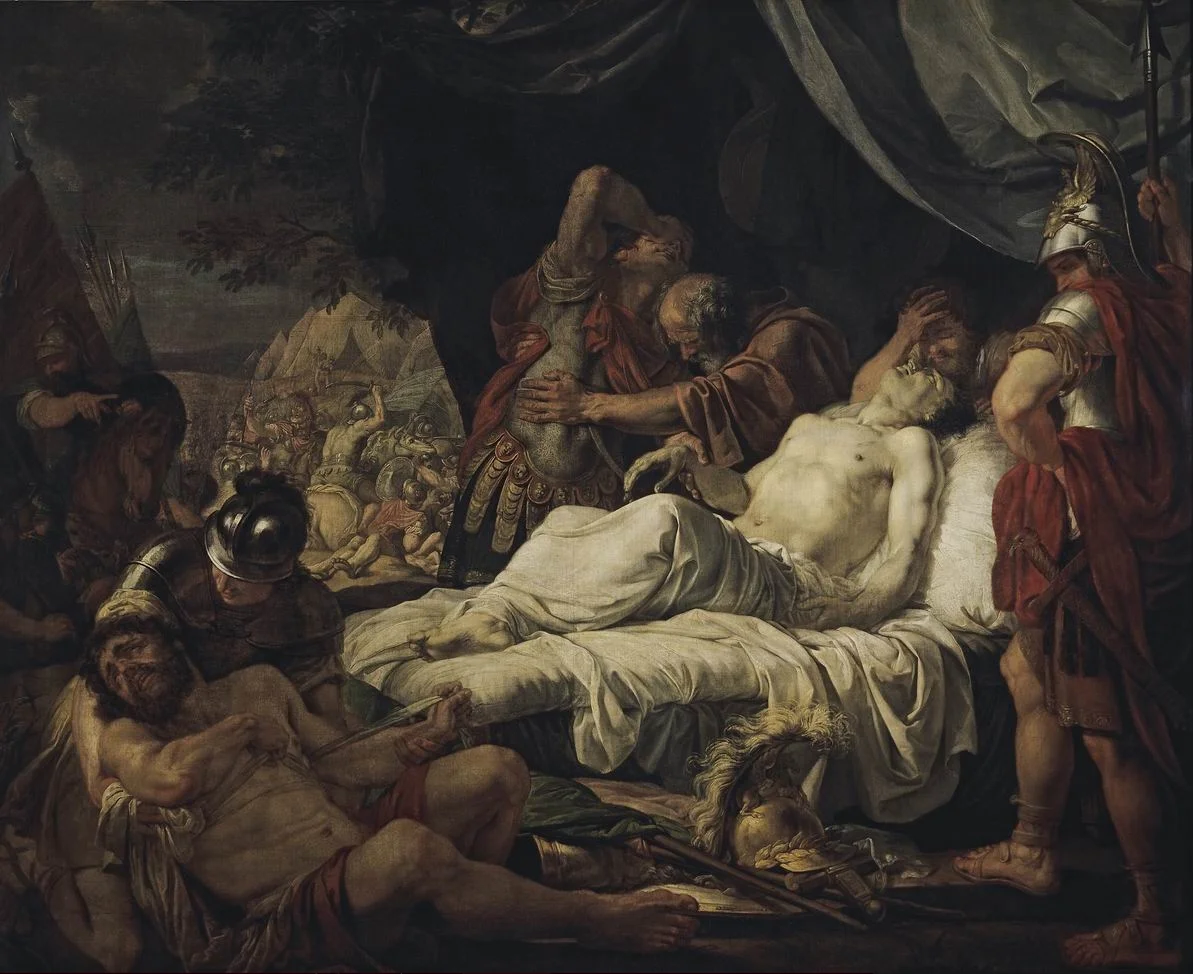

Battle of Cynoscephalae (364 BC)
An eclipse darkened the sky over Thebes on the 13th of July, 364 BC, and the priests read it as a warning. The army that had been voted to march north simply dissolved. Pelopidas went anyway. Against the counsel of the priests and the open disapproval of his own city, the great Theban general rode for Thessaly with a band of volunteer horsemen, gathering allies as he went. Within weeks he would win a battle against odds of two to one, and lose his life at the height of it, on a string of low hills the Greeks called Cynoscephalae, the dog's heads.
Not That Cynoscephalae
These hills carry a famous name twice over. The Cynoscephalae most people remember is the battle of 197 BC, where Roman legions broke a Macedonian phalanx and announced Rome's arrival as the master of Greece. This is the older fight, fought on the same broken ground 167 years earlier, and its cast is entirely Greek. On one side stood Pelopidas, the Theban liberator whose city was then the dominant military power in all of Greece. On the other stood Alexander of Pherae, a Thessalian tyrant whose name had become a byword for cruelty. The stakes were not an empire but the freedom of the Thessalian cities, and the personal grudge of men who genuinely hated the man across the field.
The Tyrant of Pherae
Alexander had seized power in the Thessalian city of Pherae in 369 BC by murdering his own uncle, Polyphron, and from there he had spread the dominance of Pherae over the other cities of the region. The Thessalians, desperate, kept appealing to Thebes for help. Pelopidas had history with this man. On an earlier mission Alexander had treacherously seized him and held him prisoner, and it took a Theban army under the great Epaminondas to win his release. By 364 BC Alexander had swallowed the districts of Achaea Phthiotis and Magnesia, and the Thessalians turned to Thebes once more. This time Pelopidas would settle it in person.
The Day on the Hills
Alexander may have fielded as many as twenty thousand troops; Pelopidas had perhaps half that, much of it a rough, untrained phalanx scraped together in Thessaly. Both sides lunged first for the high ground between the armies. Alexander's more experienced men took the heights, but Pelopidas's cavalry, which he led himself, won the plain below. Seeing the day slipping, Pelopidas did something almost unheard of: he recalled his horsemen, dismounted, re-armed himself as a common hoplite, and reorganized his infantry mid-battle. Then he caught sight of Alexander across the field. He charged straight for him. The attack outran its own ranks, and Pelopidas, suddenly alone before his men, was cut down by a volley of javelins.
A Victory Bought Dear
His soldiers did not break. Enraged, the Thebans and Thessalians reformed, and with their cavalry they shattered Alexander's army; by Plutarch's account some three thousand of his men died, many in the rout that followed. The cost on the winning side was the only man who could not be replaced. The Thessalians mourned Pelopidas as one of their own. According to Plutarch they heaped captured enemy arms around his body, and magistrates from the surrounding towns brought treasures to be buried with him. His children were granted lands, and the sculptor Lysippos was commissioned to raise a bronze statue in his memory. Few generals have been buried by a people who were not even his own.
What the Battle Decided
The war was won. Alexander was forced to surrender the cities he had taken, hand Magnesia and Achaea Phthiotis to Thebes, and accept the humiliating role of a subordinate ally, ruler, as Diodorus put it, "over Pherae alone." Thebes became the hegemon of Thessaly. The tyrant's own end came a few years later, in 358 or 357 BC, when he was assassinated by his wife Thebe and her brothers. The hills themselves keep no monument to any of this. They rise west of ancient Pherae in the open Thessalian plain, ordinary ground that twice in two centuries decided who would rule a region, and once swallowed the life of the man who freed it.
From the Air
The Cynoscephalae Hills lie around 39.36°N, 22.83°E, in the open plain of eastern Thessaly west of ancient Pherae and roughly 25 km west of Volos. The nearest airport is Nea Anchialos National (LGBL), about 20 km to the south. From the air the battlefield reads as a band of low rolling ridges, the 'dog's head' humps, between the flat farmland and the hills toward Pharsalos. Best appreciated at low altitude in clear weather, with the Pagasetic Gulf glinting to the east.
Nearby Stories
- Greece 13 km away
- Larissa Cremaste 16 km away
- Monastery of Saint David the Elder 21 km away
- Karditsa 21 km away
- Skiathos Castle 24 km away
- Tempi Train Crash 36 km away
- Meteora: The Monasteries Built on Impossible Pillars 48 km away
- Battle of Potidaea 73 km away