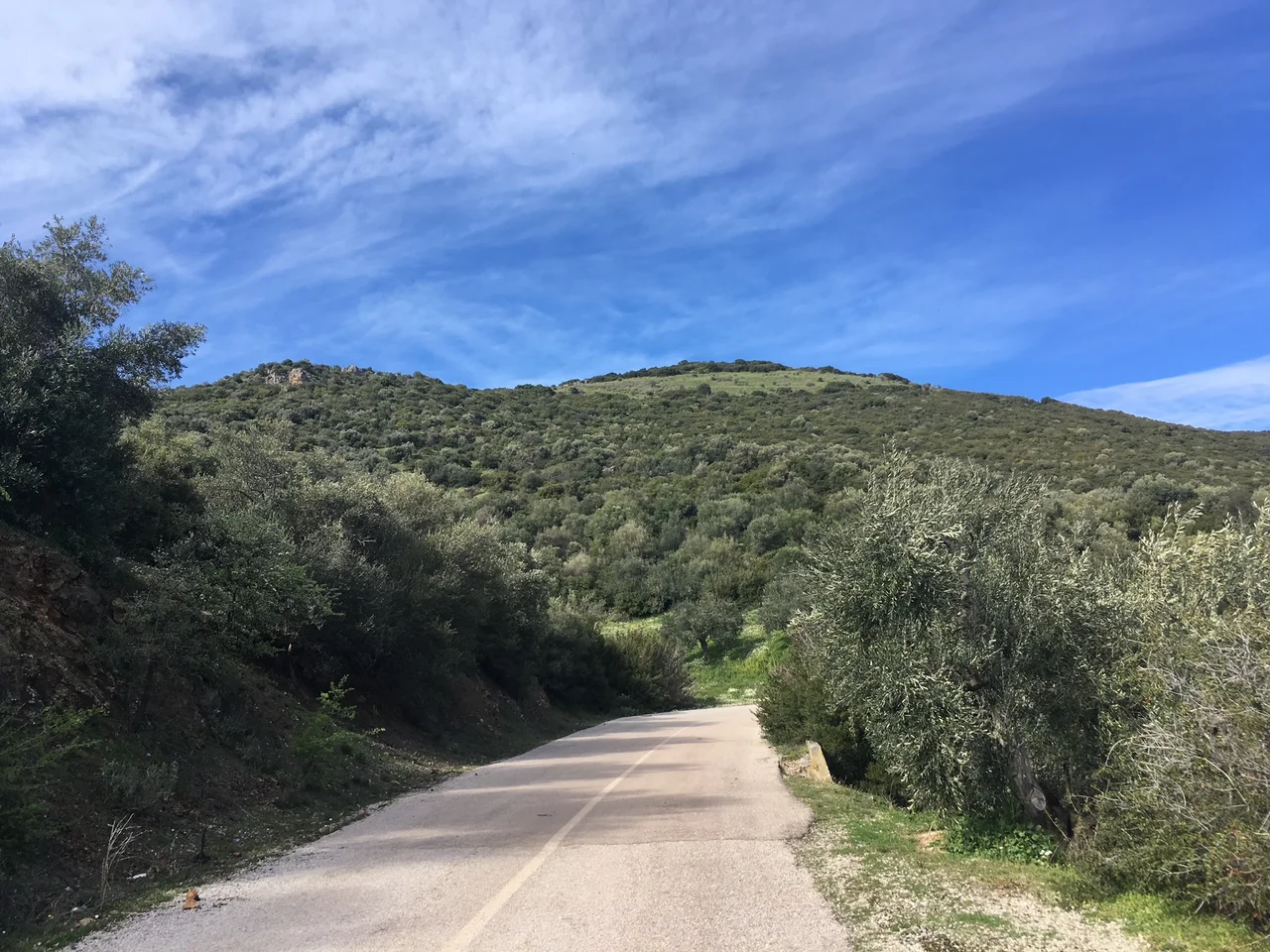

Larissa Cremaste
Its name means "hanging." Larissa Cremaste clung to the side of Mount Othrys, perched on a height that thrust out ahead of the slope, and the ancients gave it that surname to capture exactly how it looked: a town suspended above the land, distinct from the more famous Larissa that sat comfortably on the Thessalian plain. The word Larissa itself meant something like fortress, and a fortress is what the hill became. Today the ruins of its walls still grip the western face of a steep hill above the modern town of Pelasgia, two kilometers away renamed, fittingly, to echo the ancient surname this place once carried.
Hanging on the Mountain
The city occupied the flank of a hill in Achaea Phthiotis, about twenty stadia inland from the Maliac Gulf, in the country the ancients called Pelasgia. Strabo, the great Greek geographer, described it as well watered and good for vines an ordinary blessing of fertility in a landscape better known for war. The location was no accident. A settlement that hangs from a slope can see who is coming. It commands the approaches without surrendering the high ground. To the Romans, the place lent its name to a hero: because Larissa lay within the legendary domain of Achilles, some poets gave him the surname Larissaeus, though scholars suspect the epithet simply meant "Thessalian" in a general sense.
Kings, Consuls, and Conquest
For a town of modest size, Larissa Cremaste saw an outsized share of history's heavy traffic. In 302 BC, Demetrius Poliorcetes the Macedonian called "the Besieger" seized it during his war with Cassander, in the chaotic generation after Alexander when his former generals carved up the world. A century later, Rome arrived. The Roman legate Lucius Apustius took the town in 200 BC during the first war between the Roman Republic and Philip V of Macedon. And in 171 BC, in the final reckoning with Perseus of Macedon, it fell to Roman hands once more. Three captures, three different conquerors each marking the slow eclipse of independent Greek power before the rising shadow of Rome.
Walls That Will Not Fall
The ruins are most striking on the western side, where several courses of ancient masonry still stand conspicuous against the hill. The only detailed survey was made in 1912 by the German scholar Friedrich Stahlin, who mapped a substantial circuit of walls enclosing both the hilltop acropolis and a large stretch of the eastern slope. He found two main gates in the lower fortifications and a postern, a small hidden door, set into the acropolis wall. Much of his plan was reconstruction; whole stretches of the defenses had already vanished by the time he climbed the hill. Curiously, Stahlin noted nothing predating the Classical period, and most of what still stood was medieval. The fortress, it seems, kept being rebuilt because the hill kept being worth holding.
The Harbor Beneath the Hill
A city above the plain still needed a way to the sea. When crews widened the national highway between Lamia and Larisa in the early 2000s, rescue excavations turned up the answer at the hill of Agios Konstantinos, four kilometers south. There, beside the shore of the Maliac Gulf, archaeologists uncovered an urban harbor settlement almost certainly the port of ancient Larissa. Tucked into a protected bay of the Euboean Gulf, it would have been a vital node in the regional trade network, a lower town spread along the beach behind a fortification wall that climbed to a small acropolis on the adjacent hilltop. Dated to the Classical period, it was abandoned around the fourth century BC, leaving the hanging city above to face the coming empires on its own.
From the Air
The ancient site sits at approximately 38.964 degrees north, 22.839 degrees east, on a steep hill near the modern town of Pelasgia in Phthiotis, central Greece, with Mount Othrys rising behind it and the Maliac Gulf to the southeast. View from low altitude to pick out the hilltop circuit of walls and the harbor location at Agios Konstantinos near the coast. Nearest airport is Nea Anchialos (LGBL) to the north near Volos; Athens International (LGAV) lies well to the south. The Lamia-Larisa highway corridor is a useful navigation reference running below the hill.
Nearby Stories
- Tower of Amfikleia 8.8 km away
- Phthiotic Thebes 11 km away
- Martino, Phthiotis 12 km away
- Monastery of Saint David the Elder 12 km away
- Greece 15 km away
- Skiathos Castle 22 km away
- Karditsa 27 km away
- Panagia Varnakova Monastery 27 km away