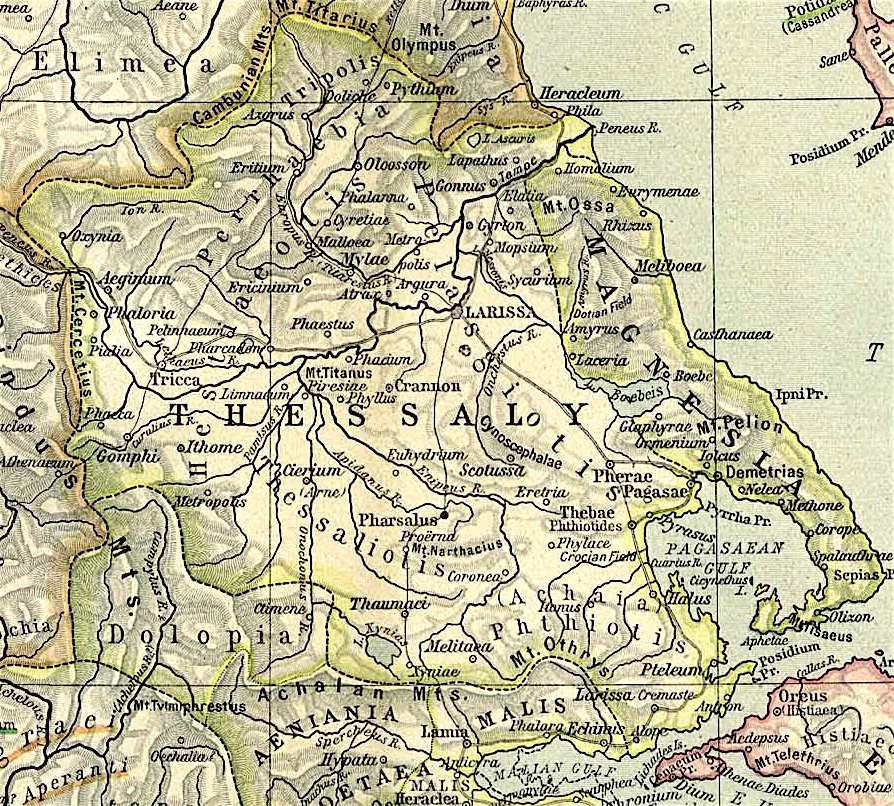

Phthiotic Thebes
Philip V of Macedon wanted this city badly enough to mine its walls. In 217 BC he dug three camps around Phthiotic Thebes, ringed it with siege lines, and waited until a tunnel he had carved beneath the ramparts brought a whole section of wall crashing down. The defenders had fought hard; now they surrendered. Philip enslaved the inhabitants, planted a Macedonian colony on the ruins, and renamed the place after himself: Philippopolis. The name never stuck. Some cities refuse to be rebranded, and this one, on a ridge above the Pagasetic Gulf, had already outlasted greater men than Philip.
A City of the Crocus Field
Phthiotic Thebes stood at the northeastern edge of ancient Phthiotis, at the head of a plain the Greeks called the Crocus Field, looking down toward the Pagasetic Gulf about 300 stadia from Larissa. Its name distinguished it from the more famous Thebes in Boeotia. The Iliad never mentions it, yet in time it grew into the most important maritime city in all of Thessaly, until Demetrius Poliorcetes founded nearby Demetrias around 294 BC and stole its primacy. The Thebans worshipped Athena, whose cult titles cluster thickly here, along with Demeter, Nike, and the sea-goddess Leucothea. A sanctuary of Athena marked the city's shared border with neighboring Halos.
Walls and Cyclopean Stone
The bones of the old city still rise from the ground near the village of Mikrothives. The original acropolis was ringed by a Cyclopean wall, the kind of massive, rough-hewn masonry that later Greeks attributed to giants because no ordinary builder seemed capable of it. The later wall of the lower town survives in long ruined stretches, studded with forty towers, dated by the German scholar Friedrich Stählin to the 4th century BC. On the acropolis, excavators uncovered the foundations of a modest Classical temple, nine by twelve meters, very likely dedicated to Athena Polias and raised, fittingly, from the recycled stone of a still older shrine. In the lower city the ancient theatre and a Hellenistic stoa can still be traced.
Conquered, Restored, Renamed Again
The city changed hands the way a coin changes pockets. It was a stronghold of Cassander, then the chief Aetolian possession in northern Greece, then Philip's prize in 217 BC. When the Roman consul Titus Quinctius Flamininus attacked it in 197 BC, on the eve of his famous victory at Cynoscephalae, the walls held and he failed. After Philip's defeat by Rome, the city revived once more, in 189 BC becoming capital of the restored Phthiotic Achaean League. The name Philippopolis quietly faded; the historian Livy still used both names for the year 185 BC, but Thebes won out. The polis lived on into the Roman Empire and was still being listed by geographers in the sixth century.
Nine Basilicas
Late Antiquity was Phthiotic Thebes's golden age. The city center had shifted down to its harbor at Pyrasos, and as the third-most important city of the province of Thessaly it grew rich on sea trade. That wealth went into churches. The Oxford Dictionary of Byzantium notes the site is best known precisely for them: nine basilicas have been excavated here. Basilica A, three-aisled and dedicated to Saint Demetrius, served as the cathedral, raised in the late 5th or early 6th century. Basilica C, despite a mid-6th-century inscription naming the priest Peter, actually dates earlier and anchors a vast ecclesiastical complex famous for its elaborate floor mosaics. These pavements survive in remarkably good condition, intricate carpets of stone laid down when this harbor town was a flourishing Christian center.
The Fire and the Long Silence
It ended in flames. A great fire in the late 7th century swept through the city and destroyed it. There was a rebuilding, and a flicker of continued importance into the early Byzantine period; the city's bishop is mentioned one last time in the 8th or 9th century. But the recovery never took. Phthiotic Thebes faded, eclipsed by the rising nearby port of Halmyros, and its harbor went quiet. Today the ruins sit between the modern village of Mikrothives and the seaside town of Nea Anchialos, which grew up over old Pyrasos. The finest finds rest in the Archaeological Museum of Volos. The mosaic floors remain where they were laid, open to the Thessalian sky, still bright underfoot after fifteen centuries.
From the Air
Phthiotic Thebes sits at 39.27°N, 22.76°E, on a low ridge near Mikrothives, just inland from the head of the Pagasetic Gulf and about 18 km southwest of Volos. The nearest airport is Nea Anchialos National (LGBL), only a few kilometers east, beside the harbor at old Pyrasos. From the air, look for the gulf curving in to the east and the broad Thessalian plain spreading west; the walled acropolis ridge stands above the surrounding farmland. Best viewed at low altitude in clear daylight.
Nearby Stories
- Greece 13 km away
- Larissa Cremaste 16 km away
- Monastery of Saint David the Elder 21 km away
- Karditsa 21 km away
- Skiathos Castle 24 km away
- Tempi Train Crash 36 km away
- Meteora: The Monasteries Built on Impossible Pillars 48 km away
- Battle of Potidaea 73 km away