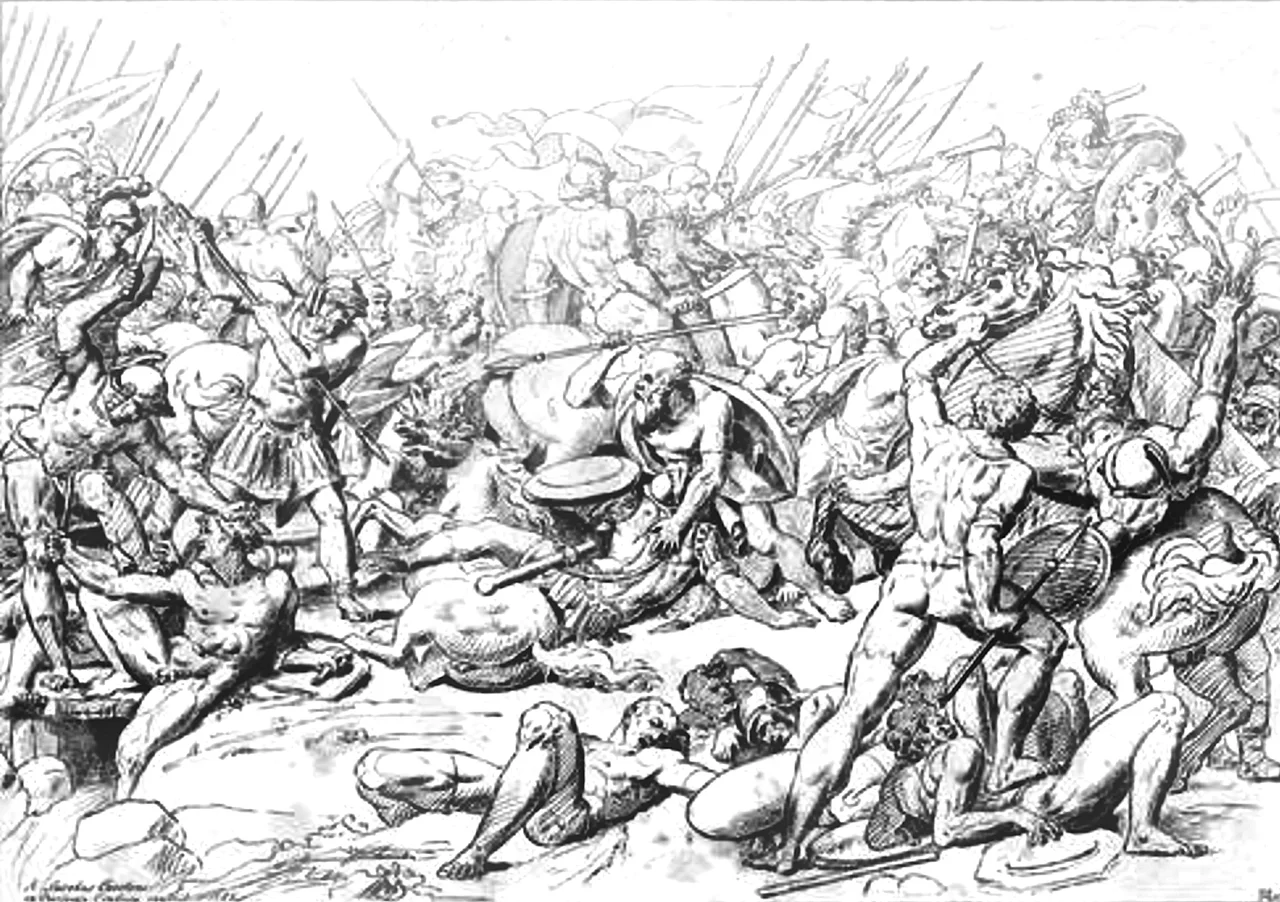

Battle of Potidaea
A young aristocrat named Alcibiades went down beneath a hoplite shield, bleeding, and a barefoot philosopher named Socrates planted himself over the body and would not move until the boy was carried to safety. That, at least, is what Alcibiades told everyone afterward, in Plato's Symposium, decades later when both men were old and the war their fight had helped start had ground Athens nearly to dust. The Battle of Potidaea was small. The siege that followed was crippling. The war that grew from both was the catastrophe that ended classical Greece's golden century - and it began here, on a narrow isthmus reaching south into the Aegean.
A Town That Belonged to Two Empires
Potidaea sat on the neck of the Pallene peninsula, the westernmost finger of the three-pronged Chalcidice peninsula in northern Greece. The town had been founded by Corinthians, paid annual magistrates from Corinth, and felt itself culturally a daughter of that great Peloponnesian city. But in 432 BC it was also a tribute-paying member of the Delian League, the alliance Athens had built to fight Persia and then refashioned into something closer to an empire. Two loyalties, two worlds, and a Macedonian king named Perdiccas II quietly fanning rebellion among Athens' allies in Thrace. When Athens demanded Potidaea tear down its sea walls and send Corinthian magistrates home, the city revolted instead.
Volunteers and Hoplites
Athens sent a fleet of thirty ships and a thousand hoplites under Archestratus. Corinth sent sixteen hundred hoplites and four hundred light troops under Aristeus, but listed them carefully as 'volunteers' - a thin fiction designed to avoid declaring war on Athens directly. Sparta promised to invade Attica if Athens pressed the issue. Athens sent another two thousand hoplites and forty more ships under Callias, son of Calliades. The Athenian force diverted from a planned campaign against Perdiccas, sailed to Chalcidice, and landed near Potidaea. Perdiccas brought two hundred Macedonian cavalry to join Aristeus, and the combined relief force marched to lift the siege. Among the Athenian soldiers in line that day were the philosopher Socrates, then about thirty-eight, and the brilliant young Alcibiades, perhaps eighteen.
The Day Itself
What we know of the fight comes mostly from Thucydides, who wrote in the next decade as a participant in the larger war. Aristeus' Corinthian wing crashed into a section of the Athenian line and broke it. But elsewhere the Athenian phalanx held and pushed forward, and when Aristeus turned to support his collapsing center he found the rest of his army in retreat. He pulled back along the seacoast to Potidaea, taking heavy losses along the way. Somewhere in that mess Alcibiades took a wound and went down. Socrates - heavyset, snub-nosed, already thinking of philosophy as a way of life - stood over his fallen friend with sword and shield until the wounded could be carried off. The story comes to us through Plato, through the mouth of Alcibiades himself, recalling what a teacher had once been to him.
The Siege That Bled Athens
The Athenians could not take Potidaea by storm, so they settled into a siege. Reinforcements came under Phormio. Both sides built walls and counter-walls. Athenian ships closed off the sea. The siege lasted until 430 or 429 BC and consumed roughly 420 talents of silver every year - a sum that staggered even Athens at the height of her wealth. Then the great plague hit. Athens, packed inside the Long Walls with refugees from the countryside, lost perhaps a quarter of its population, including Pericles himself. The leader who had argued that Athens could outlast Sparta by hiding behind walls and trusting the treasury died of the disease that thrived in the crowding his strategy required. The defenders of Potidaea finally surrendered, ate their dead before they did, and the Athenians let the survivors walk out with the clothes they wore.
What the Isthmus Holds
The site of Potidaea is occupied today by the modern town of Nea Poteidaia, where a canal cut through the isthmus in 1937 carries small boats from the Gulf of Therma to the Toroneos Gulf. Tourists drive south past it toward the beach resorts of Kassandra without often realizing that this thin neck of land was once worth a war. The Pallene peninsula stretches south, the volcanic soil dark, the Aegean bright on either side. Mount Athos, with its monastic republic, rises hazy across the next gulf east. Two and a half millennia ago a young man took a wound here and lived because his ugly older friend would not leave him - and the Western world that grew up reading their conversations took its shape, in part, from a fight on this small piece of ground.
From the Air
Located at 40.20 N, 23.33 E, on the isthmus between mainland Chalcidice and the Pallene (Kassandra) peninsula in northern Greece. Best viewed at 3,000-6,000 feet altitude. The narrow isthmus is unmistakable from the air, with the Toroneos and Therma gulfs flanking it. Nearest airport is Thessaloniki (LGTS), about 65 km northwest.
Nearby Stories
- Byzantine Empire under the Palaiologos Dynasty 22 km away
- Tempi Train Crash 29 km away
- Battle of Pydna (148 BC) 32 km away
- Vergina 46 km away
- Cyclops Cave (Youra) 63 km away
- Agios Georgios Nileias 67 km away
- Battle of Philippi 72 km away
- Battle of Athos 88 km away