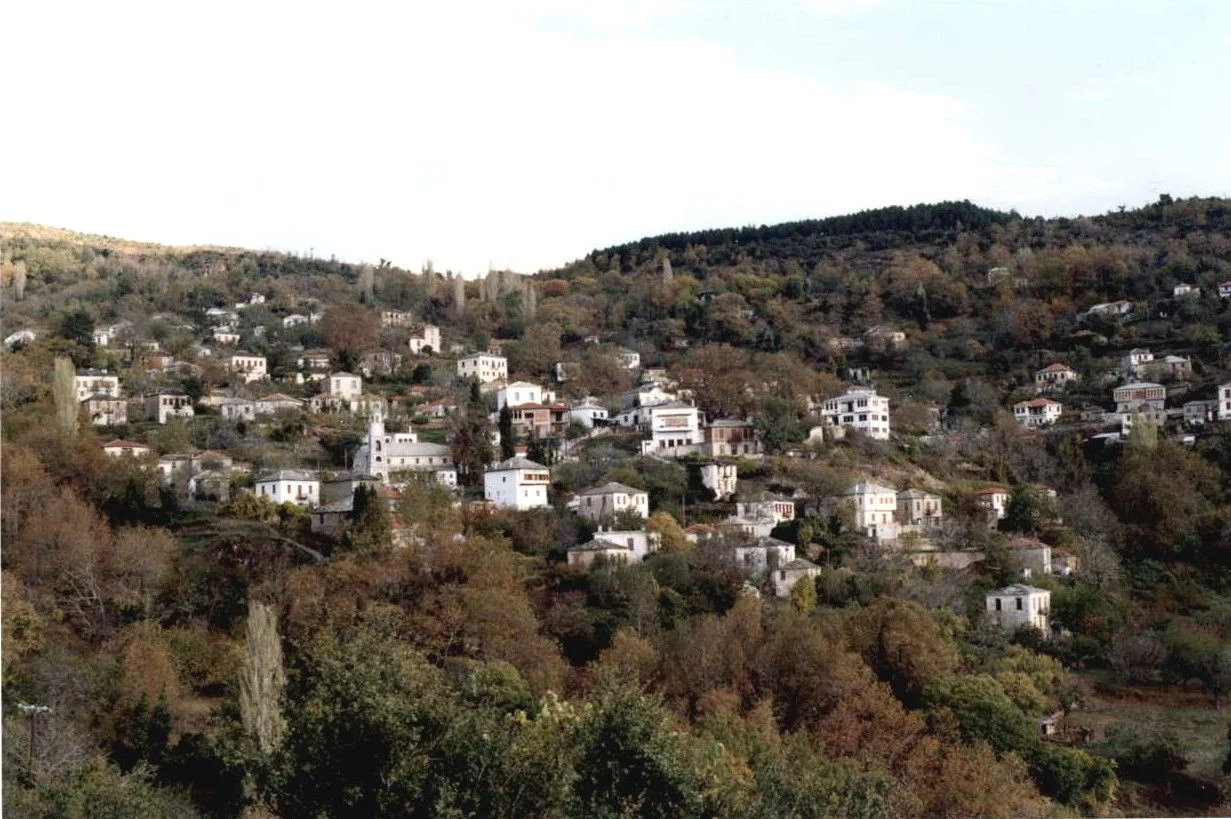

Agios Georgios Nileias
The story goes that shepherds found an icon hidden in a bush, and where the icon was found, a village grew. That is how the people of Agios Georgios Nileias explain their own beginnings, perched at around 700 meters on the green slopes of Mount Pelion, looking down toward Volos thirteen kilometers to the west. Pelion is the mountain the ancient Greeks gave to the centaurs and to the wedding of Peleus and Thetis, and its villages still feel half-mythic, stone houses and plane trees and cold spring water threaded along the contours. This one keeps a small museum of the sculptor Nikolaos Pavlopoulos, a local son who left and a place that remembered him.
A Village That Followed the Seasons
For much of its history, Agios Georgios Nileias was not really one village but a community that moved. The high settlement, at 700 meters, was a summer place, cool and breezy while the lowlands baked. When winter came down off the mountain, the inhabitants migrated to warmer ground, to Agia Triada at 500 meters, or lower still to Ano Gatzea and the seaside settlement of Kato Gatzea on the gulf. The community still gathers these scattered villages under one name, strung down the mountainside from forest to shore. It is a way of living shaped entirely by elevation, by the simple fact that on Pelion a few hundred meters of height can change the whole climate of a life.
Burned in the Revolution
The village did not escape the violence that made modern Greece. In 1821, when the Greek War of Independence broke out, Agios Georgios revolted against Ottoman rule like so many of its mountain neighbors. The uprising here was crushed. The Ottoman commander Mahmud Dramali Pasha, whose army swept through the region, put down the revolt and the village was burned. Thessaly would not join the Greek state for another sixty years; Agios Georgios finally became part of Greece in 1881. Its name later attached itself to Nileia, after Nelia, an ancient city that had stood near modern Volos, binding this mountain community to a far older layer of the region's past.
The Painter and the Sculptor
For a village of a few hundred people, Agios Georgios Nileias has produced an unusual share of artists. Yiannis Poulakas, born here in 1863, became a painter before dying in 1942. Nikolaos Pavlopoulos, who lived from 1909 to 1990, worked as both sculptor and writer, and it is his work that fills the municipal museum the village keeps in his memory. There is something fitting about a place that began with a found icon producing makers of images and forms. The mountain light, the long views down to the Pagasetic Gulf, the slow seasonal rhythm, these are the conditions in which a person learns to look closely at the world.
Still on the Mountain
Today Agios Georgios Nileias is a community within the municipality of Milies, having spent most of the twentieth century, from 1914 to 1998, as an independent commune before the maps were redrawn. The high village holds a small, steady population, larger now than it was in 1971, a quiet reversal of the rural emptying that hollowed out so much of mountain Greece. Around it the other settlements hold their own, from tiny Dyo Revmata to the busy seaside of Kato Gatzea. To climb the road up from the gulf is to pass through the whole community at once, summer village and winter village both, layered up the green flank of Pelion.
From the Air
Agios Georgios Nileias sits at 39.343 degrees N, 23.085 degrees E, on the western slopes of Mount Pelion at roughly 700 meters elevation, about 13 km east of Volos and overlooking the Pagasetic Gulf. From the air, locate it by the steep forested Pelion ridge rising behind the gulf's northeastern shore, with the community's lower villages stepping down toward the seaside settlement of Kato Gatzea on the water. The nearest airport is Nea Anchialos National (LGBL), across the gulf to the southwest. Terrain is mountainous, so favor clear daytime conditions and allow generous altitude over the ridgeline.
Nearby Stories
- Farsala 10 km away
- Oreus 10 km away
- Glossa 13 km away
- Archaeological Museum of Lamia 14 km away
- Tempi Train Crash 55 km away
- Mount Olympus 61 km away
- Siege of Euripos 62 km away
- Byzantine Empire under the Palaiologos Dynasty 112 km away