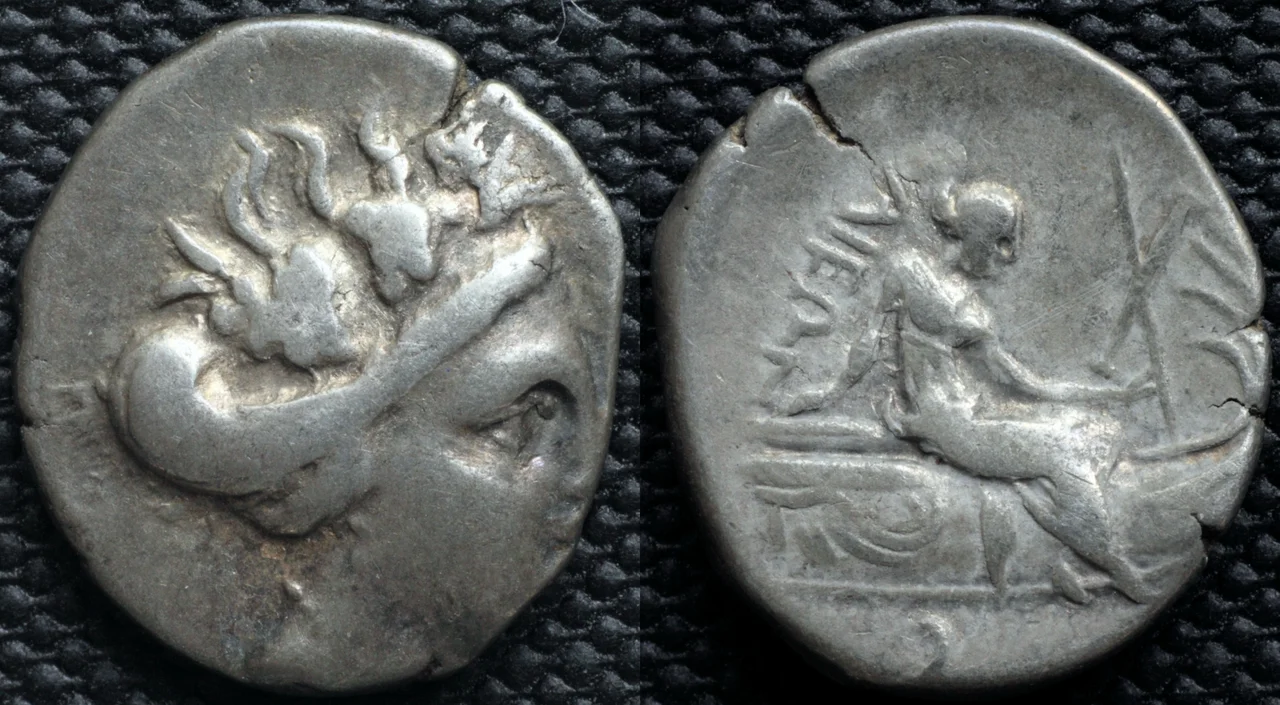

Oreus
In 1965, workers expanding the small port at Oreoi in northern Euboea hauled something extraordinary out of the water: a marble bull more than three meters long and weighing over six tons, its surface so finely worked that the sculptor had used a claw chisel to render the play of muscle and hide. The horns, fitted separately, may once have been bronze or ivory. Carved in the late third century BC as funerary sculpture, the bull had lain on the seabed for centuries before the harbor gave it back. It is the most arresting reminder that this quiet coastal village was once a city Homer himself knew by name.
Rich in Grapes
Before the fifth century BC, the city was called Histiaia, and it was among the most ancient on Euboea. Homer lists it in the Catalogue of Ships in the Iliad and gives it a memorable epithet: polystaphylos, "rich in grapes," a nod to the fertile plain it commanded at the entrance of the North Euboean Gulf. Founding stories disagreed, as they often did. Some said Histiaia was a colony from the Attic district of the same name; others credited the Thessalian Perrhaebi; a third tradition traced the name to a mythical figure, Histiaea, daughter of Hyrieus. What no one disputed was the city's value. Sitting astride a strategic strait and a broad, productive plain, Histiaia mattered to everyone who wanted to control northern Euboea.
The City That Changed Its Name
After the Battle of Artemisium in 480 BC, when the Greek fleet withdrew south against the Persian advance, Histiaia was occupied by the Persians and from that moment its name shifts in the records to Oreus, originally just a deme, a district, dependent on the older city. The change marked a city repeatedly caught between greater powers. During the Peloponnesian War, Thucydides singled out Oreus as the one town in all Euboea that stayed loyal to Athens during the revolt of 411 BC. After the war it fell under Spartan control, its Athenian settlers expelled, and it nursed a lasting grievance against Athens. Tyrants rose and fell here Neogenes, backed by Jason of Pherae, then Philistides, installed with the help of Philip II of Macedon and toppled by an Athenian expedition that Demosthenes himself had urged.
A Prize in Every War
Position and fortifications made Oreus a recurring target. In the wars of Alexander's successors, Cassander besieged it but had to withdraw when Ptolemy, general of Antigonus, came to its relief. When Rome entered Greek affairs, the city changed hands again: betrayed to the Romans by the commander of its own Macedonian garrison in 207 BC during the First Macedonian War, then stormed outright in 200 BC during the Second. In 196 BC the Roman general Titus Quinctius Flamininus declared Oreus free, along with the other Greek states a freedom that proved more rhetorical than real. By the time of Pliny the Elder, the city was counted among Euboea's vanished places, though it lingered, garbled, in later geographers' lists.
The Fortress on the Strait
Strabo placed Oreus on a lofty hill called Drymus, and the historian Livy described two citadels one overhanging the sea, the other inland. That seaward height never lost its usefulness. Centuries later the Venetians built a fortress on the site of the ancient acropolis to control the northern entrance of the strait that separates Euboea from the Thessalian mainland. In 1275 the knight Licario seized the castle and used it as a base against the Franks. The Ottomans, once they held both the island and the mainland beyond, had no reason to maintain it, and today only fragments of wall survive near the kastro of modern Oreoi. The bull, recovered from the sea, now stands in the village's small archaeological collection a single masterpiece outlasting the city that made it.
From the Air
Oreus sits at approximately 38.947 degrees north, 23.091 degrees east, at the northern coast of Euboea near the modern village of Oreoi, commanding the northern entrance of the North Euboean Gulf. From low altitude the strait between Euboea and the Thessalian mainland is clearly visible, with the castle hill above the village marking the ancient acropolis. Nearest airport is Nea Anchialos (LGBL) to the northwest on the mainland near Volos; Athens International (LGAV) lies to the south. Use the narrow channel and the flat coastal plain as navigation references.
Nearby Stories
- Atalanti 3.2 km away
- Gravia 6 km away
- Archaeological Museum of Lamia 6.6 km away
- Mount Pelion 6.8 km away
- Farsala 14 km away
- Euripus Strait 24 km away
- Skopelos 24 km away
- Alonnisos 31 km away