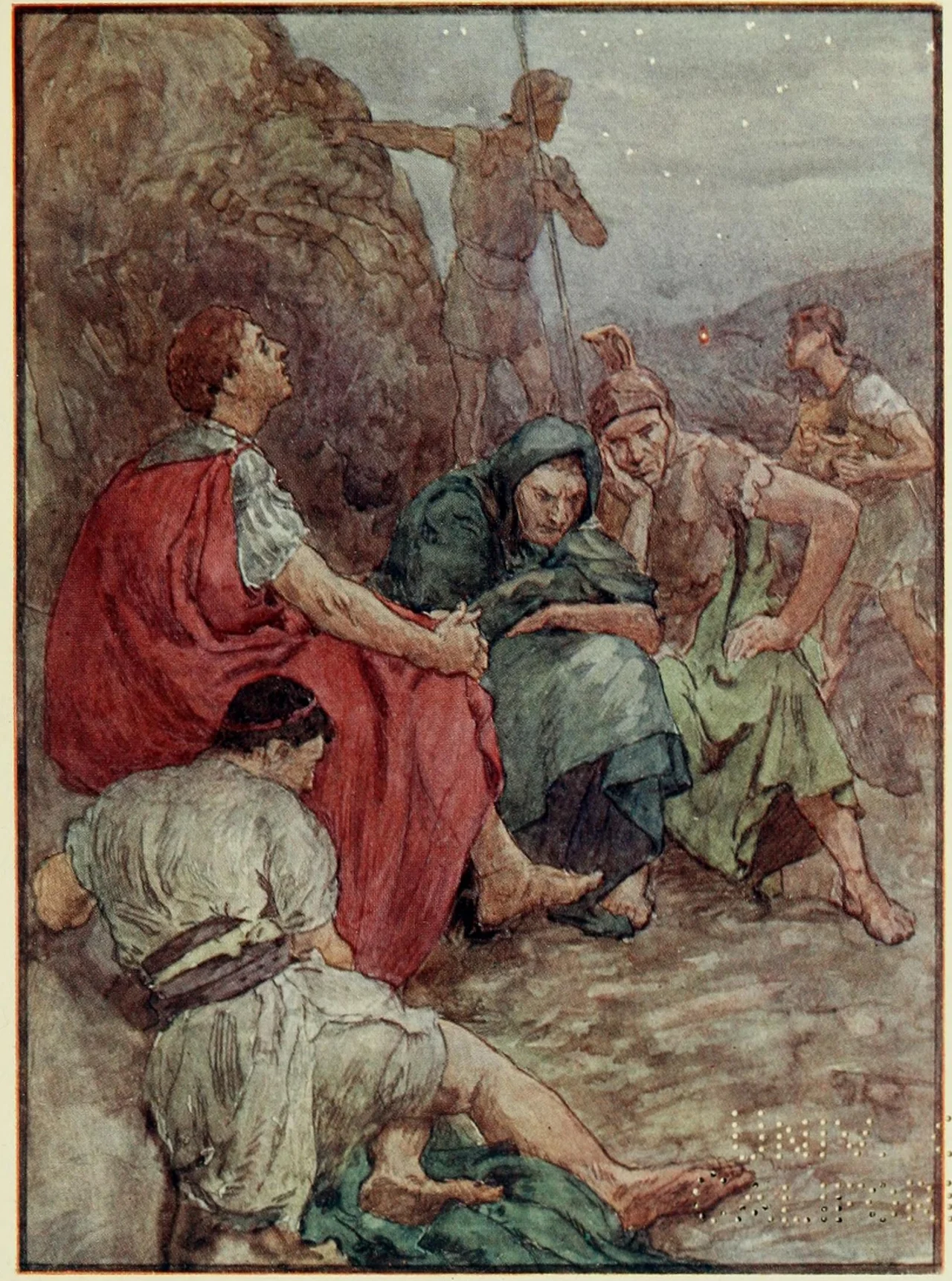

Battle of Philippi
Plutarch tells a strange story about the lead-up to Philippi. Some months before the battle, Marcus Junius Brutus was working late in his tent in Asia when he saw a shadow form at the edge of the lamplight. He asked it what it was. The shadow answered: 'Thy evil spirit, Brutus. I shall see thee at Philippi.' Whether the ghost was a portent, a fever dream, or a story Plutarch added afterwards, it captures something true about the campaign that ended the Roman Republic. By the time the armies finally met on the plain west of the city of Philippi in October 42 BC, both sides were already losing. They just did not know it yet.
Two years after the Ides
Two years after Brutus and Cassius and the other Liberators had killed Julius Caesar in the Roman Senate, the war they had hoped to avoid was on them. In Italy, three of Caesar's lieutenants had patched together the Second Triumvirate: Mark Antony, the consul who had given Caesar's funeral oration; Marcus Aemilius Lepidus, the older statesman; and Octavian, Caesar's twenty-one-year-old grandnephew and adopted heir. Antony and Octavian had crossed the Adriatic with twenty-eight legions. Brutus and Cassius had spent two years collecting an army from the eastern provinces — legions raised in Syria, Macedonia, Cilicia — and tribute money from the Greek cities they sometimes had to plunder to get it. Their plan was a defensive one: hold the Via Egnatia at a strong position, use their fleet to cut the triumvirs' supply lines, and starve them out. They chose a hill above the city of Philippi, with a marsh on one flank and broken hills on the other, and they fortified it carefully.
First battle, 3 October
Antony tried for weeks to lure them down. They would not move. So Antony began secretly building a causeway through the marsh that anchored Cassius's southern flank. When Cassius noticed, he started his own counter-wall to cut off Antony's outstretched right wing. The maneuvers tangled. On 3 October a general battle began without either side really wanting one. Brutus's troops, on the northern half of the line, charged Octavian's legions before the formal order was given. They smashed through. Three of Octavian's legions lost their standards — a mark of disgrace in Roman warfare. His own tent was overrun and his couch hacked apart. Octavian himself was not in it; he wrote later that a dream had warned him to leave; the elder Pliny wrote bluntly that he was hiding in the marsh. On the southern half of the line, Antony broke into Cassius's camp at the same time. Cassius, on a hilltop in the dust and noise, could see his own camp in enemy hands but not his colleague's success. He believed he had lost completely. He ordered his freedman Pindarus to kill him. Pindarus did. When Brutus finally reached the body, he stood over it and called Cassius 'the last of the Romans'. He did not give him a public funeral; he was afraid of what it would do to morale.
Three weeks of waiting
Both armies pulled back to lick their wounds. The casualties had been heavy on both sides — 8,000 for Cassius's wing, around 16,000 for Octavian's. The strategic position now favoured Brutus. His fleet had intercepted and destroyed two legions that the triumvirs had been ferrying across the Adriatic. Antony and Octavian were running out of food in country already plundered by both armies. Brutus could be supplied from the sea. If he could simply sit on his hill, the war was his. But Brutus was not Cassius. He had less military experience and less authority over his own officers. His allies — the eastern client kings whose levies made up much of his army — were beginning to slip away. His soldiers were tired of waiting and afraid that he had lost the initiative. After three weeks, on 23 October, against his own better judgement, Brutus accepted battle on the open plain.
Second battle, 23 October
There was almost no maneuver in the second battle of Philippi. The two armies, both Roman, both trained in the same way, marched toward each other and pushed. Cassius Dio wrote that they hardly bothered with arrows or javelins, that they crashed into close combat almost immediately, 'seeking to break each other's ranks'. Brutus had the better of it on his western wing, but he had been forced to extend his line so far to avoid being outflanked that his centre was thin. The triumvirs' first hard charge cracked it. Once they were through, they wheeled to take Brutus from the side and rear. Appian, looking back from a century later, described it as if a heavy machine were turning. Brutus's reserve lines could not catch up; the front lines disintegrated; Octavian's men captured the camp gates before the routed army could get behind them. Brutus retreated into the hills with what was left of four legions. That night, seeing capture was certain, he killed himself. The Republic he had defended had been an idea for some time. Now it was nothing.
Antony's purple cloak
Antony, finding Brutus's body, covered it with a purple military cloak — a senior commander's mark of honour. The two had not been close, but Brutus had insisted, when he joined the plot to kill Caesar, that Antony's life be spared. About 14,000 of the Liberators' surviving soldiers were absorbed into the triumvirs' legions. The young noblemen who had followed Brutus and Cassius were less lucky: many died on the field, others by their own hand afterwards, including the son of the great orator Hortensius and Marcus Porcius Cato, son of Cato the Younger. Among the noblemen who surrendered to Antony was Marcus Livius Drusus Claudianus, whose daughter Livia would marry Octavian and become an empress. Antony stayed in the East, gathering money and clients. Octavian went home to Italy with the unenviable task of finding farmland for tens of thousands of veterans. Within twelve years he would defeat Antony at Actium, become Augustus, and rule a Roman world that had stopped pretending to be a republic. The town of Philippi itself was made a Roman colony, Colonia Victrix Philippensium, and settled with the veterans who had fought there. Decades later the Apostle Paul would preach in its forum. The ruins are still visible today, a UNESCO World Heritage site since 2016, scattered across the plain where two Roman armies bled out an idea.
From the Air
41.01°N, 24.29°E, in eastern Greek Macedonia about 15 km north-northwest of Kavala on the plain between Mount Pangaion and the Lekani mountains. The archaeological site of Philippi sits on the southern edge of the old plain; the actual battle plain stretches to the west of the ruins. Nearest airport is Kavala (LGKV) about 25 km south. The plain is broad and well-drained, and the surrounding hills are clearly visible from cruising altitude in clear weather.
Nearby Stories
- Archaeological Museum of Amphipolis 25 km away
- Byzantine Empire under the Palaiologos Dynasty 38 km away
- Samothrace temple complex 57 km away
- Batak Massacre 73 km away
- Battle of Kleidion 75 km away
- Massacre of Samothrace (1821) 89 km away
- Battle of Athos 90 km away
- 1928 Chirpan-Plovdiv Earthquakes 104 km away