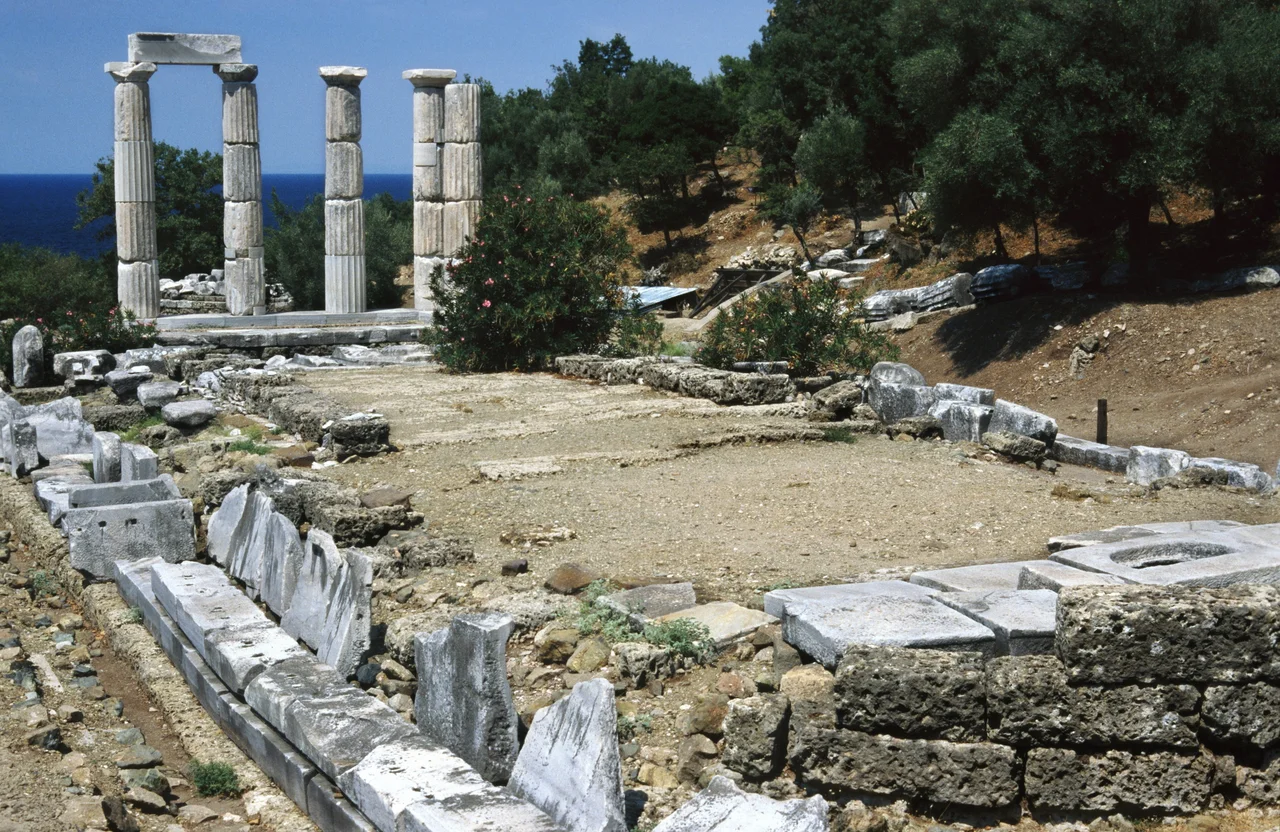

Samothrace temple complex
The names of the gods worshipped here were forbidden to speak aloud. Even Herodotus, one of the few initiates who left any clue at all, would only hint at what he had been shown. On the rugged northwest slopes of Mount Hagios Georgios, between two steep-banked torrents on the Aegean island of Samothrace, an ancient sanctuary kept its secrets so well that two and a half millennia later, archaeologists still cannot tell us exactly what happened inside the buildings whose foundations they have uncovered.
A Cult That Welcomed Everyone
What made the Samothracian mysteries unusual was not their secrecy. Plenty of cults guarded their rituals. What set this sanctuary apart was who got to enter. At nearby Eleusis, initiates progressed slowly through carefully gated stages, separated by a year or more between degrees. On Samothrace, anyone could be initiated at any time, and both stages of the mystery could be undertaken on the same day. The only requirement was simply to be present. Men and women, adults and children, Greeks and non-Greeks, the free and the indentured and the enslaved could all participate on equal terms. In a Mediterranean world organized rigidly around status, this radical openness made Samothrace something genuinely strange. The sanctuary's central deity was the Great Mother, an older pre-Greek figure associated with magnetic iron veins on the island. Initiates left wearing iron rings touched by lodestones as talismans of recognition, and a crimson sash around the waist for protection at sea.
Philip and Olympias
Plutarch tells the story plainly. Philip, still a young man, was undergoing his own initiation when he met Olympias, an orphan princess from Epirus going through the same ritual. He fell in love and arranged the marriage on the spot with her brother's blessing. Their son was Alexander the Great. The sanctuary became a Macedonian dynastic shrine after this, and the kings who succeeded Alexander competed to outdo each other's gifts. Philip III commissioned the great Hieron temple by 325 BC. Decades later, Arsinoe II, the daughter of Ptolemy I, dedicated a rotunda twenty meters across, the largest covered round space in the entire ancient Greek world. Her brother Ptolemy II built the propylaeum that served as the sanctuary's eastern bridge until an earthquake brought it down. The Antigonid kings answered with the Neorion, a building constructed to display a captured warship from their naval victory at Kos.
The Winged Victory
In 1863, the French consul Charles Champoiseau, posted at Adrianople, dug into the western terrace and found the broken pieces of a marble statue of a winged woman, her drapery rippling as if in sea wind. He shipped what he could find to Paris. Today the Winged Victory of Samothrace stands at the top of the Daru staircase in the Louvre, one of the most photographed sculptures on Earth. Champoiseau came back in 1891 to look for the limestone blocks that had once formed the prow of the ship she stood on. While searching, he stumbled into the sanctuary's theatre. The statue's exact origin is still debated. Analysis of the limestone suggests the prow may have come from Rhodes, possibly commemorating a naval victory there rather than a Macedonian dedication. Either way, she was a thank-offering to the sea-protecting gods of this island.
What Initiates Carried Home
Excavations since 1938 have turned up thousands of small objects in the soil here, and many tell quieter stories than statues do. Sailors and fishermen left seashells. They left iron fish hooks. They left modest votive offerings as thanks for surviving storms, the kind of small physical gestures that have always accompanied gratitude. Initiates who could afford it paid to have their names cut into commemorative stone plaques. The promise the gods made to those who came was simple. There would be hope for a better life. There would be protection at sea. There might be, as at Eleusis, a happy afterlife waiting. By the late Roman period, when bull-blood baptisms of the Anatolian Magna Mater were grafted onto the rituals, the cult had been absorbing influences for centuries already. Then came the Christian persecution of pagan worship in late antiquity, the temple closed, and the names spoken aloud here for the first time finally fell silent.
What You See Today
The sanctuary occupies three terraces stepping down the mountain, divided by ravines that still flow with seasonal water. The Hieron, the holiest of the temples, was partially reconstructed in 1956, its pillars rising again above the foundations. The interior once spanned eleven meters without internal supports, the largest unsupported span in the ancient Greek world. The foundation of the Arsinoe Rotunda still describes its great circle on the ground. Above the central terrace stretches the long stoa, 104 meters of Doric columns that once framed the view down to the theatre and the great altar. A small Byzantine fort built from looted stones perches at the western edge, the last evidence of human use here before the site went silent. Samothrace itself remains thinly populated, its mountain and beaches feeling much like they did when sacred ambassadors arrived in mid-July for the great annual festival.
From the Air
The Sanctuary of the Great Gods sits on the northern coast of Samothrace island at 40.50N, 25.53E, a few kilometers west of Kamariotissa. The island rises dramatically from the northern Aegean to Mount Saos at 1,611 meters, often capped in cloud. The temple complex occupies the slopes of Mount Hagios Georgios on the western edge of the ancient city. Recommended viewing altitude is 3,000-4,000 feet on a clear day for the layered terraces and the broader Aegean approach. The closest airport is Alexandroupolis (LGAL) on the Thracian mainland, about 40 nautical miles north. Limnos (LGLM) lies 50 nautical miles southwest. Weather over Samothrace can be volatile due to the island's high relief, with sudden cloud and wind shifts especially in summer afternoons.
Nearby Stories
- Battle of Athos 21 km away
- Battle of Lone Pine 23 km away
- Battle of Hill 60 (Gallipoli) 36 km away
- Battle of Imbros 41 km away
- Battle of Philippi 62 km away
- Didymoteicho Fortress 75 km away
- Archaeological Museum of Amphipolis 100 km away
- Uzunköprü Bridge 114 km away