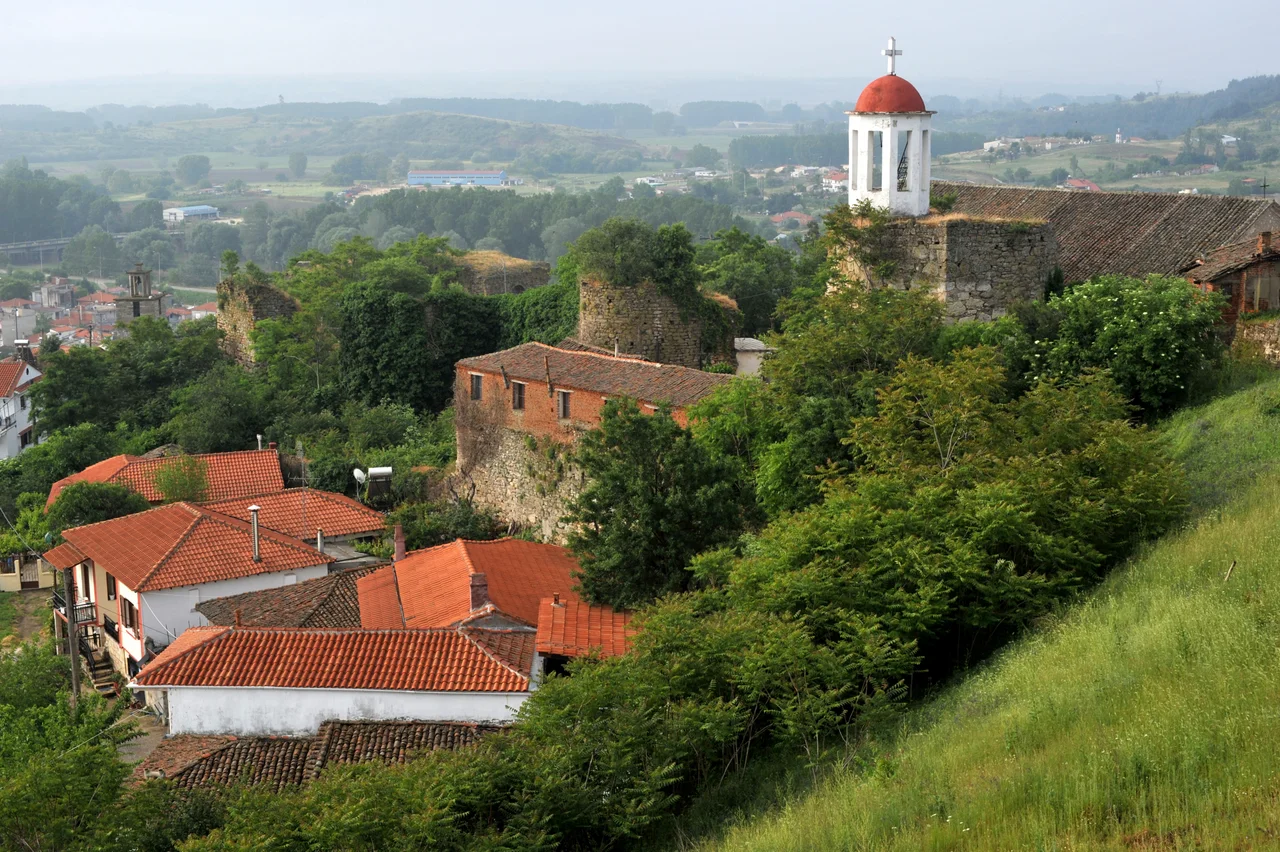

Didymoteicho Fortress
In October 1352, two Byzantine emperors fought each other on a plain below the walls of a Thracian fortress called Didymoteicho. John V Palaiologos had Serbian troops with him, sent by Stefan Dušan, the Serbian tsar. John VI Kantakouzenos had something more interesting: a contingent of Ottoman cavalry led by Orhan, the bey whose father had built the small Anatolian beylik that would eventually become an empire. The Ottomans were the difference. They scattered the Serbs, Kantakouzenos kept his throne, and somewhere on the field below this castle the Ottoman army crossed a threshold for the first time. They had won a battle in Europe. Stefan Dušan, watching from Serbia, understood instantly what he was seeing, and the rest of the continent took the next century to catch up.
The Hill and the River
Didymoteicho stands at the edge of modern Greece, kilometers from the Turkish border, the Bulgarian frontier just to the north. The fortress occupies a steep hill above the Erythropotamos River and the old road south to Constantinople. The position has been valuable for as long as anyone has been writing things down. The sixth-century historian Procopius credits Justinian I with rebuilding the walls in the 530s as part of his program of fortifying the imperial frontier. Constantine V strengthened them again in 751 after a series of long sieges. The Byzantine walls that survive today are the result of repeated rebuildings: a kilometer of curtain wall, twelve meters tall, with twenty-four towers spaced along it, some of which still bear the carved monograms of the Byzantine officials who paid to repair them.
Sieges and Owners
In 1206, the Bulgarian Tsar Kaloyan exploited the chaos following the Fourth Crusade's sack of Constantinople and besieged the fortress, then known as Demotika. The Latin Empire took it next. In 1303 the Byzantines recovered it, and the master builder Constantine Tarchaneiotes reinforced the walls with the materials and methods that mark the building's late-Byzantine phase. After the 1352 battle the fortress fell to the Ottomans within a decade; by 1361 the conquest was complete, and Demotika became an Ottoman administrative center. Bayezid II, the sultan who later built the great medical complex at Edirne, was born here in 1447 or 1448, when his father Mehmed II was still campaigning, the fortress serving as a temporary court. For three centuries afterward, the building absorbed the kind of slow neglect that comes when a strategic stronghold loses its strategic significance, the empire spreading too far past it for the walls to matter.
The Swedish King
Charles XII of Sweden lost the Battle of Poltava in 1709 against Peter the Great and fled south into Ottoman territory with what remained of his army. The Ottoman authorities housed him at Bender in modern Moldova for several years, then in 1713, after a violent confrontation called the Kalabalik that ended with Charles wrestling Janissaries on the floor of his own quarters, they moved him deeper into the empire. Tradition and most modern Swedish historians place him at Didymoteicho during this period of his exile, before his eventual return to Sweden via Vienna in 1714. The fortress has been associated with him ever since. The local stories about which tower he occupied vary, but the connection is real, and it is one of those moments when a Greek castle on a Thracian hilltop briefly turns up in Scandinavian history. Charles was killed in battle in Norway in 1718, never having recovered from the strategic catastrophe of Poltava. Didymoteicho was one of the unlikely places he had waited.
Ruin and Persistence
By 1848 the fortress was in serious ruin. The two Russo-Turkish wars of the nineteenth century, in 1828 to 1829 and 1877 to 1878, had brought Russian armies through the area and accelerated the damage. After Greek independence and the Balkan Wars, Didymoteicho came under Greek control in 1920 with the Treaty of Sevres, and modern restoration work began. Inside the walls, several post-Byzantine buildings still stand: the church of Aghia Aikaterini with its tombs, the Cathedral of Saint Athanasios from 1834, and the church of the Christ from 1846. Carved caves dot the interior, used as parts of houses by people who lived inside the walls for centuries after the imperial garrison left. On August 10, 2020, a fire broke out in the fortress complex, engulfing about eight acres of dry vegetation. More than twenty firefighters and seventeen vehicles fought it. The Cathedral of Saint Athanasios and the nearby Armenian Church were both threatened, but local volunteers and a fast emergency response saved them. The cause of the fire was never determined. The walls of Didymoteicho have stood for fifteen hundred years through worse, and they were still here when the smoke cleared.
From the Air
Located at 41.3501 N, 26.4888 E in northeastern Greece, near the Turkish border. Recommended viewing altitude: 2,000 to 4,000 feet AGL. Visual landmarks include the Erythropotamos River below, the larger Evros River marking the Greek-Turkish border just to the east, and the open plains of Thrace stretching in every direction. Nearest commercial airports are Alexandroupoli (LGAL), about 90 km south, and Edirne in Turkey just across the border, though only the Greek airport is normally accessible to Western traffic. Border airspace constraints apply; consult notams before low-level passes.
Nearby Stories
- Ottoman conquest of Adrianople 2.1 km away
- Ganos 48 km away
- Çimpe Castle 67 km away
- Samothrace temple complex 81 km away
- 1928 Chirpan-Plovdiv Earthquakes 86 km away
- Şarköy District 88 km away
- Battle of Imbros 129 km away
- Battle of Constantinople (922) 160 km away