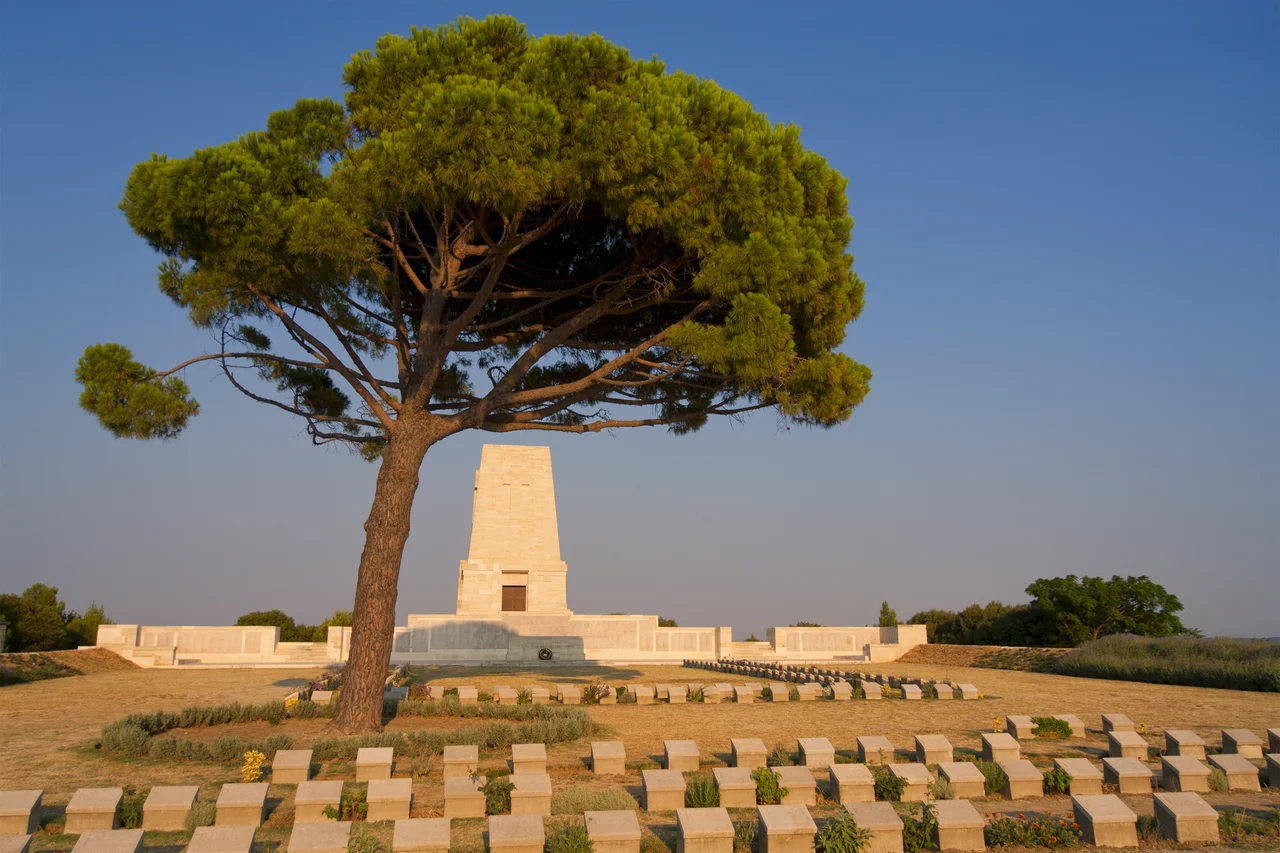

Battle of Lone Pine
There was, before the battle, an actual lone pine. It stood on a low rise the Australian soldiers had been calling 400 Plateau, the only tree on a ridge they had been staring at since April. The Turks called the place Kanli Sırt — Bloody Ridge. The Anzacs called it Lone Pine, or sometimes the Lonesome Pine after a popular wartime song. By the afternoon of 6 August 1915, when the Australian 1st Brigade rose from their trenches and went forward, the tree itself was already a stump; Ottoman soldiers had cut it for trench timbers in the months before. What followed in those four days has become, more than any other engagement, the moment by which Australia remembers Gallipoli.
The Cup the maps did not show
Lieutenant General William Birdwood, who commanded the Anzac Corps, had picked the rise as a diversion to cover the main attack going up the Sari Bair range and the new landing at Suvla Bay. The Australian 1st Brigade — battalions raised in Sydney, Newcastle, the Hunter Valley — would charge across about a hundred metres of broken open ground, take the front-line Ottoman trenches, and tie the defenders down. Reconnaissance from the air had photographed the position throughout June. What the photographs missed, hidden behind the front lip of the rise, was a hollow the Ottomans called Avcı Çukuru and the Australians later named The Cup: a depression where an Ottoman regimental headquarters and a network of bivouacs and reserves were tucked out of sight. The men who went over the top on 6 August did not know they were attacking into a much larger position than the maps showed.
Twenty minutes
At 5:30 p.m. the men jumped off. The first surprise was the trench roof: the Ottomans had laid heavy pine logs across their front-line trenches against artillery, and the attackers had to lever the logs up or find the firing slits. Some Australians dropped through gaps and started fighting in the dark of the trench underneath. Others ran on past the front line, into the second and third lines, into The Cup. Within roughly twenty minutes the Australian 1st Brigade held the main Ottoman trench. By the end of the night, two more Australian battalions had been pushed in to reinforce. The Ottoman 16th Division, alarmed, ordered everything within reach into a counter-attack.
Bombs in the dark
What followed was four days of trench fighting at distances of metres. With long firing arcs blocked by traverses and barricades, the men used the only weapons that worked at that range: improvised grenades — jam tins packed with explosive — bayonets, and shovels. Ottoman counter-attacks came in waves through the night of 6–7 August, the day of the 7th, all of the 8th, and into the 9th. Some Ottoman units lost more than half their strength. The Australian 4th Battalion was reduced to roughly a quarter of what had gone over. Captain Alfred Shout of the 1st Battalion was lighting and throwing improvised grenades when one exploded prematurely in his hands; he died of his wounds and received the Victoria Cross posthumously. He was one of seven Victoria Crosses awarded for Lone Pine — the most given for any single Australian engagement. The names of the others are Hamilton, Burton, Dunstan, Symons, Tubb and Keysor.
The diversion that wasn't enough
By the evening of 9 August, Ottoman attacks had largely stopped. The Australians had taken the position and held it. About 2,000 Australian soldiers were dead or wounded. Ottoman losses are usually estimated at 5,000 to 7,000, although precise figures for the 16th and other engaged divisions are debated. As a diversion, Lone Pine had pulled in some Ottoman reserves but had not stopped the larger August Offensive from failing in the hills to the north. The August Offensive collapsed; Suvla bogged down; Sari Bair was nearly taken at Chunuk Bair by New Zealanders before being lost again. The peninsula would be quietly evacuated four months later, in December 1915 and January 1916, with troops slipping out at night while ruses kept the Ottomans guessing. Lone Pine became simply one more stretch of front line, then an empty ridge.
What Anzac Day commemorates
After the war the Imperial War Graves Commission laid out the Lone Pine Cemetery and the Lone Pine Memorial on the ridge itself, the memorial walls listing the names of nearly 4,900 Australian and New Zealand soldiers who died in the Gallipoli campaign and have no known grave. A new pine was planted from a cone carried home by an Australian soldier from the original tree. Each year on 25 April — Anzac Day — Australians and New Zealanders gather here in the dawn for a service that connects, in living memory, this scrap of Aegean ridge to small-town cenotaphs in Auckland and Adelaide and Hobart. The dawn service is also held at the Atatürk Memorial in Wellington and at the Australian War Memorial in Canberra. Mustafa Kemal Atatürk, who commanded the Ottoman 19th Division here in 1915, said in 1934 of the foreign soldiers buried on the peninsula: 'You are now lying in the soil of a friendly country. Therefore rest in peace.' The line is carved at Anzac Cove, just down the slope from Lone Pine. Both nations come to read it.
From the Air
40.23°N, 26.29°E, on the Gallipoli peninsula about 1 km inland of Anzac Cove. The Lone Pine Cemetery and Memorial sits on the spine of 400 Plateau and is visible from the air as a rectangular walled enclosure with a tall pillar at its centre. Anzac Cove lies due west; Suvla Bay is about 5 km to the north. Nearest airport is Çanakkale (LTBH) across the Dardanelles. The peninsula reads best from altitude in clear morning light, when the eastern slope of the ridge is still in shadow.
Nearby Stories
- SMS Kurfürst Friedrich Wilhelm / Barbaros Hayreddin 7.2 km away
- Samothrace temple complex 14 km away
- 2014 Aegean Sea Earthquake 24 km away
- Mount Ida (Turkey) 24 km away
- Battle of Gallipoli (1416) 32 km away
- Cardia (Thrace) 48 km away
- Mithymna 59 km away
- Cyclops Cave (Youra) 143 km away