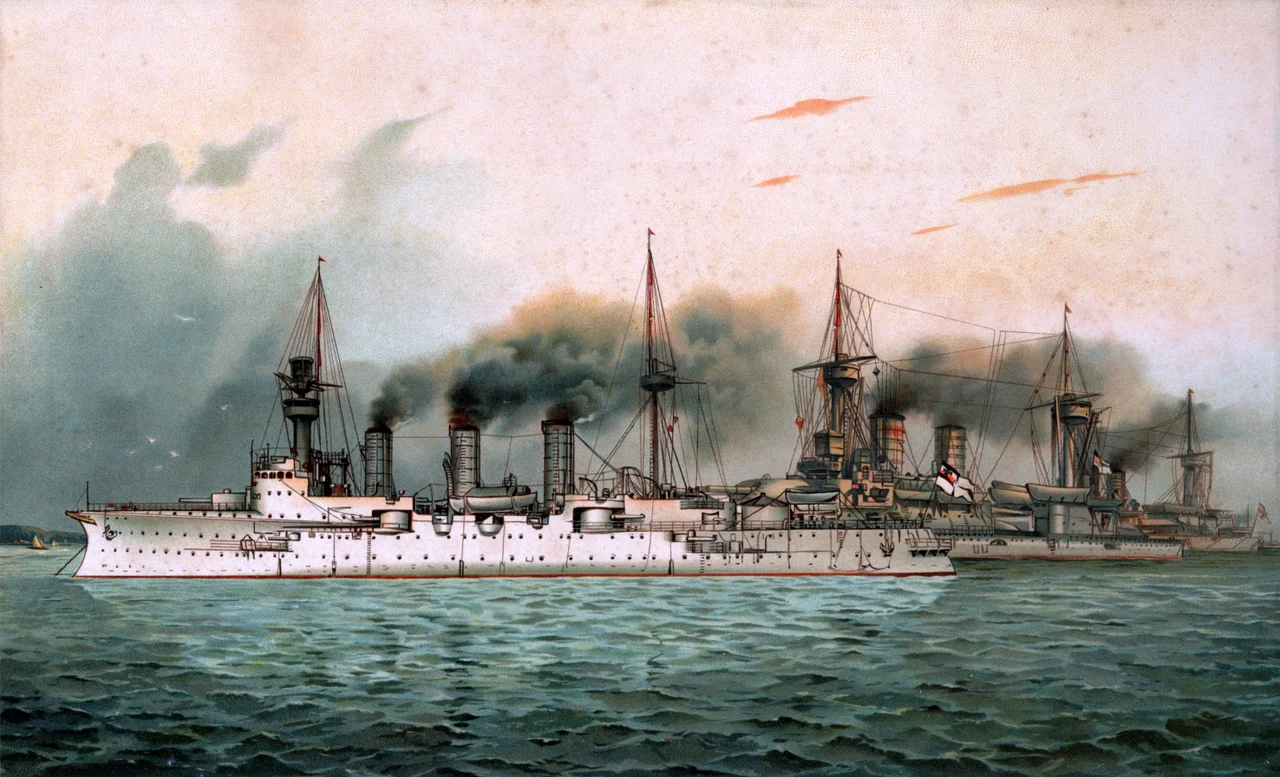

SMS Kurfürst Friedrich Wilhelm / Barbaros Hayreddin
On the morning of 8 August 1915, a single British torpedo found its mark off Bolayır, at the northern neck of the Gallipoli Peninsula. The ship it struck had already lived three lives under two flags: launched in Wilhelmshaven as SMS Kurfürst Friedrich Wilhelm, sold to the Ottoman Empire as Barbaros Hayreddin, and now, in the seventh minute after the explosion, she capsized and slipped beneath the Sea of Marmara. With her went an estimated 253 men who had woken that morning aboard a warship carrying ammunition to besieged Ottoman forces on the Gallipoli front.
Born in Iron, Named for a Conqueror
She was laid down at the Imperial Dockyard in Wilhelmshaven in March 1890, the fourth and final ship of Germany's Brandenburg class — the Kaiserliche Marine's first true ocean-going pre-dreadnought battleships. Kaiser Wilhelm II and his wife Augusta Victoria attended her launch on 30 June 1891. Commissioned in April 1894, she was immediately made flagship of the German Imperial fleet, a position she held for six years. Her armament was unusual for the era: six 28 cm guns in three twin turrets, rather than the four-gun standard of contemporary navies, giving her a heavier broadside than ships of similar displacement. Construction cost the German navy 11.23 million marks.
For sixteen years she served German purposes — flagship duties, training cruises from the Baltic to Norway and the Atlantic, a deployment to China during the Boxer Uprising of 1900–1901. Future High Seas Fleet admirals Reinhard Scheer and Franz von Hipper both served aboard her as young navigation officers. After a major reconstruction completed in December 1905, she was quietly sidelined into the Reserve Squadron. In September 1910, along with her sister Weissenburg, she was sold to the Ottoman Empire for ten million marks.
A New Name, Old Troubles
The Ottomans renamed her Barbaros Hayreddin, after Hayreddin Barbarossa, the celebrated 16th-century Ottoman admiral who had made the Mediterranean a Turkish lake. The honor was aspirational. German crews delivered the ships to Constantinople, but the Ottoman Navy struggled to crew them — trained enlisted men had to be pulled from other vessels just to fill her complement. Both Barbaros Hayreddin and her sister Turgut Reis suffered chronic condenser failures that cut their speed from 16 knots to barely eight. Rangefinders were missing. Ammunition hoists broke down. Telephones didn't work. Most watertight doors could no longer close.
The Italo-Turkish War of 1911–1912 passed without the fleet engaging meaningfully. By the time the First Balkan War erupted in October 1912, Barbaros Hayreddin was in poor condition by any honest assessment — but she was still the Ottoman fleet's flagship, and the navy had no choice but to send her out.
Two Battles, Two Defeats
The winter of 1912–1913 brought Barbaros Hayreddin into two engagements with the Greek Navy, both on the western approaches to the Dardanelles. At the Battle of Elli on 16 December 1912, the Ottoman fleet sortied to break the Greek blockade. A shell struck Barbaros Hayreddin's afterdeck, killing five men of a damage control party. A second shell jammed her rear turret. The Ottomans reversed course and retreated into the Dardanelles — a defeat.
At the Battle of Lemnos on 18 January 1913, an Ottoman plan to draw the faster Greek cruiser Georgios Averof away failed. During the two-hour artillery duel, a Greek shell hit Barbaros Hayreddin's amidships turret and killed the entire gun crew. Smoke from the hits was sucked into the boiler rooms, dropping her speed to five knots. Turgut Reis took the lead and the fleet withdrew again under fire. Between both battles, the ship fired roughly 800 rounds of main battery ammunition to little effect. The following month, she provided gunfire support at the amphibious assault at Şarköy, on this very coast — the same stretch of Marmara shore she would later sink beneath.
The Last Mission
When the Great War came in 1914, Barbaros Hayreddin was inspected by German engineers and found to be in severe disrepair. Her guns were partly stripped out and repositioned ashore as coastal batteries to help defend the Dardanelles. She became a floating artillery platform at the Nara naval base. On 25 April 1915 — the first day of the Gallipoli landings — she and her sister fired on British troops coming ashore, until her own gun barrel was destroyed by a premature detonation on the fifteenth shot.
On 7 August 1915, with British forces pressing hard at Suvla Bay, Ottoman high command ordered Barbaros Hayreddin to make for the Gallipoli front, laden with ammunition for the Fifth Army. She sailed with only a single torpedo boat as escort. The following morning, HMS E11 — the Royal Navy's most decorated submarine in the Dardanelles campaign — was waiting. One torpedo, seven minutes, 258 men lost. The rest of the crew were pulled from the water by the escort torpedo boat and a second vessel that arrived quickly. She lies on the bed of the Sea of Marmara near Bolayır, not far from where the Gallipoli Peninsula meets the Thracian mainland.
What the Water Keeps
The approximately 253 men who died with Barbaros Hayreddin that August morning were Ottoman sailors — conscripts and professionals both, serving a navy that had spent years holding together aging ships with inadequate resources. They had endured two losing battles, a failed war with Italy, and the grinding attrition of the Gallipoli campaign. Some had stood at those turrets through the winter engagements at Elli and Lemnos. Their ship had a name that evoked naval glory; their end came in seven minutes in an inland sea, within sight of the peninsula where tens of thousands of soldiers were already dying on both sides.
HMS E11 survived the war. Her commander, Lieutenant Commander Martin Nasmith, received the Victoria Cross. Barbaros Hayreddin's wreck was never raised. The water off Bolayır holds what remains of her, and of them — all approximately 253 of them.
From the Air
Barbaros Hayreddin sank at approximately 40.45°N, 26.80°E, near Bolayır at the northern end of the Gallipoli Peninsula where it meets the Thracian mainland — the narrowest point between the Sea of Marmara and the Gulf of Saros. At 3,000–5,000 feet, the isthmus is visible as a thin neck of land; to the south lies the Gallipoli Peninsula, to the east the open Sea of Marmara. The peninsula's ridge-line and the strait at Çanakkale (the Dardanelles narrows) are landmarks. Nearest airport: LTBU (Tekirdağ Çorlu Airport, ~80 km northeast); regional alternative LTBH (Çanakkale Airport, ~50 km south); LTFM (Istanbul Airport) for the broader Marmara region.
Nearby Stories
- Battle of Lone Pine 7.3 km away
- Avşa Island 7.7 km away
- Zeleia 16 km away
- Altıkulaç Sarcophagus 28 km away
- Battle of Hill 60 (Gallipoli) 28 km away
- Uzunköprü Bridge 58 km away
- 2025 Istanbul Earthquake 68 km away
- Battle of Philippi 177 km away