.jpg)
Altıkulaç Sarcophagus
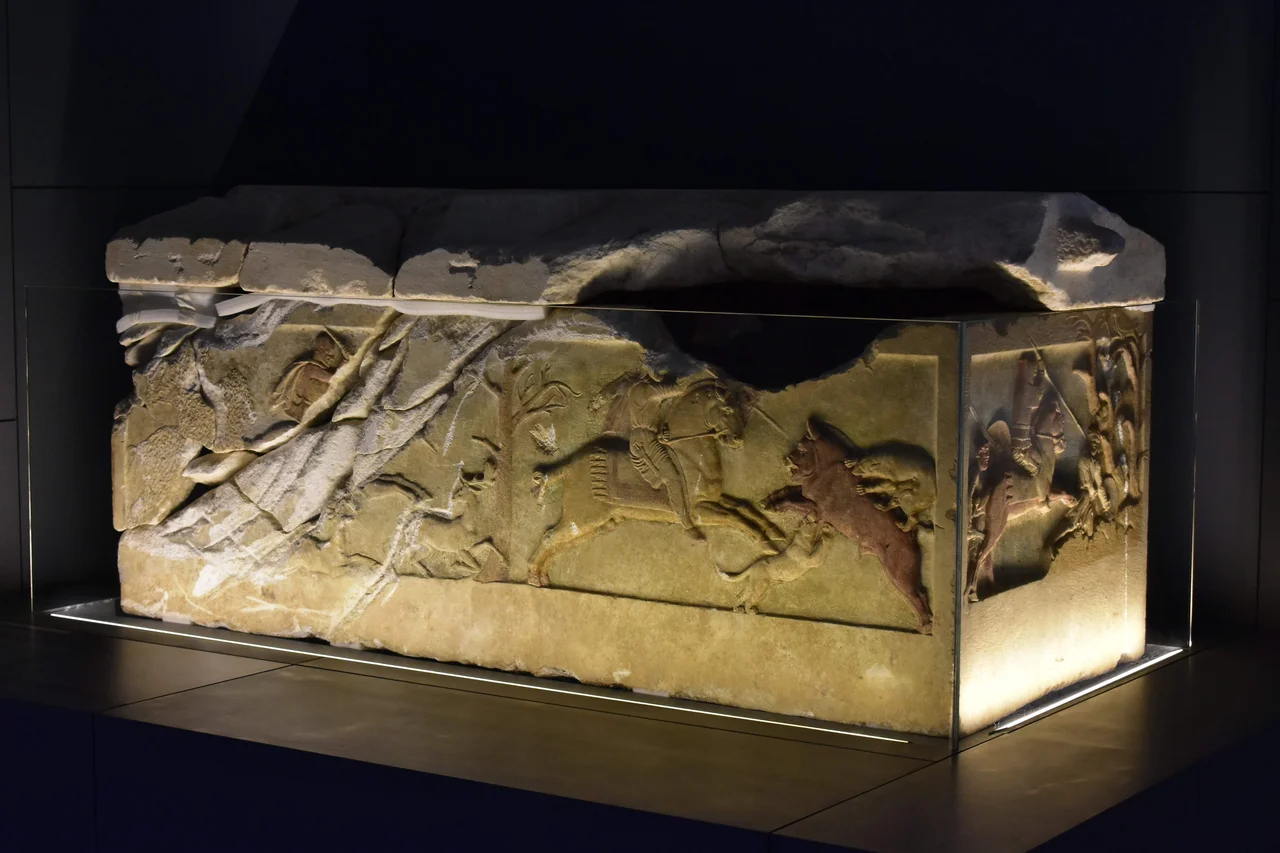
In 1998, workers uncovered a circular tomb in the Çingenetepe tumulus near the village of Altıkulaç, close to the town of Çan in northwestern Turkey. Inside, sealed in a corbel-vaulted chamber, lay a painted stone sarcophagus from around 400 to 375 BC — and inside the sarcophagus, the bones of a young man who had once been someone of great consequence. He was between 25 and 28 years old when he died. He had broken most of his limbs in a fall — probably from a horse in combat — and had lived for years afterward as a cripple, his bones knitting badly, before he died. Someone buried him in a coffin decorated with scenes of mounted hunters and warriors, and placed him under a mound of earth in the rolling country between Troy and Daskyleion. He waited there for roughly 2,400 years.
A World Between Greece and Persia
The Altıkulaç Sarcophagus was made in what the ancients called Hellespontine Phrygia — the territory controlled by the Persian satrapy that governed the northwestern corner of Asia Minor, the region closest to Greece. This was a cultural borderland. Persian nobles ruled it, Greek cities dotted its coasts, and the artistic traditions of both civilizations mixed in its tombs and temples. The sarcophagus belongs to a tradition of painted funerary monuments from Asia Minor that drew on Near Eastern royal iconography — specifically the equation of hunting skill with martial virtue that was fundamental to Persian aristocratic identity. Hunting a boar, running down a stag, engaging enemies in close combat: these were not merely scenes of leisure or warfare. They were assertions of a man's worth as a ruler and a soldier. The tomb's painter rendered them with considerable skill on four sides of the stone chest, creating one of the most vivid surviving windows into the elite culture of Persian-controlled Anatolia in the early fourth century BC.
The Man Inside
Archaeologists can reconstruct a surprising amount from bones. The man buried here was of considerable physical strength. He stood between 170 and 180 centimeters tall. He was no older than 28 when he died — possibly as young as 25. At some point before his death he had suffered a catastrophic fall from a great height, almost certainly from a horse during mounted combat. Many of his limbs were crushed. He did not die immediately; he survived the fall and lived for several more years, but his injuries never healed properly, his limbs remaining misaligned. He was a cripple in the years between his injury and his death. Given the date of the tomb, historians have suggested he may have been connected to the family of Pharnabazus, the satrap of Hellespontine Phrygia, who fought the Greeks on several occasions — including a campaign led by the Spartan king Agesilaos, who ravaged the area around Daskyleion in 395 BC.
Scenes Carved for Eternity
The painted scenes on the sarcophagus treat hunting and combat as parallel demonstrations of the same virtues: courage, horsemanship, controlled aggression. On one side, mounted hunters pursue a boar; on another, a Phrygian horseman — identifiable by his distinctive tiara-like cap — attacks Greek infantry. The choice to include both scenes was deliberate. In Persian royal ideology, the king who hunted well fought well; the man who could master wild animals could master armies. The iconography draws on traditions visible in the tombs of Lycia and across Asia Minor, suggesting the craftsmen who made this sarcophagus were working within a well-established tradition of dynastic self-presentation, even this far from the Persian heartland. The sarcophagus dates to roughly the same period as the famous Lycian tombs, situating it at the height of Persian power in Anatolia — just decades before Alexander the Great would shatter that world forever.
From Discovery to the Troy Museum
After its discovery in 1998, the Altıkulaç Sarcophagus was initially displayed at the Çanakkale Archaeological Museum alongside an earlier masterpiece, the sixth-century BC Polyxena sarcophagus, which depicts the sacrifice of the Trojan princess of that name. Both objects spoke to the extraordinary archaeological richness of the Troad and its borderlands. Both have since been moved to the Troy Museum, which opened in 2018 near the ancient site of Troy at Hisarlık. The Troy Museum was purpose-built to house the most significant archaeological material from this region, and the Altıkulaç Sarcophagus — with its painted surfaces, its Greco-Persian imagery, and its eloquent human remains — is among its most compelling holdings. The young dynast who suffered his fall and waited in the dark under the Çingenetepe mound is now visible to anyone who cares to look.
From the Air
The Altıkulaç discovery site lies at approximately 40.095°N, 27.145°E near the village of Altıkulaç, east of Çan in the eastern Troad region of northwestern Turkey. From the air at 3,000 feet the rolling agricultural landscape between ancient Troy to the west and the Sea of Marmara to the north is clearly visible; the site sits roughly halfway between those two landmarks. The nearest airport is LTBH (Çanakkale Airport), approximately 45 km to the west-southwest; LTBG (Bandırma Airport) is about 90 km to the northeast. The Troy Museum, where the sarcophagus is now displayed, is near Tevfikiye village, approximately 50 km to the west.
Nearby Stories
- Kapıdağ Peninsula 7.4 km away
- 1912 Mürefte Earthquake 8.7 km away
- Lake Kuş 17 km away
- Battle of Aegospotami 17 km away
- Balıkesir 30 km away
- Northern Aegean 38 km away
- Cunda Island 61 km away
- Uzunköprü Bridge 94 km away