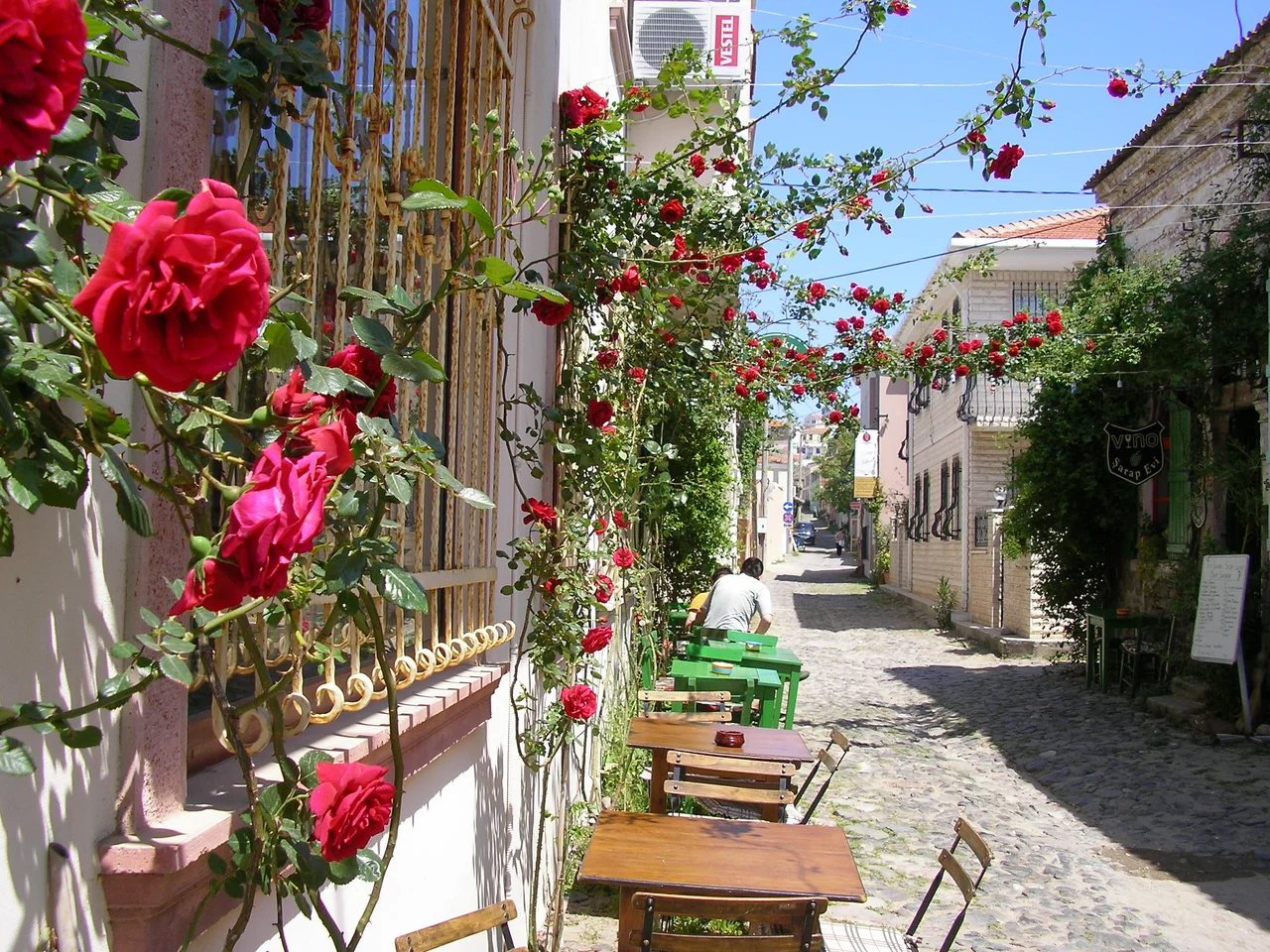

Cunda Island
In the Ottoman census of the early 1880s, the island then known as Moschonisi counted 4,671 people, and 4,417 of them were Greek. Nine in ten. Today not one of those families remains, and the great Greek Orthodox cathedral they built has become a museum. Cunda Island, also called Alibey, sits in the Edremit Gulf just sixteen kilometers off the coast of Lesbos. It is now a sunlit Aegean resort of cobbled lanes and whitewashed windmills, and to walk it well you have to know whose hands laid the stones.
The Fragrant Island
The Greeks called it Moschonisi, the fragrant island, the largest of an archipelago they named Hekatonisa after the goddess Hekate. Settlement here reaches back into antiquity, to places the old sources call Nasos, Pordoselene, and Chalkis. Pausanias, the ancient travel writer, recorded a story from Poroselene bay in the island's north: a dolphin that had once saved a drowning boy and lived on among the people who remembered it. For most of recorded time this was a Greek island, prosperous and devout, its harbors busy and its hillsides terraced, a world that felt as permanent as the rock it stood on.
A Community Destroyed
What happened to that world was deliberate and devastating, and it must be told plainly. In 1913, an Ottoman official proposed settling wealthy Muslim migrants on the island to dilute its Greek majority. Persecution began in 1914. The bishop Photios and other leading men were seized, beaten, and locked in a mill. Islanders were deported to the mainland, forbidden to take their belongings, then scattered among distant villages where many died. On September 19, 1922, several hundred of the remaining Greek islanders were killed; only some children were spared, sent to orphanages. The island's churches were looted and turned into stables. These were not statistics. They were families with names, a community erased within a decade.
Strangers Who Stayed
After the 1923 Treaty of Lausanne and the population exchange between Greece and Turkey, the last Greek islanders were forced to leave for a Greece most had never seen. Into their emptied houses came Cretan Turks and Muslims expelled from nearby Lesbos, people who had themselves been torn from their own homelands by the same treaty. There is no triumph in this arrival, only another displacement layered onto the first. The newcomers inherited a beautiful island and a heavy silence, and the descendants of those who came have spent recent decades learning, and increasingly honoring, the story of those who left.
What the Restorers Saved
The island's great landmark is the Taxiarchis Church, the Metropolitan cathedral the Moschonisi Greek Orthodox congregation built in 1873, dedicated to the archangels. Converted to a mosque in 1927 and shattered by a 1944 earthquake, it stood abandoned for decades. Then the Rahmi M. Koç Foundation leased and restored it, opening it as a museum on May 31, 2014. Other relics fared worse: the Greek monastery of Saint Demetrius, raised in 1766 with islanders' donations, was destroyed by treasure hunters in 2020. That a Turkish institution chose to rescue a Greek cathedral, while looters tore down a Greek monastery, captures the island's unfinished reckoning with its own past.
Cunda Today
Reach Cunda now and it feels like the platonic Aegean resort: cats dozing in alleys, windmills bright against the blue, restaurants spilling onto the waterfront. A bridge and a late-1960s causeway tie the island to the mainland through Lale Island, the first such crossing of a strait ever built in Turkey and still standing. Scholars come too. Harvard and Koç universities have run an intensive Ottoman and Turkish summer school here. Cunda's beauty is real and worth the journey, but the richest way to see it is with both eyes open, to the light on the water and to the people who once called this fragrant island home.
From the Air
Located at 39.361°N, 26.643°E in the Edremit Gulf off Ayvalık, Balıkesir Province, Turkey, about 16 km east of Lesbos, Greece. The 26.8 km² island reads from above by its whitewashed windmills, the prominent Taxiarchis Church, and the bridge-and-causeway link west to Lale Island and the mainland. Recommended viewing altitude 2,500–5,000 ft. Nearest airports: Balıkesir Koca Seyit / Edremit (ICAO LTBU, IATA EDO) about 45 km northeast, and İzmir Adnan Menderes (ICAO LTBJ, IATA ADB) some 180 km south; Mytilene International (LGMT) lies just across the strait on Lesbos. Clear Aegean light is best in early morning or at the famous golden hour before sunset.
Nearby Stories
- Agios Isidoros, Lesbos 14 km away
- Eresos 15 km away
- Antandrus 21 km away
- Lyrnessus 25 km away
- Volissos 61 km away
- Altıkulaç Sarcophagus 61 km away
- St. Helena Church 63 km away
- Battle of Imbros 76 km away