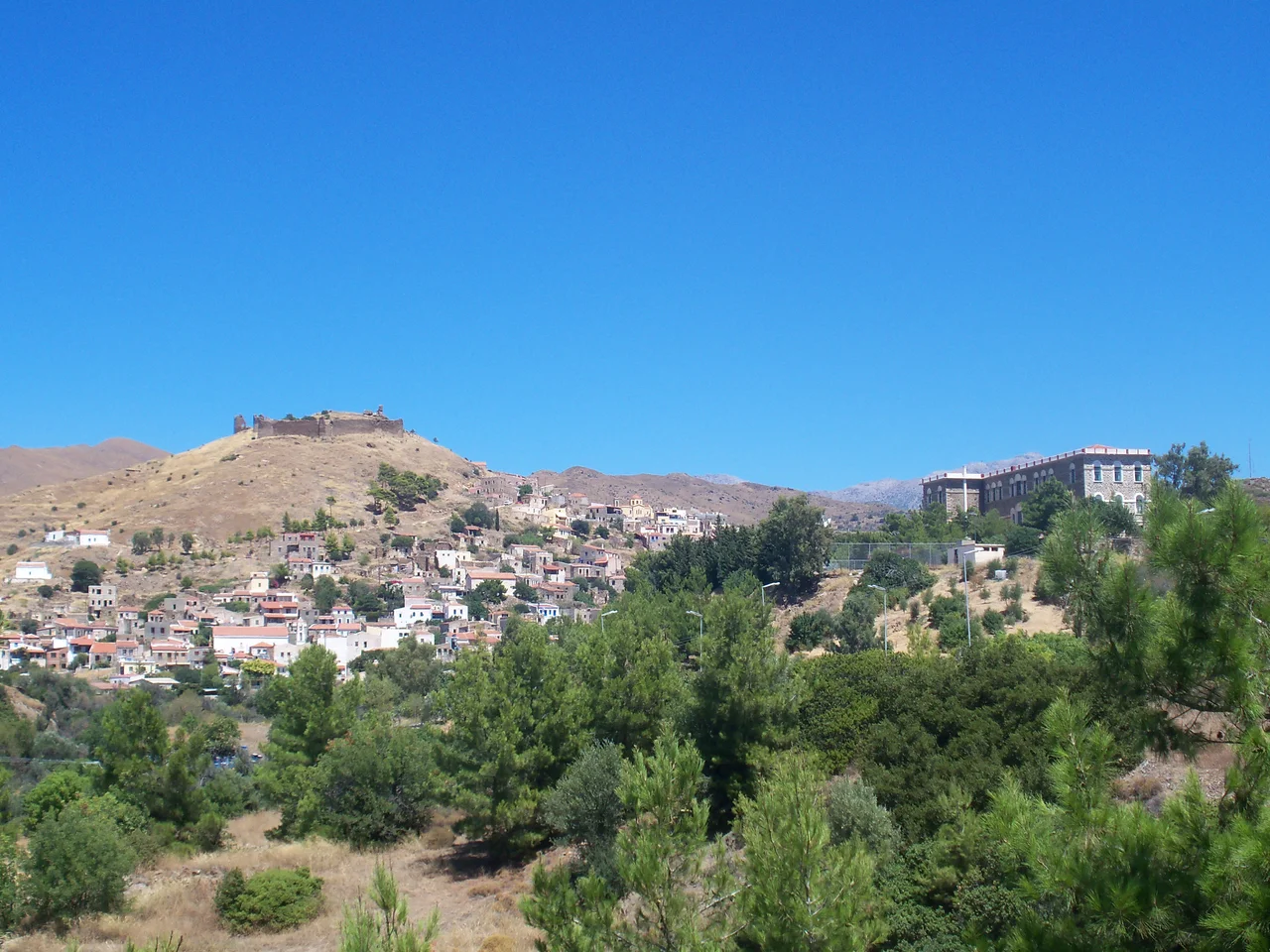

Volissos
At the entrance to Volissos, a marble plate carries lines in ancient Greek making a bold claim: that Homer lived in this hill village and composed his epics here. The source is no local boast but Herodotus, who long ago named Volissos among the places that shaped the poet. Whether or not the blind bard ever climbed these slopes, the village wears the claim proudly, an amphitheater of stone houses tumbling down a hillside in the remote northwest of Chios, far from the crowds and the ferries.
The Castle on the Hill
Crowning the village is a castle, trapezoid in plan, with six round towers anchoring its corners. Its foundations are Byzantine, but the fortress took its final shape in the fifteenth century when the Genoese, who then held Chios for its mastic and its trade, rebuilt it to guard the northwest coast. The houses below climb toward it in the amphitheatrical style of old Aegean settlements, lanes narrowing as they rise, until near the summit you find rooms to let, a small crepe shop, and a view that opens across the hills to the distant sea. From up here the layout of the whole village reveals itself at once.
A Village Holding On
Volissos is the largest village in northwest Chios, yet it has been emptying for decades. Since the 1950s, the young have left for Chios Town and for Athens, drawn by schools and work the village could not offer; its single school now serves as both primary and secondary for the surrounding settlements, its enrollment thinning year by year. What remains is a working community in miniature: a post office, a pharmacy, a doctor's surgery, a bakery that still bakes the old way, taverns and cafes around two squares named Christos and Pythonas, each with its own church. It is a place that knows exactly what it is.
The Saint and Her Festival
Volissos is honored as the birthplace of Saint Markella of Chios, the island's patron, whose monastery stands on the shore at Agia Markella below the village. Each 22 July, thousands of pilgrims pour in from across Chios and beyond to mark her feast, and holy water is said to spring from a hole in the rock right at the cold sea's edge. The night before, the port of Limia fills with a very different crowd, a summer music festival where hundreds of young people gather to dance until dawn. Saint and celebration, devotion and party, share the same weekend without apparent contradiction.
Mountains and Shore
Behind the village rise the highest mountains on Chios, crowned by Pellinaion at 1,297 meters. Below, about a kilometer and a half from the houses, lies Limia, the little port that links Volissos by sea to the island of Psara across the water. The coast here is generous with beaches, Lefkathia, Limnos, Lampsa, Gonia, Magemena, Managros, some with seasonal bars and tavernas, most quiet enough to feel found rather than visited. It is a corner of the island where the rhythm slows, where a castle keeps watch over a village that has outlasted empires, and where the sea is never far.
From the Air
Volissos sits in northwest Chios at 38.48°N, 25.93°E, about 40 km from Chios Town. The nearest airport is Chios Island National (LGHI) on the island's east side. From the air the six-towered hilltop castle and the amphitheatrical village beneath it are clear landmarks, set against the high ground of Pellinaion (1,297 m), the island's tallest peak, just inland. The port of Limia and a string of northwest-coast beaches mark the shoreline below; the island of Psara lies across the water to the northwest. Mountainous terrain and summer meltemi winds can make for turbulent air over the ridges; mornings are usually calmest.
Nearby Stories
- Aegean Sea 10 km away
- Erythrae 10 km away
- Battle of the Oinousses Islands 13 km away
- Battle of Corycus 20 km away
- Greek Islands 32 km away
- Eresos 56 km away
- Ikaria 69 km away
- Skyros 72 km away