
Eresos
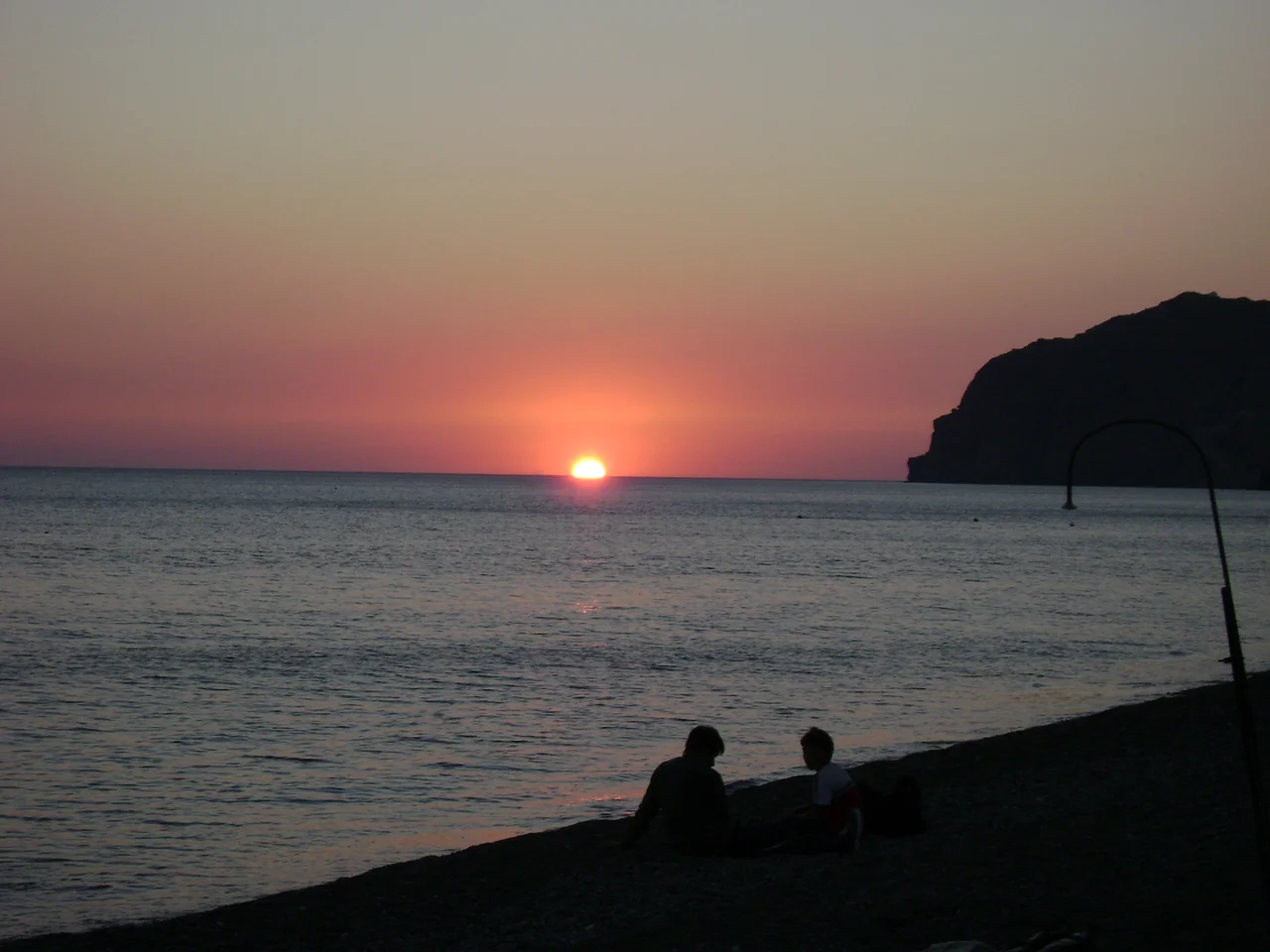
Two of the ancient world's most remarkable minds were born in the same small corner of Lesbos. One wrote verses so tender and exact that the ancients called her the Tenth Muse; the other catalogued the living world so carefully that he is remembered as the father of botany. Sappho and Theophrastus both came from Eresos, a village of dark volcanic hills on the island's barren southwest. Today the inland village and its twin by the sea, Skala Eresou, draw travelers to a long beach of grey volcanic sand, its water clear enough to have earned a Blue Flag. Some come for the sun. Many come because of the poet whose name still echoes here, 2,600 years after she sang.
The Poet of Eresos
Sappho was born around 620 BCE, by long tradition at Eresos, into a family prominent at Mytilene, the island's leading city. The ancients revered her without reservation. Plato is said to have called her the Tenth Muse; later readers named her simply "the Poetess," as Homer was "the Poet." She wrote lyric verse, poetry meant to be sung to the lyre, with an intimacy and precision that nothing in earlier Greek literature had matched. Tragically, almost all of it is lost. What survives comes down to us in fragments, lines quoted by later writers or recovered from scraps of ancient papyrus, and even these broken pieces are enough to mark her as one of the supreme poets of antiquity. Her legacy gave the world two words, sapphic and lesbian, drawn from her name and her island, and Skala Eresou has become a place of pilgrimage, including for women who trace their own history to hers.
The Father of Botany
Around 371 BCE, Eresos produced a second extraordinary figure: Theophrastus. He left the island for Athens, where he studied under Aristotle and eventually succeeded him as head of the Peripatetic school. Where his teacher had ranged across all of philosophy, Theophrastus turned a patient, systematic eye on plants. His works on the natural history and causes of plant life were so thorough and so original that he is honored as the founder of botany, the first thinker to study the plant kingdom on its own terms rather than as a footnote to medicine or farming. A third native, Phaenias of Eresus, also studied with Aristotle. For a remote village on a volcanic coast, Eresos sent a striking number of its children into the front rank of Greek learning.
Twenty Centuries of Masters
Eresos was one of the lesser cities of Lesbos, and its history reads like a chronicle of being fought over. In the Peloponnesian War it changed hands again and again between Athens and Sparta. Tyrants seized it, democrats expelled them, Persians reinstalled them; one long inscription, set up by the victorious democrats around 300 BCE, accuses a pair of tyrants named Eurysilaus and Agonippus of holding the city's women hostage on the acropolis and helping the Persians turn pirate. After Alexander's officers finally secured the island, the two tyrants were shipped to Egypt and sent back for trial and execution. Rome arrived next, and the elites of Eresos embraced it eagerly, raising altars to Augustus, his wife Livia, and his heirs. The oldest Greek inscription on all of Lesbos, dating to the sixth century BCE, was found in the hills above the town, the trace of a vanished temple.
Down to the Sea
The village you visit today is the result of fear and good sense. Around the end of the seventeenth century the inhabitants pulled back from the coast to the inland site, four kilometers from the water, to escape pirate raids. In 1821, as the Greek Revolution began, the sea-captain Dimitrios Papanikolis slipped a fireship against an Ottoman two-decked frigate anchored near Eresos and destroyed it, a feat the village still honors in the name of its football club. Only in the early twentieth century did a local doctor, judging the inland site unhealthy, lead the slow return to the shore that became Skala Eresou. The beach has since drawn its own literature. Lawrence Durrell set a verse play here; Armistead Maupin sent a character to its grey sands. The hills are bare and volcanic, the light is hard and clear, and somewhere in it the memory of Sappho's voice still seems to hang.
From the Air
Eresos lies at 39.17°N, 25.93°E on the southwest coast of Lesbos, Greece, with the beach village of Skala Eresou about four kilometers to the south on the shore. The terrain is bare, rocky, and volcanic in origin, sloping to a long grey-sand beach on the Aegean. The nearest airport is Mytilene International (LGMT) on the east of the island, roughly 60 km away by road. Best viewed at low to medium altitude in clear summer light, when the dark volcanic hills and the broad curve of the beach stand out sharply against the sea.
Nearby Stories
- Solar eclipse of May 20, 1966 10 km away
- Battle of the Oinousses Islands 20 km away
- Destruction of Psara 38 km away
- Aegean Sea 39 km away
- Antandrus 43 km away
- Skyros 73 km away
- Troy 73 km away
- Battle of Athos 84 km away