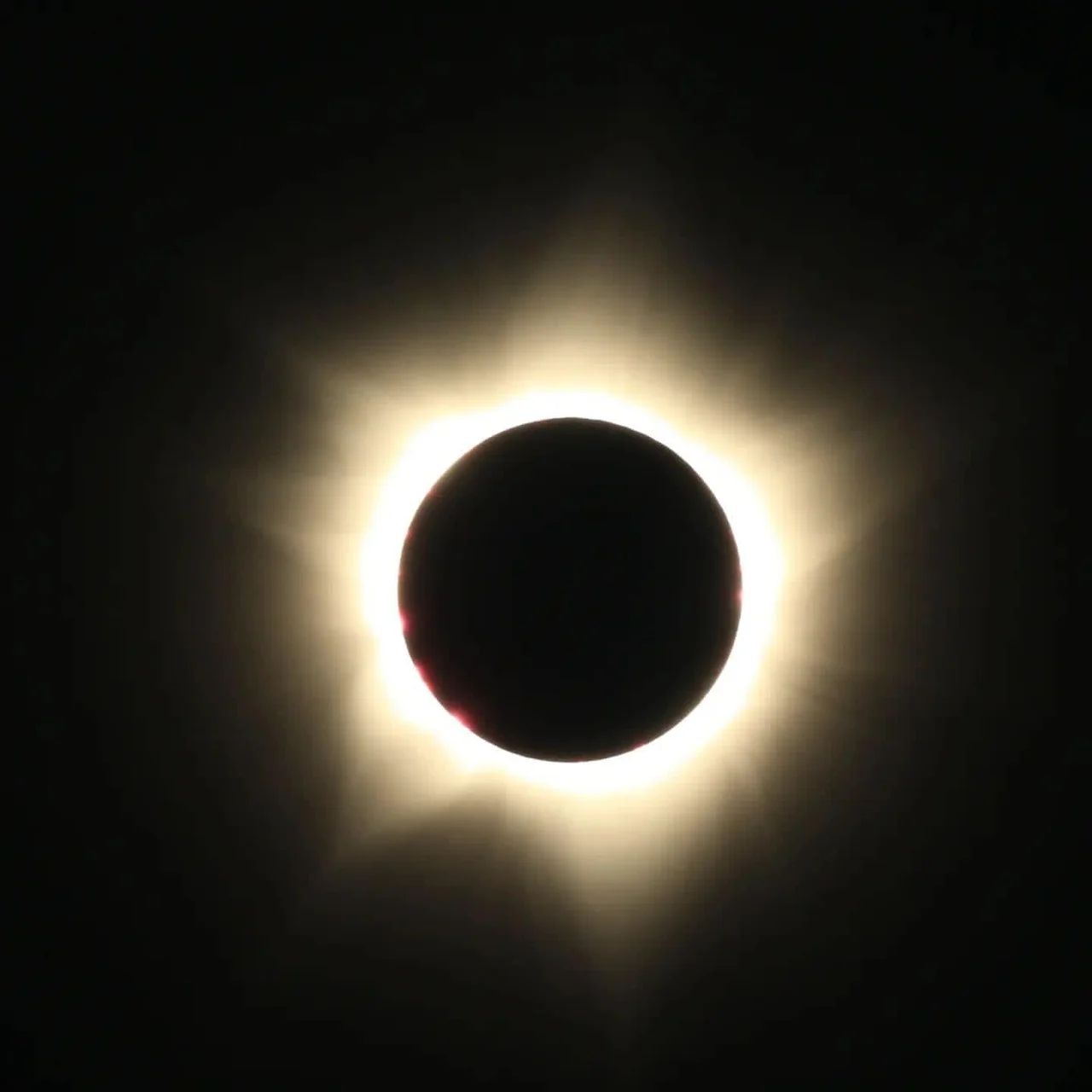

Solar eclipse of May 20, 1966
For roughly five seconds, the Sun became a ring. On the morning of Friday, May 20, 1966, the Moon slid almost perfectly across the Sun's face but fell just short of covering it, leaving a thin blazing circle suspended over the Aegean. This was an annular eclipse with a magnitude of 0.9991 — so close to total that the band of annularity narrowed to barely three kilometers wide. To stand inside that sliver as the ring closed and reopened was to occupy one of the most precisely defined patches of ground on the planet that day. And the place to be was the Turkish coastal town of Ayvalık.
A Ring Drawn Across the World
The Moon's shadow began its work in West Africa at dawn. The path of annularity touched down over Guinea — sweeping across its capital, Conakry — then raced northeast across Mali, Algeria, and Libya before crossing the Mediterranean into Greece and Turkey. From there it pressed on through the Soviet Union, over what are now Russia and Kazakhstan, and finally into China. Tens of thousands of kilometers away from that narrow center line, a partial eclipse dimmed skies across North Africa, Europe, and much of Asia. But the geometry that mattered most converged on the eastern Aegean, where the point of maximum eclipse fell near 39°N, 26°E — practically on top of Ayvalık itself.
Why Astronomers Came to Ayvalık
An eclipse this close to total is a gift to science, and astronomers knew it. When the Moon nearly fills the Sun's disk, the apex of its umbral shadow grazes the Earth's surface and the edges of the two bodies seem to touch. That allowed observers to catch Baily's beads — the glittering points of sunlight that spill through valleys on the Moon's rugged limb, normally seen only during a total eclipse. The beads let scientists measure the Moon's mountains and the precise size and shape of the Earth. Teams converged on the locations with the best geometry and the clearest skies: in Greece, the observation sites clustered at Saronida and Anavyssos south of Athens; in Turkey, they gathered at Ayvalık, looking out across the water toward the Greek island of Lesbos.
The Crown That Never Came
There was a tantalizing possibility. Because this eclipse came so achingly close to total, some predicted that the Sun's corona — the pearly halo of outer atmosphere reserved for total eclipses — might briefly flash into view. A team crossed to Lesbos hoping to witness it. They were rewarded with Baily's beads, the diamond-bright fragments of the vanishing Sun, but the corona never appeared. The Moon simply did not cover quite enough. It was the kind of near-miss that defines annular eclipses: spectacular, scientifically rich, and yet withholding the one prize that only true totality can offer. The watchers got their ring of fire, but not the crown.
A Link in an Ancient Chain
No eclipse stands alone. This one belonged to Solar Saros 137, a family of eclipses recurring roughly every eighteen years, and several of its siblings had shared that same razor-thin geometry near magnitude 1. The annular eclipse of May 9, 1948 had been watched from Rebun Island in Japan; earlier members of the series drew observers near Paris and to Camptonville, California. The 1966 eclipse was also one of four eclipses in its own year — bracketed by penumbral lunar eclipses in May and October and a total solar eclipse that November. For a few seconds over the Aegean, though, this particular link in that long celestial chain belonged entirely to Ayvalık, where the Sun became a ring and then, just as quickly, was whole again.
From the Air
The point of maximum eclipse fell at roughly 39.2°N, 26.4°E, in the eastern Aegean just off the Turkish coast near Ayvalık and the Greek island of Lesbos. The path of annularity here was only about 3 km wide, running northeast across the sea. Best appreciated from 3,000–6,000 ft with the Aegean and the long ridge of Lesbos in view to the west. Nearest airports: Mytilene/Lesbos (ICAO LGMT) on the Greek side, Edremit/Balıkesir Koca Seyit (LTFD) to the northeast, and İzmir Adnan Menderes (LTBJ) to the south. The region offers reliably clear late-spring mornings — the very reason observers chose it in 1966.
Nearby Stories
- Agios Isidoros, Lesbos 14 km away
- Eresos 15 km away
- Antandrus 21 km away
- Lyrnessus 25 km away
- Volissos 61 km away
- Altıkulaç Sarcophagus 61 km away
- St. Helena Church 63 km away
- Battle of Imbros 76 km away