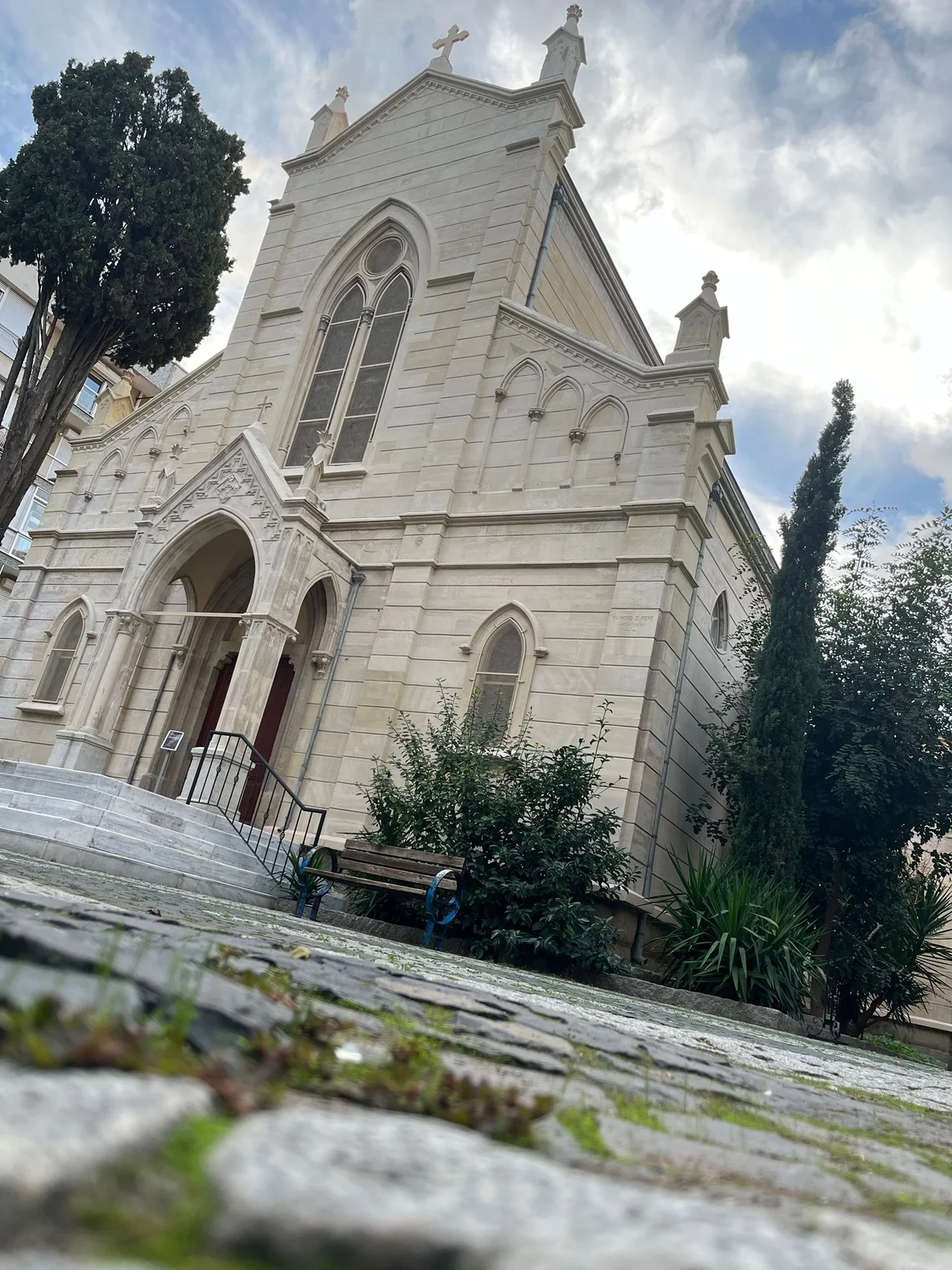

St. Helena Church
The cornerstone for St. Helena was laid on 17 June 1904 in Karsiyaka, then a leafy suburb across the bay from Smyrna where French engineers, Italian merchants, and Levantine families with mixed European passports were building summer villas with view-bearing gardens. They needed a parish. Sultan Abdulhamid II had granted the firman two years earlier on condition that costs not exceed 1,000 Ottoman lira and that funds be raised voluntarily from the neighbourhood Catholics. The architect they chose, Raymond Charles Pere, had recently designed the clock tower at Konak that still defines the Izmir skyline. He gave them a small neo-Gothic church with a three-nave plan, twelve white Marmara marble columns, a Carrara marble altar in the apse, and pinnacles and a bifora across the facade.
Why Cordelio Filled with Catholics
Karsiyaka, known to the foreigners by its Levantine name Cordelio, sits on the north shore of the gulf of Izmir directly across from the old Smyrna waterfront. The nineteenth-century Sultans, eager to keep pace with the modernization sweeping Europe, hired specialists from across the continent for railways, tramways, telegraph systems, and banks. Many of those specialists settled near where their work needed them, and many of them were Catholic. By the 1860s the Cordelio community had grown large enough that Smyrna's archbishop sent a priest in 1868 to look after their souls. A small chapel went up by 1874 on what is now 1716 Street, near the police station on the short stretch leading from the bazaar to the railway tracks. It served the parish for thirty years.
Don Alfonso and a Donated Plot
Don Alfonso M. Vallery was appointed first parish priest of the new parish of Karsiyaka in 1882, and he stayed for forty-five years, longer than most marriages last. During his tenure 405 baptisms, 48 marriages, and 190 funerals were recorded in the small chapel. Count Nicola Aliotti, a Levantine landowner of deep Christian principles, donated 2,100 square feet of ground for a proper church. The Sublime Porte processed the paperwork, and Pasha Kamil, the city's governor, drew up the imperial firman dated Sefer 18, 1312, by the Hijri calendar (18 April 1902 by the Gregorian). The community pulled together the money. Engineer Pere drew the plans. Construction began two years later.
The Building Itself
St. Helena is built of brick, concrete, and sandstone, laid out as a basilica with three naves, no columns down the central axis, and a generous gallery above the small ones at the rear. Inside, the central nave reaches fourteen metres at its peak. Pointed arches separate the nave from the side aisles, supported by twelve marble columns from the islands of the Sea of Marmara. The apse contains five lancet windows around an altar of Carrara marble, with side chapels to the Sacred Heart and the Immaculate Conception of Lourdes. The masonry was finished in 1906. Stained glass arrived in 1908. A statue of Polycarp, the second-century bishop of Smyrna and the city's first Christian martyr, stands inside; he is the figure who connects the building to the older Christian history of the place.
The Earth Shook
Father Domenico Bertogli was parish priest on the night of 2 February 1974 when, at four minutes past two in the morning, the ground beneath Izmir lurched. People poured into the streets in their bedclothes. The 1974 earthquake registered nothing extraordinary by Anatolian standards, but the church had not been built for it. The top of the facade leaned dangerously forward. Three slabs fell from the outer wall onto the roof of the side nave, breaking through several square metres of tile. Cracks opened in the vaults. A restoration ten years earlier and a facade cleaning three years before had been undone in seconds. Father Domenico, writing later, hoped he could restore a church beloved by Christians and admired by Muslims for its beauty. The Capuchin community, the archbishop, and various benefactors raised the money. The Conventual Friars Minor took over from the Capuchins in 1997. They run the parish still.
What a Small Church Carries
St. Helena is named for the mother of Constantine the Great, the empress who, by tradition, recovered the True Cross in Jerusalem and distributed fragments of it to the eastern Christian world. The dedication is appropriate for a coastal city in Asia Minor where, by Christian tradition, Polycarp was martyred and where John the Evangelist addressed one of his seven letters in the Book of Revelation. The Catholic community Pere built for is much smaller now than in 1904, and most of the foreign families who funded the original construction left after the events of 1922. What remains is a working parish in Turkish, a building that survived an earthquake, and a small reminder that Karsiyaka was once Cordelio, a place where the railway-builders of three nations sent their children to school.
From the Air
St. Helena Church stands at 38.45 degrees north, 27.11 degrees east, in the Karsiyaka district on the north shore of Izmir Bay. Adnan Menderes Airport (LTBJ) is 25 km south of the city centre; Cigli (LTBL) sits 7 km northwest. From cruising altitude the bay is the dominant feature; the church itself is visible from low approach as a small neo-Gothic facade among residential blocks west of the ferry terminal. Visibility along the Aegean coast is best in spring and autumn.
Nearby Stories
- Battle of Corycus 12 km away
- Battle of the Oinousses Islands 19 km away
- Eğlenhoca 20 km away
- Temple of Artemis at Ephesus 24 km away
- Akhisar Museum 28 km away
- Ottoman conquest of Lesbos 77 km away
- Hadrianotherae 134 km away
- Palace of the Grand Master of the Knights of Rhodes 193 km away