
Ottoman conquest of Lesbos
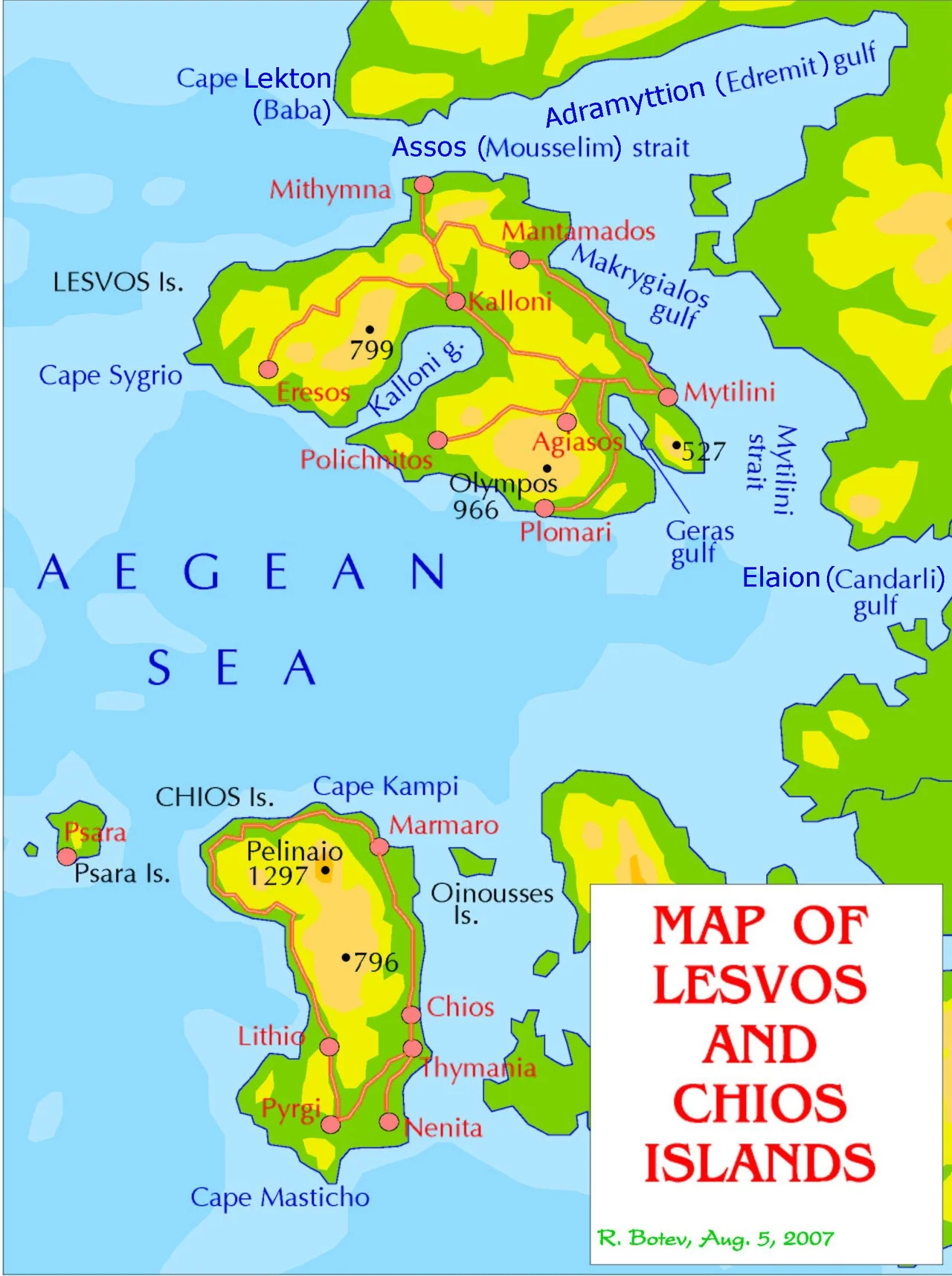
Before he sailed against Lesbos, Mehmed II walked through the ruins of Troy. The young sultan who had taken Constantinople nine years earlier stood among the fallen stones and, according to the historian Kritoboulos, declared himself the avenger of the ancient Trojans against the Greeks. Then he marched to Assos, on the Anatolian shore, and looked across a narrow strait of water at the island he had come to swallow. It was August 1462. Within a month, the last Genoese lordship in the Aegean would be gone.
The Adventurers Who Ruled an Island
For over a century, Lesbos had belonged to the Gattilusio, a Genoese family who won the island in 1355 the way ambitious men of that age won things: a marriage to a Byzantine emperor's sister, and a willingness to fight for the rest. From their castle at Mytilene they ruled a small maritime realm that once reached across the northeast Aegean. But after Constantinople fell in 1453, the world tilted. Mehmed II began stripping the family of its holdings one by one, demanding ever-larger tributes in gold. The end came partly through the Gattilusio themselves. In 1458, Niccolò Gattilusio deposed and strangled his own brother to seize the island, handing the sultan the perfect pretext for conquest.
The Siege
The Ottomans landed on 1 September. When envoys demanded surrender, Niccolò answered that he would yield only to force, so force came. Six enormous cannon were hauled into position, each able to hurl a stone weighing more than 700 pounds, and for ten days they hammered the walls of Mytilene. The tower of the Virgin collapsed into rubble. Then discipline inside the castle dissolved. Soldiers broke into the warehouses, drank the wine, and devoured stores that could have fed the defenders for a year. When the Janissaries climbed into the breaches, they met almost no one. "The place lacked a brave and experienced soldier," the historian William Miller later wrote, "who would have inspired the garrison." On 15 September, Niccolò handed over the keys.
The Promises and the Price
Mahmud Pasha had sworn by his sword and by the sultan's head that the people's lives would be spared. The promises did not hold. Some 300 Italian soldiers were executed as pirates. On 17 September, the inhabitants of Mytilene were marched past the sultan and three clerks who wrote down their names. Around 800 boys and girls were taken for the sultan's palace. The strong and healthy were sold as slaves; the nobility were shipped off to repopulate Constantinople. Some ten thousand islanders were torn from their homes, and some died in the crowded ships before they ever reached the slave markets. Niccolò himself was strangled in the capital. These were not statistics on a chronicle's page. They were families, parents and children, a whole city's worth of lives undone in a week.
Four and a Half Centuries
The fall of Lesbos was not a sideshow. It snuffed out the last semi-independent Christian state in the northeast Aegean and helped ignite the First Ottoman-Venetian War the following year. Venice would try to take Mytilene back in 1464 and fail. The island settled into Ottoman rule that would last, with only brief interruptions, until 1912, when the Kingdom of Greece finally claimed it during the First Balkan War. Walk the ramparts of the great castle at Mytilene today and you can still read the layers: Byzantine foundations, a Genoese inscription dated 1460, the year Niccolò frantically dug his trenches and earthen mounds, and the Ottoman mosque and works that followed. The stones remember a September when a city changed hands and a people were scattered.
From the Air
The Castle of Mytilene crowns the citadel hill at roughly 39.11°N, 26.56°E on the southeast coast of Lesbos. Mytilene International Airport (ICAO: LGMT) lies about 8 km south. From the air, the fortified headland between the two harbors is the dominant landmark, with the Anatolian coast of Turkey, from which Mehmed's army crossed, visible just across the strait to the east. Best viewed at 3,000-4,000 feet in the clear, dry light of an Aegean summer.
Nearby Stories
- Eresos 9.6 km away
- Lyrnessus 15 km away
- Battle of the Oinousses Islands 17 km away
- Antandrus 31 km away
- Volissos 41 km away
- St. Helena Church 44 km away
- Akhisar Museum 70 km away
- Battle of Imbros 96 km away