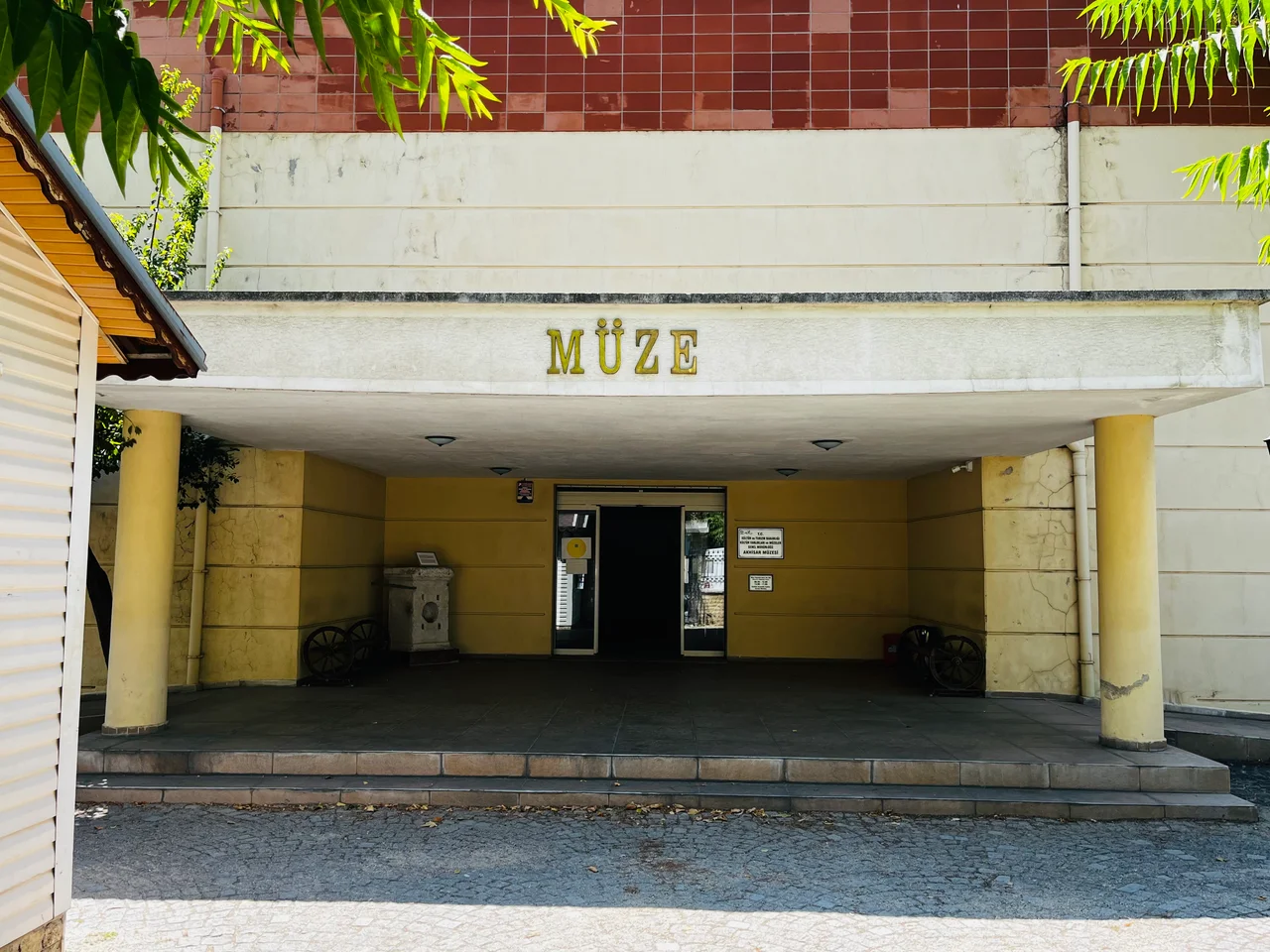

Akhisar Museum
Ayşe Aloğlu built it in 1932 as a memorial to her son. Ali Şefik had died young from illness, and his mother used family money to put up a two-story hospital in his name on a quiet street in Akhisar, in western Anatolia. The hospital eventually became a school, then a residence for teachers, then the center of a local political fight in 2005 about why the government wanted to close it. After eight years of restoration, it reopened in 2012 as the Akhisar Museum. The 650 square meters of galleries inside hold pieces of Lydia, of Thyatira, of the Yortan culture, and of an Ottoman world of carpet looms and tobacco knives that was vanishing even as the building first opened its doors.
A Building That Kept Changing Jobs
The Ali Şefik Hospital served the people of Akhisar through the early years of the Turkish Republic, then transferred to the Ministry of National Education at local request, with Ayşe Aloğlu's blessing. It became Ali Şefik Middle School and stayed one until 1992, when renovations turned it into a residence for teachers. By 2005, the government wanted the building back for other purposes. The Akhisar branch of the Eğitim Sen union called the closure politically motivated and organized protests with the support of local residents. The protests changed the outcome but not the closure. Officials promised the building would become a museum to add to the city's cultural heritage, and in 2007 the teachers moved out. Five years of survey, restoration, and permitting followed, complicated by the building's protected heritage status. Culture and Tourism Minister Ertuğrul Günay opened the museum on August 6, 2012.
Thyatira's Coins and a Gold Ram
Akhisar sits on top of ancient Thyatira, one of the seven cities addressed in the Book of Revelation, and the museum's archaeology section is built around what the soil keeps giving up. Coins from Thyatira span every period from the Archaic to the Ottoman, an unbroken eighteen-century run of political and economic memory in metal. The standout piece is a gold ram-shaped figurine from the early fifth century BC, found in the village of Gökçeler. Beside it sits the Gökçeler relief, a stone slab dated to the Archaic period and known as the Young Man Relief, depicting a tomb scene from the Anatolian-Persian world that overlapped with the Lydian kingdom. Hellenistic and Roman ceramics, glass vessels, ossuaries, terracotta figurines, and four Roman inscriptions used as honorific markers and funerary stelae fill the rest of the case lineup.
Tear Bottles and Lekythoi
Some of the most affecting objects in the collection are also the smallest. The unguentaria, often called tear bottles, are slender clay vessels Romans placed in graves to hold perfumed oils and, the tradition went, the tears of mourners. The museum has a careful row of them, each shaped differently, each from someone's funeral. The Attic lekythoi, narrow oil flasks decorated with mythological scenes and palmette motifs, also came from burials, this time of Lydian families wealthy enough to import painted ceramics from Athens. The Yortan culture pottery on display dates to the third millennium BC, with the smooth dark surfaces and pinched spouts that gave the culture its name in twentieth-century archaeology. Fossil samples in another gallery represent western Anatolia between 18 and 11 million years ago, when this corner of the world looked entirely different.
Arasta
The ethnography section ends in a smaller room called Arasta, which is the Ottoman word for the bazaar street where craftsmen worked side by side. The display reconstructs the trades that defined Akhisar in the nineteenth and twentieth centuries: tobacco cultivation, with its bale-pressing crates and the slim curved needles for threading leaves to cure on lines; felt-making, including pieces by the felt-maker Orhan Patoğlu; carpet weaving on a working loom from the western Anatolian rug tradition; carriage-making and saddlery; and the elaborate copper and brass fittings of Turkish coffee preparation. Hand embroidery, hammam supplies, and tools from coffeehouse culture round out the room. The 1,250-square-meter garden outside holds an open-air collection of larger stone artifacts. The museum displayed 1,051 pieces when it opened in 2012; as of 2019, the official total on view stands at 689.
From the Air
Akhisar Museum at 38.9203°N, 27.8372°E, in the town of Akhisar, Manisa Province, western Turkey. The Thyatira archaeological site sits adjacent to the museum. Visual altitudes 3,000-5,000 ft over the broad Akhisar plain. İzmir Adnan Menderes (LTBJ) lies 51 nm southwest, Manisa Air Base (LTBT) 31 nm south. Summer haze from the agricultural valley reduces visibility; spring brings clear views east toward the Lydian heartland and west to the Aegean.
Nearby Stories
- St. John the Evangelist's Anglican Church, Izmir 35 km away
- Lyrnessus 45 km away
- Hadrianotherae 45 km away
- St. Helena Church 60 km away
- Izmir 75 km away
- Green Mosque of Bursa 121 km away
- Bursa 149 km away
- Antalya Museum 277 km away