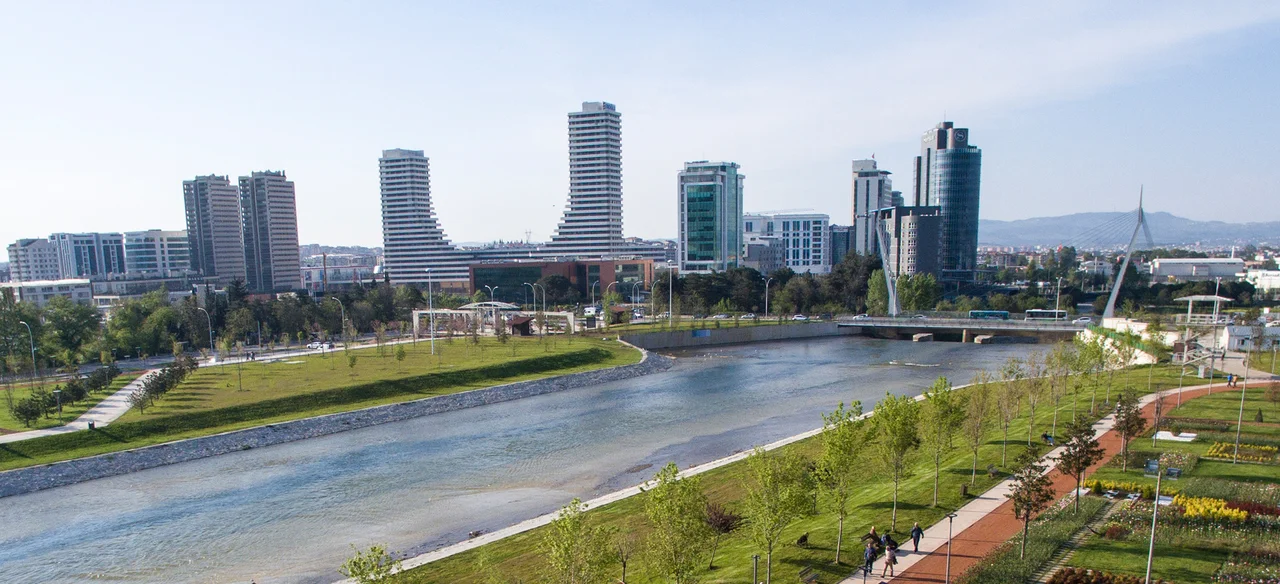

Bursa
Before there was an Ottoman Empire, there was Bursa. The city sits on the lower northern slopes of Mount Uludag, looking out across the Marmara plain toward the sea, and from 1335 until the early 1360s it was the seat of a small Turkish beylik that would eventually swallow Constantinople and rule three continents. The first Ottoman sultans are buried here. The first Ottoman mint was struck here. The Grand Mosque, with its twenty domes paid for after a battlefield vow, still anchors the old city. Bursa is where the empire learned what it would become before it became too big to fit inside one valley.
Prusa Under Olympus
Long before the Turks arrived, this corner of Bithynia was Greek. Around 200 BC, King Prusias I rebuilt an older settlement here and named it after himself - Prusa, sometimes Prussa, the city under Olympus, since classical writers called the mountain looming above it the Mysian or Bithynian Olympus. In 75 or 74 BC the last Bithynian king, Nicomedes IV, willed his entire kingdom to the Roman Republic, and Prusa became Roman. By the mid-sixth century, under Justinian, the city was already known across the Mediterranean for its silk. Pliny the Younger, governing the province around 110 AD, wrote to Trajan asking permission to build baths here - the same hot springs that had drawn the Bithynian kings still drew the Romans, and they still draw visitors today. The thermal water was once called the royal water. The springs have been working continuously for at least two thousand years.
The First Capital
In 1326, after a long siege, Orhan, son of Osman, took Bursa from the Byzantines. Within a decade his court had moved here, and Bursa became the capital of an entity still small enough that historians call it the Ottoman beylik - the principality that would, in another century and a half, become the empire. Orhan and his father Osman are both buried in the city. The early sultans built furiously: caravanserais like the Koza Han where silk merchants stored their wares, hospitals, madrasas, the first official Ottoman mint. Sultan Bayezid I commissioned the Grand Mosque between 1396 and 1400, with its twenty domes arranged in four rows of five - twenty domes, supposedly, in place of the twenty separate mosques he had vowed to build if he won the Battle of Nicopolis in 1396. He won. He built one mosque with twenty domes. The 192 calligraphic inscriptions inside are among the great works of Ottoman religious art, and the dim, horizontal light of the interior - lit through a skylight in the ablution dome - gives the building a contemplative quality the later, vertical, Hagia Sophia-influenced mosques deliberately abandoned.
Silk and the Long Road
Bursa's wealth came from silk. The city sat near the western terminus of the Silk Road, the great overland route from China across central Asia to the Mediterranean, and during both Byzantine and Ottoman centuries Bursa was where Eastern silk was sorted, sold, and shipped on to Genoa, Florence, and Venice. The Koza Han - the silkworm cocoon market - was built in 1491 and still operates as a textile bazaar today. Caravans came in from the east loaded with raw silk and Ming Chinese porcelain; they left with Italian silver and gold. Traders grew rich. Many of the wealthiest in the late Ottoman period were Armenian, until the events of 1915 emptied much of that community from the city in the Armenian genocide. Greek Orthodox families were forced from their coastal villages and pushed inland through Bursa in the same year. The demographic upheaval was permanent. Kurds, Circassians, Syrians from the south, and later Bulgarian Turks expelled from Bulgaria between the 1940s and 1990s reshaped the city again and again.
Yesil Bursa
The modern nickname is Yesil Bursa - Green Bursa - for the parks, the plane trees, and the vast forests of Mount Uludag rising directly behind the city. Uludag itself climbs to 2,543 metres and now hosts one of Turkey's most popular ski resorts, reached from the city by an 8.8-kilometre gondola lift that lifts skiers to 1,870 metres above the streets below. In summer the mountain is a hiking destination. In winter, on a clear day, you can ski the upper slopes and look out across the Sea of Marmara toward Istanbul, a hundred kilometres north. Down in the city, the Inkaya Sycamore - a 600-year-old plane tree near the village of the same name - is old enough to have shaded the early Ottomans. The Cumalikizik village just outside Bursa, with its preserved Ottoman-era houses, is now a UNESCO World Heritage Site and a glimpse of what early Ottoman village life looked like before the empire grew larger than any village could contain.
After the Capital Moved
When the Ottomans took Adrianople - now Edirne - in the 1360s, the capital moved west. Bursa lost the court but kept its mosques, its tombs, its silk markets, and its place at the spiritual centre of the dynasty. After the conquest of Constantinople in 1453, the capital moved again, but Bursa never quite faded - it remained an administrative seat, a trade hub, a place where the early sultans were honoured with annual visits. In 1402 the Mongol conqueror Timur defeated Bayezid I at the Battle of Ankara and sacked the city. In 1855 an earthquake damaged it heavily. Bursa kept rebuilding. Today it is the fourth-largest city in Turkey, with over 2.2 million people, and the country's largest centre of automotive production - Fiat, Renault, Karsan, Bosch, all manufacturing here in the same valley where the silk merchants once unloaded their caravans. Underneath the highway interchanges and the apartment blocks, the early Ottoman city is still readable. The tombs of Osman and Orhan are still visited. The Grand Mosque still fills with Friday prayer. The hot springs still flow.
From the Air
Bursa is located at approximately 40.19 N, 29.08 E in northwestern Turkey, on the lower northern slopes of Mount Uludag (2,543 m). Bursa Yenisehir Airport (LTBR) is 49 km east of the city; most international travelers prefer Istanbul Airport (LTFM) or Sabiha Gokcen (LTFJ) about 100-130 km north. Recommended viewing altitude 2,500-5,000 m AGL. The dominant visual reference is Mount Uludag rising sharply behind the city; the Sea of Marmara lies about 30 km north. The Grand Mosque's twenty-domed roof and the cluster of Ottoman tombs on the lower slopes are visible landmarks in clear conditions.
Nearby Stories
- Hellespontine Phrygia 35 km away
- Hereke Carpet 40 km away
- HMAS AE2 43 km away
- Sedef Island 48 km away
- Balıkesir 58 km away
- Hereke 70 km away
- Hadrianotherae 99 km away
- Mevlâna Museum 342 km away