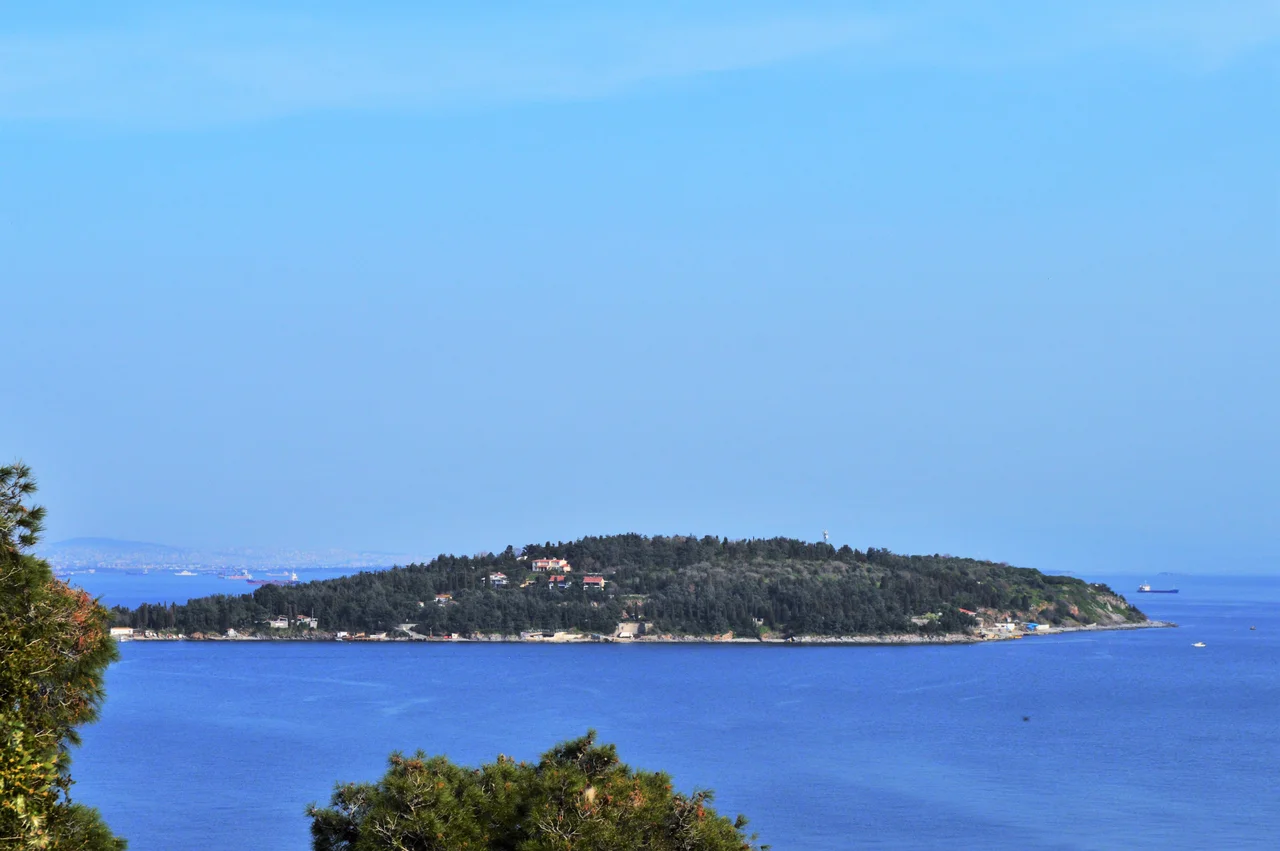

Sedef Island
Its Turkish name means Mother-of-Pearl Island — Sedef Adası — though the Greeks who named it first called it Terebinthos, for the turpentine trees that once covered its slopes. Both names are acts of translation: of an island small enough to walk across in an afternoon, tucked just east of Büyükada, at the far end of the Princes' Islands chain. Sedef is one of the few inhabited islands of the archipelago that remains mostly private property, and the care that has shaped it shows in the pine forests and the quiet.
The Patriarch Who Was Imprisoned Here
In 857 AD, Patriarch Ignatios of Constantinople was sent into exile on this island — then barely a dot in the Marmara, its slopes fragrant with terebinth. He remained imprisoned on Sedef for ten years. The circumstances were political: Ignatios had been deposed as Patriarch in a dispute that involved the Byzantine court and ultimately led to what became known as the Photian Schism, one of the early fractures between Eastern and Western Christianity. In 867 AD, with the political winds having shifted, Ignatios was reinstated as Patriarch. He returned to Constantinople after a decade on this island, a small and obscure place that had nonetheless held one of the most important religious figures in the Byzantine world. The island does not make much of this history today; there is no marker, no monument. The terebinth trees are mostly gone.
A Name Written in Resin
The Greek name Terebinthos refers to the terebinth tree — Pistacia terebinthus — once common across the Mediterranean and valued for the turpentine resin it produces. The presence of the word in the island's ancient name suggests these trees once covered Sedef's slopes in sufficient numbers to define the place. They no longer do. The current forest is largely pine, planted deliberately by Şehsuvar Menemencioğlu, who purchased the island in 1956 and made the reforestation of its hillsides one of his priorities. The transformation from turpentine to pine is a small ecological story about human intervention in island landscapes — not always for the worse. The pines that shade Sedef's paths today are a decision, not an inevitability.
A Strict Code and a Protected Character
At 0.157 square kilometers, Sedef is one of the smallest islands in the archipelago, barely a tenth the size of Büyükada. Most of it is privately owned. What makes Sedef unusual is not just its size but the building code that governs it: houses may not exceed two floors. This rule, shaped in part by the efforts of Şehsuvar Menemencioğlu after he acquired the island, has kept Sedef from the incremental densification that has altered other small islands across the Mediterranean. The combination of private ownership, planted forests, and a strict height limit has given the island an unusual coherence — what you see from the Büyükada ferry dock looking east is essentially what was intended: a wooded, low-built island that sits quietly in the water, neither developed nor abandoned.
On the Edge of the Archipelago
Sedef sits east of Büyükada, the last significant landmass before the Sea of Marmara opens toward the Asian shore. Wikivoyage notes that Sedef and Yassıada are mostly private property with limited public access, distinguishing them from the four major islands that ferry services regularly connect. Most visitors see Sedef from the water — a wooded profile against the Marmara sky — rather than from its shores. The island is officially classified as a neighborhood in the Adalar district of Istanbul Province, the same administrative category as its larger neighbors, though its character is closer to a private estate than a neighborhood in any conventional sense. It exists at the archipelago's edge, the last pearl in a chain strung between the city and the open sea.
From the Air
Sedef Island is located at approximately 40.85°N, 29.1444°E, positioned east of Büyükada in the Sea of Marmara and visible as a small, densely wooded landmass from the air. At 1,500 feet, its compact profile and forested character distinguish it from the larger, more developed Büyükada immediately to the west. The nearest airport is LTFJ (Sabiha Gökçen International), approximately 20 km to the north-northeast on the Asian mainland; LTFM (Istanbul Airport) lies around 55 km to the northwest. The island marks the southeastern extent of the Princes' Islands chain.
Nearby Stories
- Second Battle of Çatalca 1.5 km away
- Tarabya 4.1 km away
- Şile 7.9 km away
- Hereke Carpet 12 km away
- Battle of Melantias 19 km away
- Bursa 47 km away
- Bandırma 51 km away
- 2025 Kartalkaya Hotel Fire 192 km away