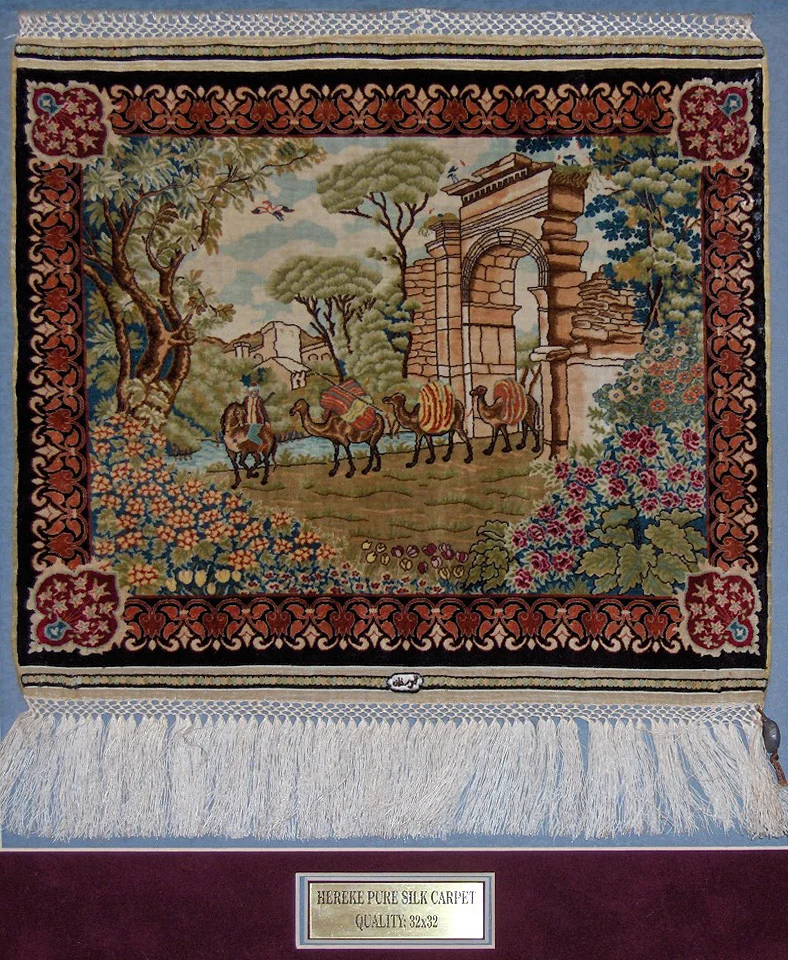

Hereke Carpet
When Sultan Abdülmecid I built Dolmabahçe Palace on the Bosphorus in the 1840s, he decided that the greatest palace then being built should also display the greatest carpets in the world. He founded the Hereke Imperial Manufacture in 1841 and gathered the finest weavers of the Ottoman Empire at a small coastal town 60 kilometers east of Istanbul. What emerged from those looms — massive, intricately knotted carpets in silk and wool, with patterns drawn from Ottoman court tradition and adorned with the best available dyes — became known as Hereke carpets: the standard by which Ottoman luxury textile production would be measured for the rest of the empire's existence, and well beyond.
Born in a Palace's Shadow
The Hereke Imperial Manufacture was not simply a workshop — it was an ambition made physical. Sultan Abdülmecid I wanted his new palace to contain carpets that no European royal residence could match, and so he assembled the best artists and carpet weavers from across the empire. The factory produced not only carpets but silk fabric, upholstery, and curtains for the Ottoman court, all to specifications that required exceptional precision.
Over 140 large carpets and 115 prayer rugs were made for Dolmabahçe alone — more than 48,000 square feet of handwoven textile. A separate workshop was established on the palace grounds in Istanbul and staffed by Hereke weavers. The largest carpet produced for the palace's Ambassador's Hall covers approximately 120 square meters, making it among the largest handwoven carpets ever made. Once the palace commission was complete, Hereke's output became the preferred diplomatic gift of the Ottoman sultans: carpets presented to visiting royalty, heads of state, and select foreign dignitaries. It was not until 1890 that any Hereke pieces were made available for commercial sale in Istanbul.
The Mathematics of the Knot
What distinguishes a Hereke carpet technically is density. Wool-on-cotton carpets are woven at 3,600 knots per square decimeter — a quality grading called 60x60. Silk-on-silk carpets reach 10,000 knots per square decimeter, graded 100x100, which translates to over one million knots per square meter. Each knot is a Turkish knot, also called a Gördes or Ghiordes knot: a symmetrical double knot that wraps completely around two warp threads, making it more secure and durable than the asymmetrical single knot used in Persian rugs. Double knots, once tied, cannot be undone or removed without cutting.
The pile heights are correspondingly precise: 1.5 to 2.0 millimeters for silk carpets, 4.0 to 5.0 millimeters for wool. The fineness of the silk weave is what produces the carpet's almost photographic pattern clarity — the kind of detail that allows a floral design to render individual petals with crisp edges. Hereke carpets are geographically registered with patents, meaning only carpets genuinely produced in Hereke under the traditional method may carry the name.
Patterns Across Three Traditions
The designs that Hereke weavers developed drew from multiple sources without being dominated by any one of them. Ottoman court patterns formed the foundation — floral medallions, arabesques, and the elaborate curvilinear vocabulary of Istanbul's imperial decorative arts. Influences from Persian carpet-making traditions and Mameluke Egyptian designs were incorporated as the factory's ambitions expanded. The Usak medallion composition, a Turkish carpet tradition dating to the 16th century, was widely used. Some designs reflected Western European tastes, as the Ottoman Empire of the mid-19th century was engaged in the broader cultural exchange known as the Tanzimat reform era.
The most recognized classic pattern is known as the Flower of Seven Mountains. Other traditional patterns include the burucie and the polonez. Today, Hereke carpets are still produced using both the original Abdülmecid-era patterns and contemporary figurative designs. The connection to those first commissions for Dolmabahçe has been maintained as a deliberate continuity — a lineage of craft that the weavers themselves understand as the defining characteristic of their work.
After the Empire
The Hereke factory burned to the ground in 1878 and was rebuilt in 1882 — a disruption, but not a termination. During the late 19th and early 20th centuries, Hereke carpets were presented as gifts to the royal families of Japan, Russia, Germany, and England, and won prizes at international exhibitions: Vienna (1892), Lyon (1894), Bursa (1907), Brussels (1910 and 1911), Turin (1911), and Izmir (1921). The factory's reputation for outstanding quality was, by then, internationally established.
With the end of the Ottoman Empire and the establishment of the Turkish Republic, Hereke production contracted. Production was restricted for several decades, until master weavers began reviving the tradition in the middle of the 20th century. By 1920 the town had also been home to a state-run carpet-making school attended by both Muslim and Christian women and children. The craft survived. Today, Hereke carpets remain among the most sought-after handmade textiles in the world — not as relics of an empire, but as the continuation of a discipline that demands years of training and exceptional skill from every weaver who practices it.
From the Air
Hereke is located on the northern shore of the Gulf of İzmit (Izmit Bay) at approximately 40.783°N, 29.615°E, roughly 60 km east of Istanbul along the Marmara coast. From the air, the Gulf of İzmit is a distinctive long inlet running east-west; Hereke sits near its western entrance on the north shore. Nearest major airport: LTFJ (Sabiha Gökçen International), approximately 40 km to the west on the Asian shore of Istanbul. Cengiz Topel Airport (LTBQ) is closer, roughly 50 km east at Izmit. The E-5 coastal highway and rail line connecting Istanbul to Izmit run through Hereke and are visible from the air.
Nearby Stories
- Sedef Island 3.6 km away
- Yoros Castle 8.8 km away
- Şile 9.4 km away
- Kefken Island 9.5 km away
- Sangarius Bridge 19 km away
- Bursa 47 km away
- Green Mosque of Bursa 71 km away
- 2025 Kartalkaya Hotel Fire 133 km away