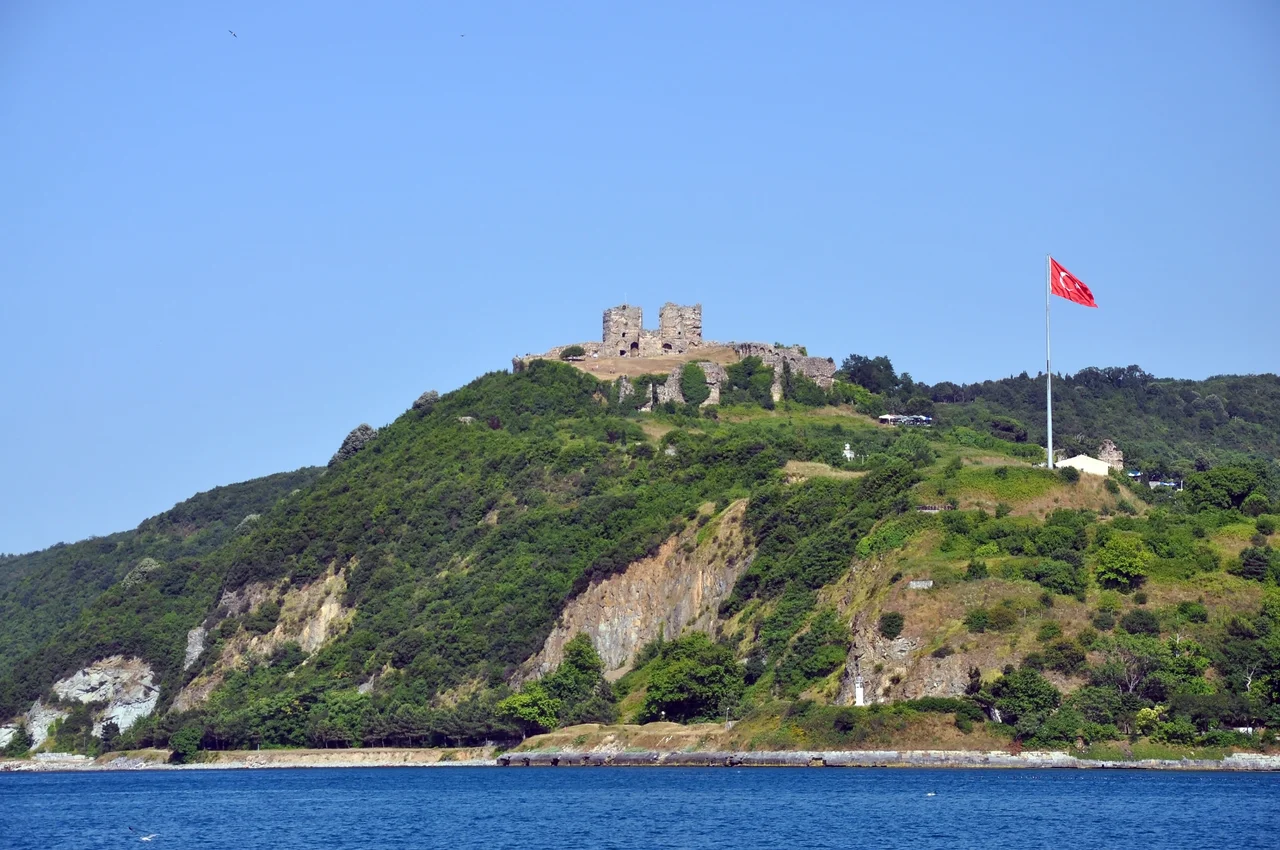

Yoros Castle
Where the Bosphorus finally surrenders to the Black Sea, a ruined castle stands on a limestone hill and watches both at once. The Greeks who settled here centuries before Christ called it Hieron — Sacred Place — and built temples to Zeus Ourios, the granter of fair winds, because every ship that had survived the Black Sea needed a god to thank. That instinct was correct. The strait below is narrow enough to chain shut, and whoever held this hill controlled the passage between two seas. Yoros Castle, known today also as the Genoese Castle, is what twenty-five centuries of that strategic arithmetic looks like in stone.
A Place the Gods Noticed First
Long before there was a castle here, there was a sanctuary. Phoenician traders and then Greek colonists recognized the promontory above the Bosphorus-Black Sea confluence as a place of power, and the archaeological record agrees: remains of temples have been uncovered on the site, including shrines dedicated to Zeus Ourios and the Altar of the Twelve Gods. Sailors emerging from the Black Sea's unpredictable waters had reason to give thanks, and Hieron provided the altar.
The hill sits at one of the narrowest points of the Bosphorus, with the European shore — Rumeli Kavağı — close enough across the water that a heavy chain could be stretched between the two sides to bar enemy warships. The Byzantine emperors of the Palaiologos dynasty understood this geometry and strongly fortified both shores during their empire's final, embattled centuries. The hill didn't just offer a view. It offered control.
Three Empires, One Fortress
The castle changed hands with the exhausting frequency of a frontier post that everyone wanted but no one could hold for long. Ottoman forces first captured it in 1305, but the Byzantines reclaimed it. Sultan Bayezid I seized it again in 1391 as a staging point for his siege of Constantinople, using the site as a base while construction began on Anadolu Hisarı downstream. The Byzantines attempted to retake Yoros in 1399 — the attack failed, and the village of Anadolu Kavağı below was burned in the process. The Ottomans then held the fortress until 1414, when the Genoese took possession for forty years. That occupation is why locals still call it the Genoese Castle.
After Sultan Mehmed II conquered Constantinople in 1453, a Genoese presence at the throat of the Bosphorus became strategically intolerable. Within a few years they were expelled. Mehmed refortified the walls, installed a customs office, a quarantine station, and a garrison — turning a contested military prize into a functioning gateway. Sultan Bayezid II added a mosque inside the walls. Later, Murad IV refortified the site in 1624 against a threat of a very different kind: a fleet of 150 Cossack raiding boats that had sailed across the Black Sea to attack Bosphorus villages.
What the Walls Still Say
The castle declined after its final Ottoman refortification under Abdülhamid I in 1783, and by the time the Turkish Republic was declared in 1923 it had been abandoned for generations. What remains is a ruin, but not an empty one. The citadel walls still stand in places, and carved into them are Greek inscriptions alongside the heraldic symbol of the Palaiologos family — the last Byzantine dynasty, whose double-headed eagle marked their empire's final generation. Those marks in the limestone are among the most tangible traces of Byzantium's end anywhere in the region.
The village of Anadolu Kavağı below the castle has become the last ferry stop on the Asian side of the Bosphorus, famous for its fish restaurants and the climb to the ruins. From 2018 to 2021 the site was closed for excavations; it has since reopened to visitors, though the military zone that surrounds the hill remains off-limits. The Yavuz Sultan Selim Bridge — the third Bosphorus crossing — has been visible from the walls since 2016, a modern span across the same chokepoint the ancient Greeks thought worthy of the gods.
The View That Made History
Stand at the walls on a clear day and the geography explains everything. To the south, the Bosphorus runs toward Istanbul, its surface busy with tankers and ferries. To the north, the Black Sea opens, wide and grey-green and without shores visible. The confluence below is not dramatic — no waterfall, no visible boundary — but the shift in color between the two bodies of water is real, a meeting of currents that has capsized ships and decided battles.
The chain the Palaiologos emperors could have stretched across this narrows was never used to save Constantinople — the city fell in 1453 anyway, from a different direction, after a different chain across the Golden Horn was overcome. But Yoros Castle remained, cycling through rulers as the centuries passed, until it became what it is now: a ruin with an extraordinary resume, and a view that has mattered to every civilization that ever looked at a map of the Black Sea passage.
From the Air
Yoros Castle sits at 41.179°N, 29.094°E on the Asian shore at the northern mouth of the Bosphorus where it opens into the Black Sea. Approaching from the south at 3,000–5,000 feet, the fortress is visible on its promontory above the fishing village of Anadolu Kavağı. The confluence of the Bosphorus and the Black Sea is directly north of the castle — look for the subtle color shift in the water. The Yavuz Sultan Selim Bridge (Third Bosphorus Bridge) is visible to the south. Nearest major airport: LTFJ (Sabiha Gökçen International), approximately 35 km to the south on the Asian shore. Winds can be funneled and gusty through the Bosphorus narrows.
Nearby Stories
- Kınalıada 6.2 km away
- Şile Castle 7.8 km away
- Second Battle of Çatalca 8.9 km away
- Hereke 20 km away
- 2025 Istanbul Earthquake 25 km away
- Battle of Constantinople (922) 61 km away
- Januarius MacGahan 87 km away
- Edirne 160 km away