,_K%C4%B1nal%C4%B1ada,_Hafen_--_2024_--_0452.jpg)
Kınalıada
The soil here runs red. Iron and copper deposits streak Kınalıada's hills in shades of ochre and rust, which is how the island got its Turkish name: Henna Island. The Greeks who once lived here called it Proti — 'First' — because it was the first island you reached sailing out from Constantinople. First to arrive, first to receive the empire's unwanted: for centuries, Kınalıada served as the Byzantines' preferred address for emperors they wished to forget.
The Island of First Arrivals
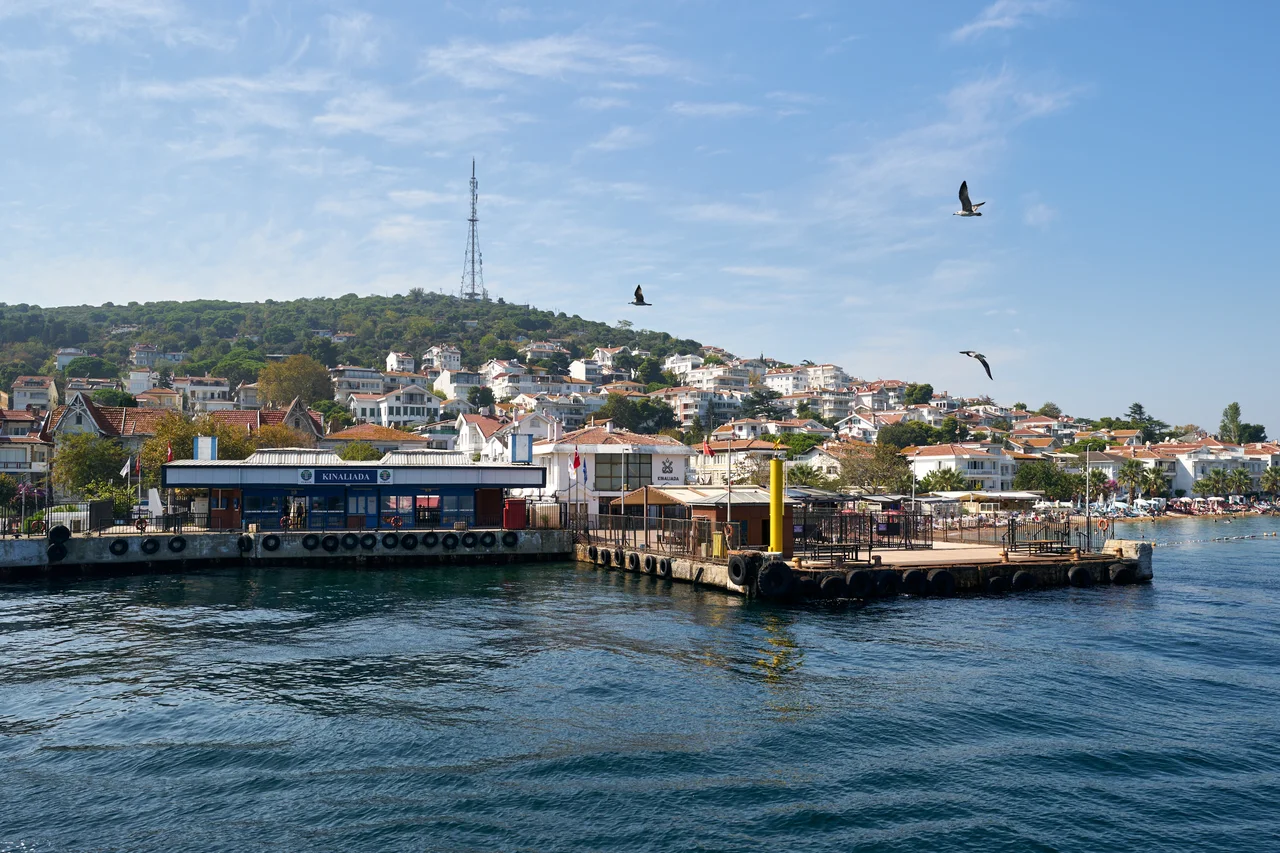
Lying just 12 kilometers from the Asian shore of Istanbul, Kınalıada is the closest of the Princes' Islands to the mainland. Most ferries stop here first before continuing down the chain to Burgazada, Heybeliada, and finally Büyükada. The island's population stands at around 2,025 people (2022 census), making it the fourth largest of the inhabited islands — small, but not empty. Three hills define its modest topography: Çınar Tepesi (Plane Tree Hill, 115 meters), Teşrifiye Tepesi (Visiting Hill, 110 meters), and Manastır Tepesi (Monastery Hill, 93 meters). Unlike the pine-forested islands further down the chain, Kınalıada is one of the least forested of the group, its reddish, mineral-rich slopes giving it an austere, sun-warmed character.
A Convenient Destination for Inconvenient Emperors
Byzantine emperors facing forced retirement had limited options, and Kınalıada received more than its share of them. Emperor Romanos IV Diogenes — defeated at the catastrophic Battle of Manzikert in 1071, blinded as a political measure, and stripped of his throne — spent the remainder of his days at the Monastery of the Transfiguration on Hristo Peak. The monastery predates him; it is believed that Emperor Leo V the Armenian was among the first notable figures buried in what would become the monastery's grounds after his own exile to the Prince Islands. Emperor Tiberius III, another deposed ruler, was buried on this island. Kınalıada, the article notes, was the island most commonly used as a place of exile under the Byzantine Empire — a distinction that says something about the value Constantinople placed on visible proximity as a form of punishment.
An Armenian Summer and a Modernist Mosque
By the 19th century, regular ferry service transformed the islands from places of exile into desirable retreats, and Kınalıada became particularly associated with Istanbul's Armenian community. Each summer, Armenian families from the city made the crossing to their island houses, establishing the kind of seasonal community that gave the island its distinct cultural flavor. That community has dwindled significantly since the mid-20th century, as pressures on Istanbul's minorities reshaped the city and its outlying islands alike. What remains is a cultural memory embedded in the architecture and the rhythms of island life. At the waterfront, one unexpected landmark stands apart: the Kınalıada Mosque, designed in 1964 by Başar Acarlı and Turhan Ayuroğlu to evoke the shape of a yacht — a rare modernist statement among the islands' largely 19th-century wooden streetscapes.
Notable Residents Across the Centuries
Two figures from very different eras claim notable connections to Kınalıada. Empress Irene (c. 752–803), one of the most consequential rulers of the Byzantine Empire, is associated with the island — a ruler who, unusually for her era, governed in her own name and convened the Second Council of Nicaea. Mesrob II Mutafyan (1956–2019), who served as Armenian Patriarch of Constantinople, is another notable resident, his life spanning the island's recent demographic changes and the continuing presence of the Armenian community in Istanbul. Between these two figures — separated by more than a millennium — lies the full arc of the island's story: imperial power, religious authority, community, and change.
From the Air
Kınalıada is located at approximately 40.91°N, 29.05°E, the westernmost and closest of the major Princes' Islands to the Istanbul shore. At 1,500 feet, the island's three hills and reddish mineral slopes are clearly distinguishable from the greener, more forested islands to the southeast. Manastır Bay on the northern side of the island is a visible landmark. The nearest airport is LTFJ (Sabiha Gökçen International), approximately 18 km to the northeast; LTFM (Istanbul Airport) lies around 45 km to the northwest.
Nearby Stories
- Second Battle of Çatalca 1.5 km away
- Tarabya 4.1 km away
- Şile 7.9 km away
- Hereke Carpet 12 km away
- Battle of Melantias 19 km away
- Bursa 47 km away
- Bandırma 51 km away
- 2025 Kartalkaya Hotel Fire 192 km away