_01.jpg)
Hereke
The town of Hereke sits on the northern edge of the Gulf of İzmit, 60 kilometers east of Istanbul, where the Marmara coast curves into the long bay that reaches toward Izmit. It is not a large place. Most travelers pass through on the coastal highway or the Adapazarı Express train without stopping. But in the world of handmade carpets, the name Hereke carries the same weight that a grand appellation carries in wine — a geographic designation that promises a specific quality, a specific tradition, a specific kind of human labor. The town earned that name in 1843, when an Ottoman sultan decided to build the finest textile factory in his empire here, and set weavers to work.
The Sultan's Decision
Sultan Abdülmecid I established the Hereke Imperial Factory in 1843, and his purpose was specific: to furnish the Ottoman court with textiles — carpets, fabrics, upholstery, curtains — that would be unrivaled in quality anywhere in the world. The timing was deliberate. The sultan was simultaneously overseeing the construction of Dolmabahçe Palace on the Bosphorus, his intended replacement for the medieval Topkapı as the center of Ottoman power. He wanted a palace worthy of the nineteenth century, and he wanted carpets worthy of that palace.
Weavers from across the empire were gathered at Hereke. A second workshop was established on the Dolmabahçe grounds, staffed with Hereke craftspeople. The resulting output — over 140 large carpets and 115 prayer rugs totaling more than 48,000 square feet — furnished a palace that remains one of the largest in the world. From the start, Hereke was defined not by local tradition but by imperial aspiration.
A Factory, Then a School
The Hereke factory's history included setbacks. In 1878 it burned to the ground; it was rebuilt in 1882 and resumed production. During the late nineteenth and early twentieth centuries, the factory's carpets were distributed as diplomatic gifts of the highest order — presented to the royal families of Japan, Russia, Germany, and England — and won international prizes at exhibitions in Vienna, Lyon, Bursa, Brussels, Turin, and Izmir.
By 1920, Hereke also housed a state-run carpet-making school where both Muslim and Christian women and children learned the craft. That detail matters: weaving at Hereke was not solely the work of a professional class but was woven into the life of the wider community. With the collapse of the Ottoman Empire and the founding of the Turkish Republic, production contracted, and Hereke's imperial output ceased. But master weavers preserved the techniques, and by the mid-twentieth century the tradition had revived.
One Million Knots per Square Meter
What makes a Hereke carpet a Hereke carpet is, in the end, a matter of knots. The Turkish knot — called the Gördes or Ghiordes knot, a double knot that wraps symmetrically around two warp threads — is more durable than the single knot used in Persian rugs. Silk-on-silk Hereke carpets contain over one million knots per square meter. Wool-on-cotton carpets are woven at 3,600 knots per square decimeter. The pile of a silk carpet is cut to between 1.5 and 2.0 millimeters — thin enough that the weave almost functions as a textile painting.
The Hereke method also involves a distinctive loom preparation and allows for a second weft, a structural difference that further separates Hereke carpets from other traditions. Because the knots are double and cannot be removed without cutting, a finished Hereke carpet is essentially a permanent object. Hereke carpets are geographically registered with patents — the name is protected, and only pieces genuinely made in Hereke under the traditional method may carry it.
The Town That Carries the Name
Modern Hereke is a neighborhood within the Körfez district of Kocaeli province — absorbed into the larger municipality in 2008, having previously been an independent municipality, and before that attached to Gebze district until 1987. Its mahalles include neighborhoods named 17 Ağustos (August 17), Cumhuriyet, and Yukarı Hereke. Minibuses run from Gebze and Izmit; the coastal highway passes through; the Adapazarı Express connects it by rail to Istanbul.
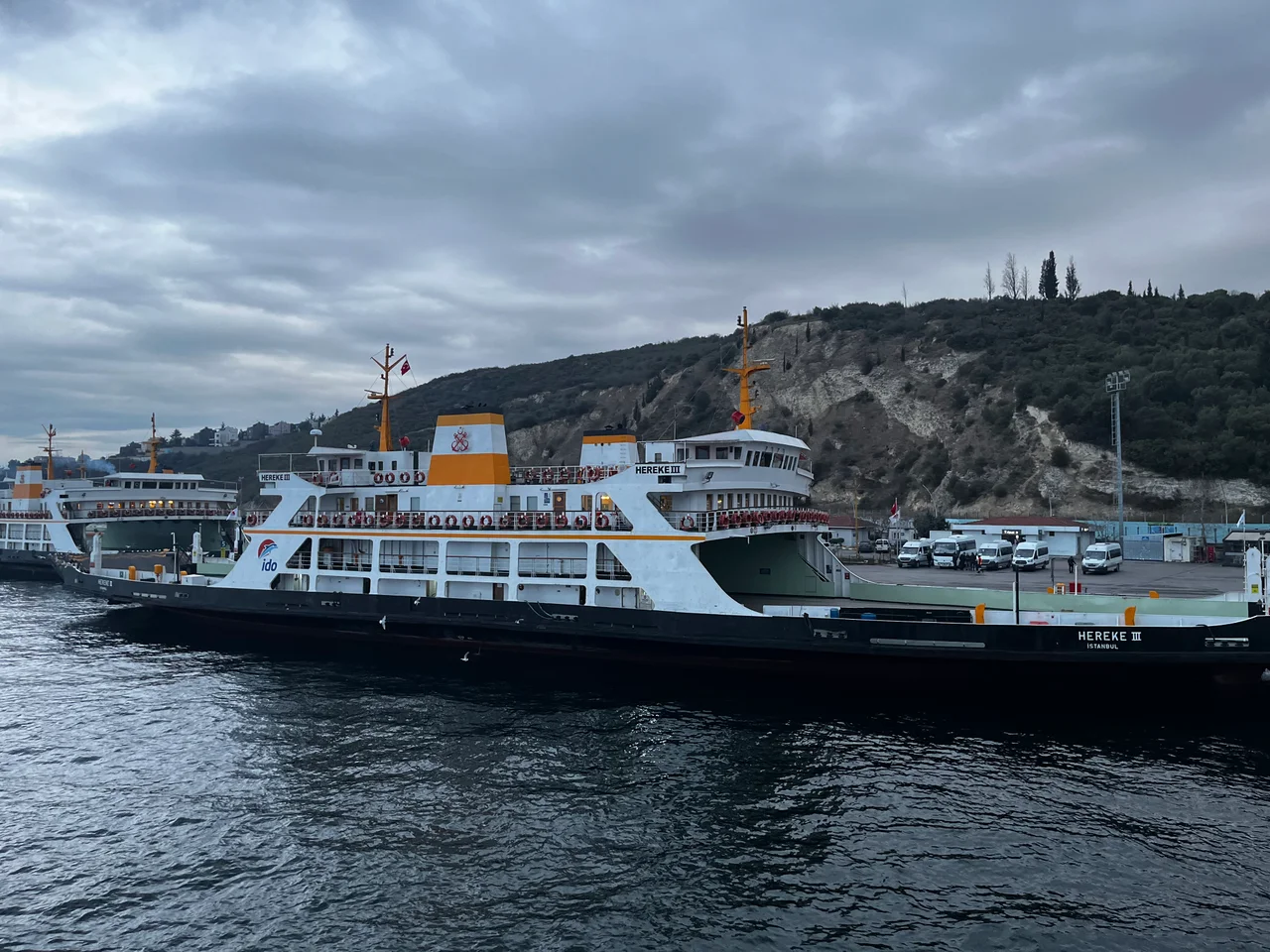
What distinguishes Hereke from other small Marmara coast towns is its persistent identity as a place of craft. The factory that defined it for nearly two centuries has marked the town's character in ways that administrative reorganizations have not erased. Visitors come for the carpets — to see them made, to understand what 10,000 knots per square decimeter looks like when it is spread across a workshop floor. The Gulf of İzmit gleams below, the same water that Ottoman barge traffic crossed to deliver silk and dye to the imperial workshops, and the same water that ferries and sea buses still cross today.
From the Air
Hereke is located at approximately 40.791°N, 29.631°E on the northern shore of the Gulf of İzmit (Izmit Bay), Kocaeli province, Turkey. From the air, the Gulf of İzmit is immediately recognizable as a long, narrow inlet running east into Anatolia from the Sea of Marmara. Hereke sits near the inlet's western entrance. The E-5 coastal highway and rail line are both visible running through the town. Nearest major airport: LTFJ (Sabiha Gökçen International), approximately 40 km west on the Asian shore of Istanbul. Cengiz Topel Airport (LTBQ) is located approximately 50 km east near Izmit. The Osmangazi Bridge spanning the Gulf of İzmit is visible to the west.
Nearby Stories
- Sedef Island 3.6 km away
- Yoros Castle 8.8 km away
- Şile 9.4 km away
- Kefken Island 9.5 km away
- Sangarius Bridge 19 km away
- Bursa 47 km away
- Green Mosque of Bursa 71 km away
- 2025 Kartalkaya Hotel Fire 133 km away