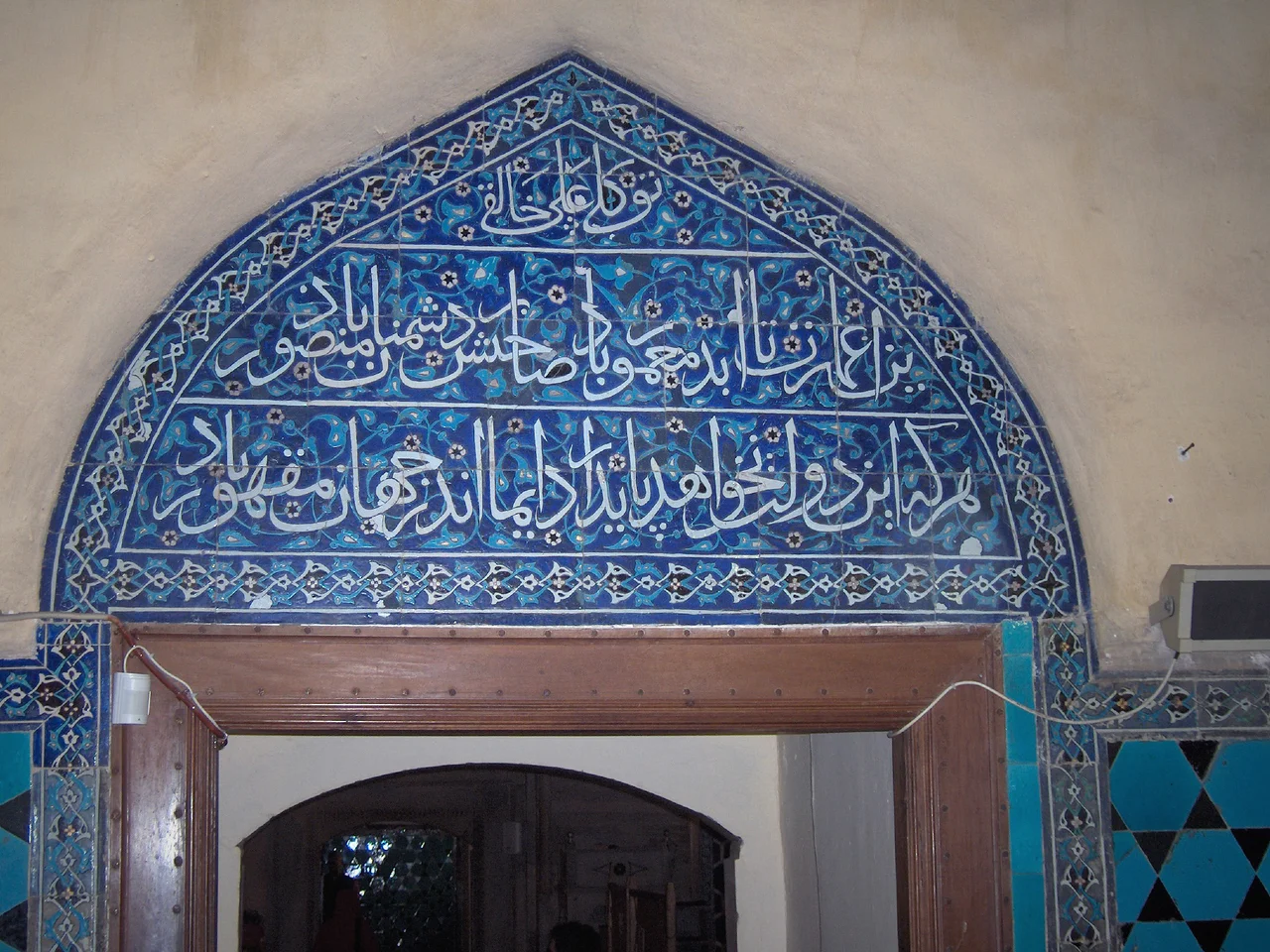

Green Mosque of Bursa
Above the mihrab, picked out in Persian calligraphy that anyone literate in 15th-century Istanbul or Tabriz could read, runs a phrase that explains why the Green Mosque feels different from anything that came before it: amal-i ustadhan-i Tabriz, work of the masters of Tabriz. Sultan Mehmed I had just finished reuniting an Ottoman Empire that had fractured after his father Bayezid I lost a battle to Tamerlane. To consecrate the recovery, he commissioned a mosque on the eastern hills of Bursa and brought tile-makers from Persia to face it in green and turquoise and ochre. The result, finished in late December 1419 or early January 1420, is one of the most beautiful interiors in Ottoman architecture, and the moment a young dynasty stopped imitating its neighbors and began composing in its own voice.
A Sultan's Reconstruction Project
Mehmed I Celebi inherited not an empire but the wreckage of one. After Bayezid I's catastrophic defeat at Ankara in 1402, Tamerlane carried the Ottoman sultan back to Samarkand in a litter and let Bayezid's four sons fight each other for what remained. Mehmed won the civil war by 1413, and from then until his death in 1421 he set about restitching the realm. The Green Mosque was part of that project. Construction began in 1412 in the eastern foothills of Bursa, the original Ottoman capital before the conquest of Constantinople in 1453. The vizier Haci Ivaz Pasha, a battlefield commander turned patron of the arts, supervised the build. The 15th-century historian Asikpasazade noted that Ivaz Pasha brought masters and men of skill from foreign lands to help. The Persian, Anatolian, and Timurid hands that worked here left their fingerprints in tilework that no purely Ottoman workshop would have produced.
The Inverted T
Step inside and the geometry surprises you. The Green Mosque is built on what scholars call an inverted T-plan, a two-story cube with an extension on its qibla side that creates the cross-shaped layout of central hall flanked by domed iwans on east and west. The vestibule opens up a short staircase to the prayer hall, with marble cubby-holes on each side for slippers, a sign that the floor was once paved. Now it is carpeted. A marble fountain sits in an octagonal pool in the central hall. Light filters down through windows on the qibla wall. Wide corridors framed by reused Byzantine columns, hauled from somewhere and given a new life, run to the corner rooms where small fireplaces wait for winter. Stairs spiral up to the lofts, including the royal box where the sultan could pray separately from the congregation.
The Masters of Tabriz
What makes the Green Mosque green is the tile. Black-line technique, monochrome underglaze, mosaic, painted terra-cotta relief: scholar Patricia Blessing has documented the unusual variety of methods used in the same building. The colors run from emerald and turquoise to white, yellow, and two distinct purples. Hexagonal wainscot tiles in dark green, overlaid with gold, cover the lower walls. The mihrab niche, twelve rows of muqarnas crowned with two ribbed columns, glitters with intricate patterning. Above it, the inscription crediting the masters of Tabriz appears alongside a couplet from the Persian poet Sa'di. The black-line technique recalls earlier Seljuk work seen in places like the Karatay Madrasa in Konya, but the synthesis at Bursa is something new. Patterns associated with Timurid ceramics from Central Asia mingle with Anatolian Seljuk traditions and emerging Ottoman taste.
The Green Tomb
When Mehmed I died in 1421, his son and successor Murad II commissioned the Green Tomb, the Yesil Turbe, on the same complex. The mausoleum sits across from the mosque, faced with the same brilliant turquoise tiles that give the kulliye its name. Inside, beneath an octagonal cenotaph, lie Mehmed I and members of his family: his sons Mustafa, Mahmud, and Yusuf, several women of his household, and his nanny. The hammam and the imaret, the bathhouse and the public kitchen that once completed the kulliye, survive only in fragments. The mausoleum now houses the Bursa Museum of Turkish and Islamic Art.
Earthquake and Restoration
On 28 February 1855, a 7.5 magnitude earthquake struck Bursa and damaged the Green Mosque badly. The Ottoman government turned to a French architect named Leon Parvillee, who had been working in Istanbul since 1855 as a decorator and contractor with deep interest in early Ottoman style. Parvillee directed the restoration that began in 1863, repairing both the structure and the tilework. His sense of how Ottoman architecture should be presented to itself, drawn from years of study, would later influence how 19th-century Ottoman officials thought about their own architectural heritage. UNESCO inscribed historic Bursa, including the Green Mosque, on its World Heritage List in 2014, recognizing the city as the cradle of an empire that lasted 600 years and stretched from Vienna to Yemen. The mosque is open to visitors today and remains an active place of prayer.
From the Air
Located at 40.182 degrees north, 29.075 degrees east, in the eastern Yildirim district of Bursa, Turkey. The complex sits on the lower slopes of Mount Uludag, the Bithynian Olympus that rises to 2,543 meters south of the city. Bursa's main commercial airport is Yenisehir (LTBR), 50 kilometers east; Istanbul's Sabiha Gokcen (LTFJ) is 95 kilometers north across the Sea of Marmara. From the air Bursa appears as a long city draped along the northern foot of Uludag, with the green tile of the mosque catching afternoon sunlight against the city's predominantly red-tiled rooftops.
Nearby Stories
- Hellespontine Phrygia 35 km away
- Hereke Carpet 40 km away
- HMAS AE2 43 km away
- Sedef Island 48 km away
- Balıkesir 58 km away
- Hereke 70 km away
- Hadrianotherae 99 km away
- Mevlâna Museum 342 km away