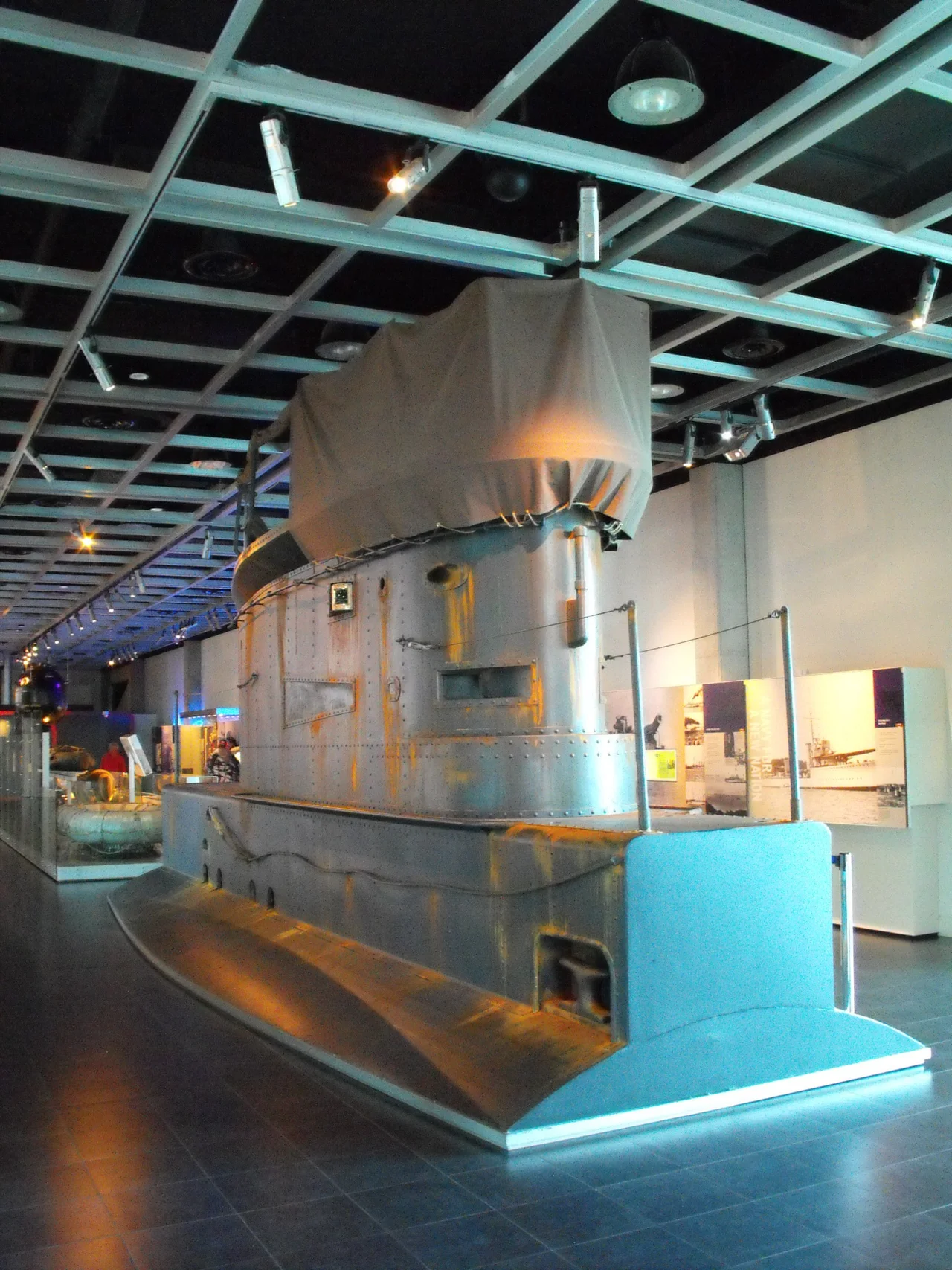

HMAS AE2
The orders given to HMAS AE2 in April 1915 were remarkable for their bluntness: run amok inside Turkish territory. She was an Australian submarine, 181 feet long, commissioned barely a year earlier, and she had spent most of her short service life searching for a war worth fighting. In the Pacific and Indian Ocean theatres, there was no role for submarines. So she was towed to the Mediterranean, and eventually assigned to a campaign that would define a generation of Australians — the Dardanelles.
A Long Road to the Strait
AE2 was one of two submarines ordered by the newly established Royal Australian Navy, built by Vickers Armstrong in England and commissioned in 1914. Together with her sister, AE1, she sailed to Australia — at the time, the longest voyage ever undertaken by a submarine. AE1 disappeared without a trace during operations off New Guinea. AE2 survived the Pacific theatre and was eventually towed to the Mediterranean, arriving at Port Said, Egypt, in January 1915. She joined the British 2nd Submarine Flotilla and began patrol work in support of the Dardanelles Campaign. In March 1915, she ran aground off Mudros when returning from patrol — the harbour lights had been switched off in her absence, without anyone thinking to warn her commander, Lieutenant Commander Henry Stoker. She was towed to Malta for repairs. By April, she was back in service and waiting for her moment.
Through the Narrows
The Dardanelles was not an easy passage for a submerged vessel. Strong currents ran against any southbound approach from the sea, and the shallow, mine-laden strait left little margin for mechanical error. AE2's first attempt, made on 24 April 1915, ended six nautical miles in when the forward hydroplane coupling failed, making the submarine impossible to control below the surface. Stoker pulled her back. The attempt the following day succeeded. AE2 became the first submarine to penetrate the Dardanelles and enter the Sea of Marmara — a significant achievement in a campaign that would otherwise come to be defined by its failures. The crew spent the next five days moving across the Marmara, surfacing in different locations to give the impression of multiple submarines and attempting attacks on Turkish shipping. Mechanical problems, accumulating throughout, prevented those attacks from succeeding.
Scuttled in the Marmara
On 30 April 1915, mechanical faults forced AE2 to the surface. The Turkish torpedo boat *Sultanhisar* engaged her and damaged the hull. With the submarine unable to dive and taking damage, Lieutenant Commander Stoker ordered the crew to abandon ship and scuttle. AE2 went to the bottom in 86 metres of water. All of her crew were captured. They became prisoners of war in the Ottoman Empire, and the years of captivity that followed were hard. AE2 holds a particular place in Australian naval history — she was the only Royal Australian Navy vessel lost to enemy action during the First World War, a distinction that carries the full weight of what that war cost. The Royal Australian Navy refers to her today as the 'Silent ANZAC.'
Resting Place
Selçuk Kolay, director of the Rahmi M. Koç Museum in Istanbul, began searching for the wreck in 1995, and in 1998 located it at 86 metres depth. A 2007 investigation sent a drop camera through the submarine's open hatch and into the control room. By then, additional damage had occurred since the initial discovery; the bow portion of the external hull casing had been destroyed, and the conning tower showed significant deterioration. A 2008 workshop brought together Turkish and Australian experts and recommended against raising the wreck — the cost was estimated at AU$80–100 million, and the structural condition made relocation too risky. The Australian and Turkish governments agreed to leave AE2 where she had settled. Sacrificial anodes have been fitted to slow corrosion, and the site is marked with a buoy. Commemorative bronze plaques have been installed along sites connected to AE2's voyage from Australia to the Dardanelles. The wreck lies where the crew left it, holding its quiet in the Marmara.
From the Air
HMAS AE2 rests on the floor of the Sea of Marmara at approximately 40.67°N, 28.08°E, in 86 metres of water. The site is not visible from the surface or air, but the surrounding sea is open and relatively calm in settled weather. From the air at 5,000–10,000 ft, the full breadth of the Sea of Marmara is visible — the Dardanelles entrance lies approximately 90 km to the southwest, the Bosporus approximately 80 km to the northeast. The nearest airport is Istanbul Airport (LTFM), roughly 65 km to the northwest. Bandırma Airport (LTBG) lies approximately 55 km to the southwest. The wreck site sits in the deeper central basin of the sea, away from the island chains.
Nearby Stories
- Battle of Cyzicus 7.5 km away
- Ganos 9.6 km away
- Kanuni Sultan Suleiman Bridge (Istanbul) 11 km away
- Biga Çayı 12 km away
- 1509 Constantinople Earthquake 30 km away
- Selymbria 30 km away
- Bursa 58 km away
- Uzunköprü Bridge 72 km away