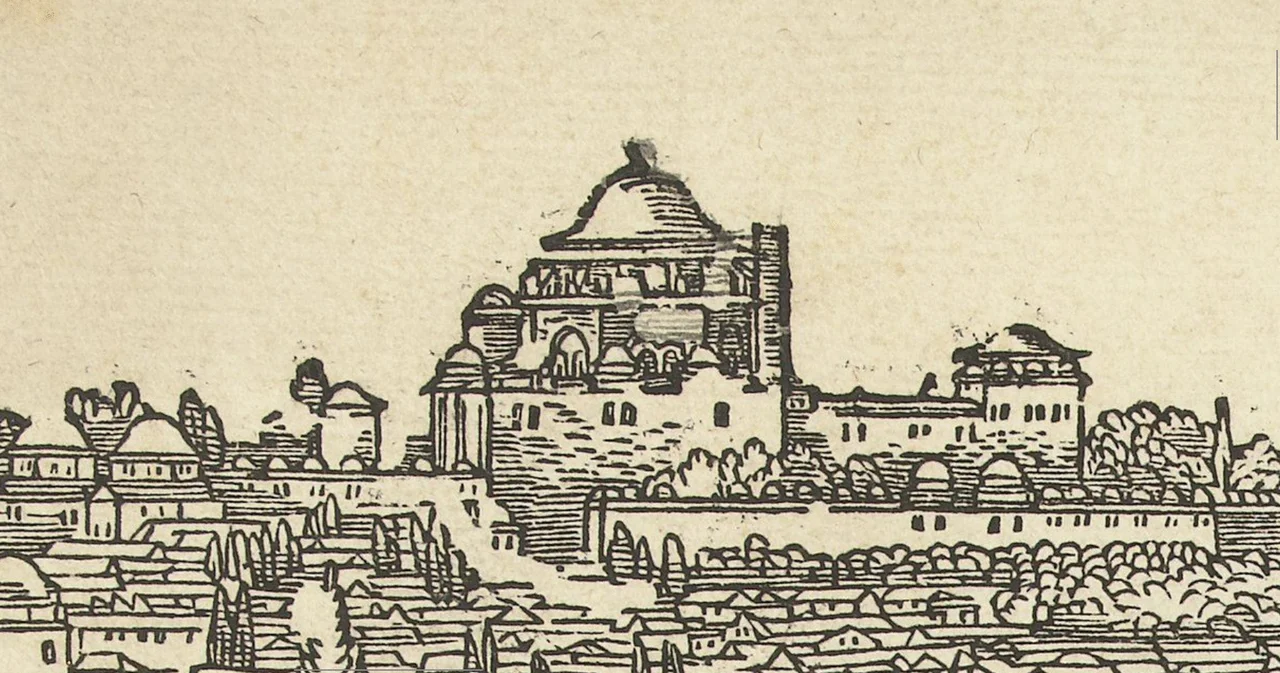

1509 Constantinople Earthquake
Sultan Bayezid II got up to pray. That single act, on the night of 10 September 1509, is the reason he survived - because a few hours later, around ten in the evening, the floor of the Sea of Marmara wrenched sideways along the North Anatolian Fault and the bedchamber he had just left collapsed. Outside the walls of Topkapi Palace, an entire city was learning what its grandchildren would still call Kıyamet-i Suğra - the Lesser Day of Judgment. Constantinople, only fifty-six years into its life as the Ottoman capital, shook for hour after hour, then shook again. The aftershocks lasted forty-five days. Estimates of the dead, written down centuries later by historians sifting fragmentary chronicles, range from one thousand to thirteen thousand - a span wide enough to admit how little anyone really knows.
A City Built on the Fault
The Sea of Marmara is not a bay so much as a wound - a pull-apart basin where the North Anatolian Fault makes a sharp bend just south of Istanbul. The Anatolian plate slides westward against the Eurasian plate at roughly two centimeters a year, and where it cannot slide cleanly, it stores the difference as strain. Every few centuries it lets that strain go. On 10 September 1509 the fault released so violently that residents reported major shocks at half-hour intervals, sustained and protracted, the kind of shaking that shakes the will out of you. Damage was reported as far west as Edirne, the old Ottoman capital, and well east into Izmit. Galata across the Golden Horn suffered. Büyükçekmece on the western suburbs suffered. Inside the walls, people fled into open parks and squares because anything with a roof felt like a coffin.
The Lesser Day of Judgment
By morning, 109 mosques in Constantinople had been utterly destroyed and most of those still standing had lost their minarets. The newly built Bayezid II Mosque - the sultan's own foundation, finished only three years earlier - had its main dome shattered and a minaret toppled. The Fatih Mosque, the imperial mosque atop the city's fourth hill, had four of its great columns broken and a fissure cracked through its dome. Along the Theodosian land walls, the line of fortifications that had held against besiegers for a thousand years before finally falling in 1453, forty-nine towers collapsed or were damaged. The Maiden's Tower out in the Bosphorus shook. The Rumeli Hisari and Anadolu Hisari fortresses on opposite shores - Mehmed II's strangling forts that had choked Byzantine Constantinople before the conquest - both took serious damage. And 1,070 ordinary homes simply came down on top of the families inside them. The Ottoman chronicler who recorded these numbers was counting buildings because the dead were uncountable.
The Sultan in a Tent
Bayezid II spent the next ten days living in a tent in the palace garden. The sea had thrown a tsunami over Galata's docks. The aftershocks would not stop. When he could finally bring himself to leave, he went west - to Edirne, the city the Ottomans had ruled before they had Constantinople, the calmer, older capital where the ground was not still moving. The empire's response was characteristically Ottoman: massive, organized, and fast. Tens of thousands of stonemasons, carpenters, and laborers were marched in from Anatolia in the east and Rumelia in the west. Construction began on 29 March 1510 and was officially declared finished on 1 June - nine weeks of imperial muscle to put a city back together. The work was hasty, and parts of the rebuild collapsed again within a few decades, but the message mattered: the city would not be abandoned, the capital would not move.
What the Monk Said
There is a story, told and retold in later Ottoman histories, that the earthquake had been predicted - by an unnamed Greek monk who had traveled all the way from Saint Catherine's Monastery in the Sinai to warn Bayezid in his court. Whether the monk existed, whether the prediction was real or invented after the fact to give a divine shape to a geological event, no one knows. What we do know is that the fault has not stopped working. The Marmara segment that slipped in 1509 has slipped again, and again - in 1766, in 1894, and as recently as April 2025. Seismologists now estimate a roughly 64% probability of a magnitude-7 or larger earthquake near Istanbul before 2030. The city the Ottomans rebuilt has grown into a metropolis of more than fifteen million people. The fault has not noticed.
From the Air
The 1509 earthquake epicenter is in the Sea of Marmara at roughly 40.90°N, 28.70°E, southwest of modern Istanbul. From the air, the relevant geography is striking: a long inland sea pinched between the bulk of Anatolia to the south and the Thracian peninsula to the north, with the city of Istanbul straddling the Bosphorus at its eastern end. Best viewed at 6,000-15,000 feet on clear days when both shores are visible. Nearest airports are Istanbul Airport (LTFM) and Sabiha Gökçen (LTFJ); Tekirdağ Çorlu (LTBU) lies to the west, and Bursa Yenişehir (LTBR) to the south.
Nearby Stories
- Camp Armen 10 km away
- Second Battle of Çatalca 16 km away
- Sea of Marmara 17 km away
- MV Struma 28 km away
- Kapıdağ Peninsula 28 km away
- Bursa 59 km away
- Uzunköprü Bridge 122 km away
- 2025 Kartalkaya Hotel Fire 222 km away