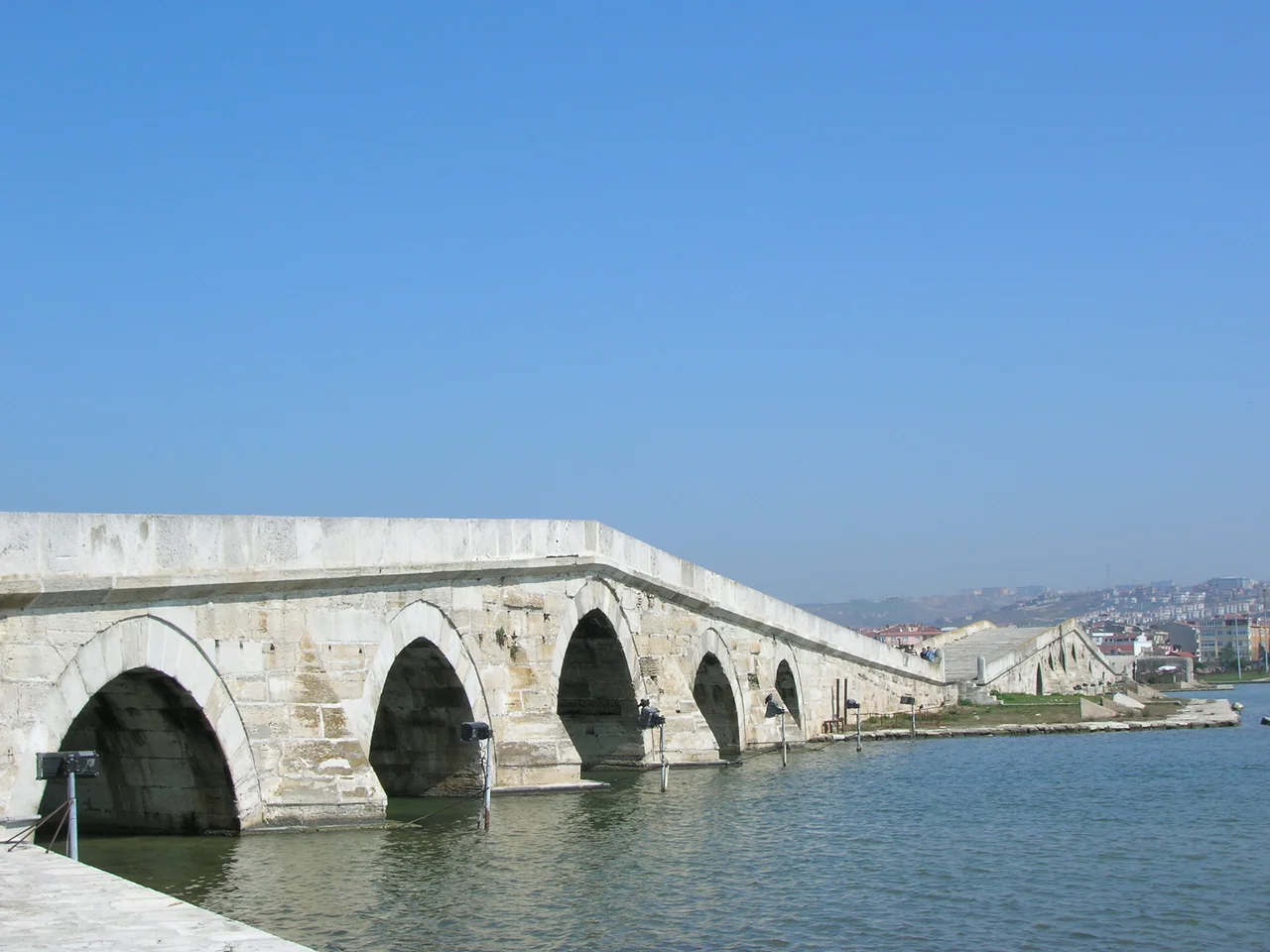

Kanuni Sultan Suleiman Bridge (Istanbul)
Mimar Sinan built this bridge in a single year. That fact alone is worth sitting with — the chief architect of the Ottoman Empire, already in his late seventies and deep into the most productive career in the history of Islamic architecture, was handed a problem: an army needed to cross the broad, shallow mouth of Lake Büyükçekmece, and a rickety earlier crossing kept failing. By 1567 the Kanuni Sultan Suleiman Bridge stood complete, its 28 stone arches marching across the inlet in four sections divided by three natural islets, its grey granite courses fitted so precisely they have required only one major restoration in nearly 460 years. The bridge carries a sultan's name and an architect's genius.
An Army's Crossing, an Architect's Answer
The need was military and urgent. Ottoman campaigns pushing into Europe depended on reliable supply lines across Thrace, and the mouth of Lake Büyükçekmece — a large but shallow inlet on the Marmara coast west of Constantinople — was a chronic bottleneck. Sultan Suleiman the Magnificent had died the previous year, but the empire's momentum continued under Selim II, and the road west had to function. Sinan's solution was elegant in its pragmatism: drain the inlet during construction, set the foundations dry, then let the waters return around a structure built to last. Workers reportedly pumped the water out of the lake to lay the piers — a logistical feat that speaks to the organization behind every Sinan project. The result was a bridge that divided its 28 spans across three shallow islets, so the structure breathed with the water rather than fighting it. Stone arches, not timber planks. Engineering, not improvisation.
Grey Granite on a Thracian Shore
The bridge is not a delicate thing. Its materials — rough-dressed grey granite, laid in courses without ornamental flourish — announce a utilitarian seriousness. Sinan could produce exquisite decoration when patrons wanted it; the Süleymaniye Mosque and the Selimiye in Edirne show what his workshops could achieve in tile and marble. But the Büyükçekmece bridge is a working structure, and it looks like one. Four sections, three islets, twenty-eight arches: the geometry is clear, the masonry dense, the silhouette low against the water. What it communicates is confidence rather than grandeur — the confidence of a builder who knew exactly how much stone was needed and wasted none of it. Standing on the bridge today, you feel the slight rise and fall of each section as it crosses its islet, a rhythm built into the structure that the eye only slowly recognizes.
Five Centuries and One Restoration
The bridge carried the main road west from Istanbul for centuries. Caravans, armies, ambassadors, pilgrims on the way to Mecca — all crossed here before any alternative existed. A modern road bridge was eventually built alongside it on the seaward side, and traffic moved there, but Sinan's bridge survived the transition. Between 1986 and 1989 it was carefully restored at considerable cost, the only major intervention in its nearly 460-year life. That longevity is itself a kind of argument about Ottoman engineering standards. Bridges built hastily or cheaply crumble within generations; this one, built dry in a year and anchored in granite, has outlasted empires. It is now a pedestrian structure, promoted for its symbolic and historic resonances, which is another way of saying it has earned retirement. It still crosses the same water, on the same islets, with the same arches Sinan specified.
Sinan at the End of a Long Career
Mimar Sinan was born around 1488 or 1490 — sources differ — and died in 1588, working until the end. He served three sultans, designed more than 370 structures by some counts, and built the Büyükçekmece bridge when he was approaching eighty. For most architects, a bridge of this scale would be a career highlight. For Sinan it was a commission fitted in between mosque complexes, caravanserais, and aqueducts. He is buried in a tomb he designed for himself, beside the Süleymaniye Mosque in Istanbul, under an epitaph that calls him the architect of the world. The Büyükçekmece bridge is modest by his standards, and it is still standing, which is perhaps the quietest form of boast available to a builder.
From the Air
The Kanuni Sultan Suleiman Bridge sits at approximately 41.022°N, 28.571°E, at the mouth of Lake Büyükçekmece on Istanbul's European shore along the Marmara Sea. From the air at 2,000–4,000 feet, the bridge's four-section stone span is clearly visible crossing the inlet, with the lake opening northward and the modern road bridge running parallel to the seaward side. Nearest major airport is LTFM (Istanbul Airport), approximately 18 km to the northeast. The former Istanbul Atatürk Airport (LTBA) lies about 13 km to the east at Yeşilköy. Best viewed in morning light when the sun illuminates the stone from the east.
Nearby Stories
- Istanbul Canal 5 km away
- Polonezköy 8.1 km away
- MV Struma 8.9 km away
- Sea of Marmara 11 km away
- HMAS AE2 42 km away
- Bandırma 75 km away
- Sangarius Bridge 101 km away
- Edirne 135 km away