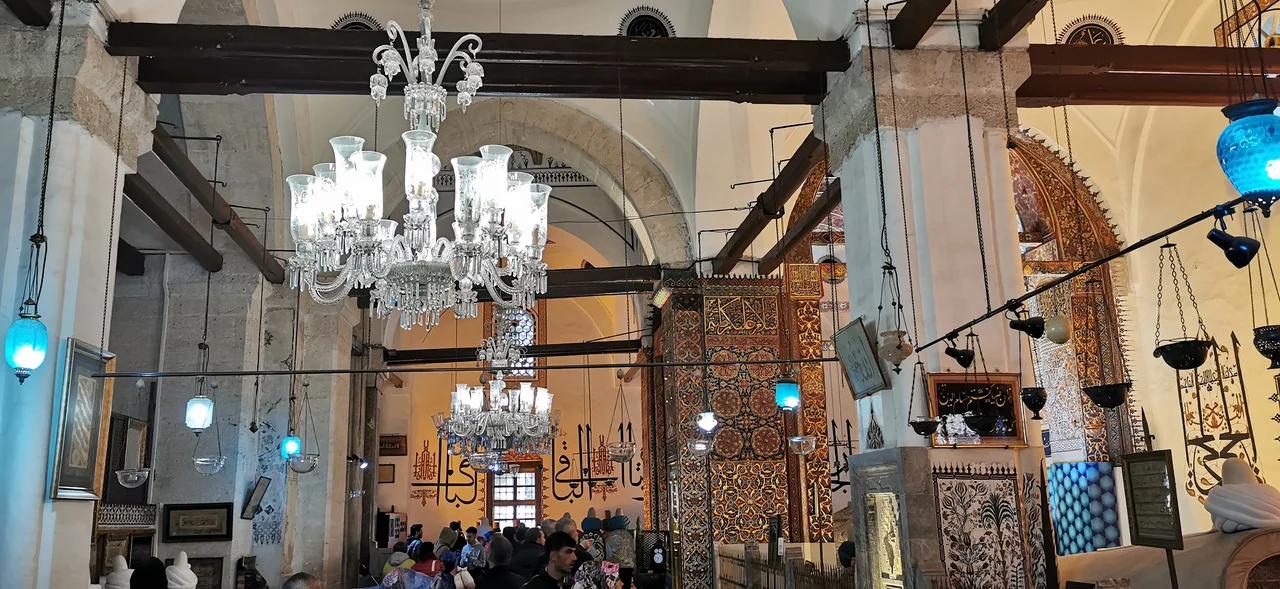

Mevlâna Museum
Pilgrims still pray here. Although Atatürk's 1926 decree turned the dergah - the Mevlevi dervish lodge - into a state museum, and although the building is officially classified as a museum and ticketed accordingly, what visitors actually find inside is something more complicated. People come from across Turkey, Iran, Afghanistan, Pakistan, the Balkans, and farther afield to stand near the sarcophagus of Jalal ad-Din Muhammad Rumi - the thirteenth-century Persian Sufi mystic the Turkish-speaking world calls Mevlâna, 'our master'. Many bring prayers learned from his Masnavi. Some weep openly. The Mevlâna Museum receives more visitors than almost any other museum in Turkey - 3.4 million in 2019, placing it second only to the Hagia Sophia - and a substantial number of them are pilgrims rather than tourists. The distinction matters. This is a sacred site that happens also to be open to ticketed entry.
Konya and the Rose Garden
Rumi was born in Balkh, in what is now northern Afghanistan, around 1207. His family fled the advance of the Mongols and traveled west across Anatolia, eventually settling in Konya around 1228, when Rumi was a young man. The Seljuk sultan Ala' al-Din Kayqubad, who had invited Rumi's father Baha' ud-Din Walad to Konya in the first place, gave the family his rose garden as a burial place when the elder scholar died on January 12, 1231. When Rumi himself died on December 17, 1273 - a date still observed by Mevlevi communities as the Sheb-i Arus, 'the Wedding Night,' celebrating his union with the divine - he was buried beside his father in the same garden. His successor Husameddin Çelebi commissioned a mausoleum, the Kubbe-i Hadra ('Green Dome'), under the Seljuk architect Badr al-Din Tabrizi. It was finished in 1274, paid for by Gurju Khatun, a Georgian princess who had become a devotee of Rumi during his lifetime, and the emir Alameddin Kayser.
The Whirling Dervishes
The Mevlevi order took its name from Mevlâna and developed the practice for which it remains internationally known: the sema, a ceremonial dance in which white-robed dervishes spin slowly with arms extended - the right palm turned upward toward heaven, the left turned downward toward earth - while musicians play the kemence, the daire, the kudüm, and especially the ney, the reed flute whose sound Rumi used in the opening lines of the Masnavi as the metaphor for the soul cut from its origin and crying for return. The sema is not a performance. It is a prayer-in-motion, a moving meditation in which the dervish becomes a conduit between divine and material realms. The Ritual Hall, the Semahane, was built during the reign of Suleiman the Magnificent in the sixteenth century. In the museum's display cases sit the actual instruments used in this practice over centuries - ney flutes belonging to specific masters, prayer rugs, dervish robes, and the haunting tall felt hat called a sikke that represents the gravestone of the dervish's ego.
Beneath the Turquoise Dome
The actual tomb chamber sits beneath the famous Kibab'ulaktab - the turquoise-tiled dome that has become the visual symbol of Konya itself. Rumi's wooden sarcophagus, dating to the thirteenth century, is a masterpiece of Seljuk woodcarving, intricately inlaid and inscribed. Beside him lies his father Bahaeddin Veled, and beyond them several family members including his son Sultan Veled, who organized the Mevlevi order into a stable institution after his father's death. The brocade covering Rumi's sarcophagus, embroidered in gold thread with Quranic verses, was a gift from Sultan Abdul Hamid II in 1894. The silver lattice screen between the sarcophagi and the main chamber was crafted by an artisan named Ilyas in 1579. Six other coffins, lined up in three pairs on the left side of the mausoleum, hold the original dervishes - the Horasan erler - who came to Konya with Rumi from Balkh and never left.
Manuscripts and the Reed Flute
In glass cases around the Semahane sit some of the most precious objects of the Persianate Sufi tradition. A Divan-i-Kebir from 1366 holds Rumi's lyric poetry in spidery cursive script. Two early manuscripts of his great Masnavi-i Manavi - the Spiritual Couplets, the 25,000-line poem sometimes called 'the Quran in Persian' - date from 1278 (just five years after Rumi's death) and 1371. Four crystal mosque lamps from sixteenth-century Mameluk Egypt hang nearby. There is an eighteenth-century Kirsehir prayer rug, dervish clothing including garments said to have belonged to Rumi himself, and - in the small mosque adjoining - a box decorated with mother-of-pearl believed to contain a hair from the beard of the Prophet Muhammad. None of these objects can be photographed without permission. Visitors who treat them as ordinary museum exhibits miss what they are. They are relics, in the precise religious sense - objects of veneration whose continuing role in living devotion has not stopped because the building is officially a museum.
Suppression and Survival
When Atatürk dissolved the Sufi orders in 1925 as part of the secularizing reforms of the new Turkish Republic, the Mevlevi tekke at Konya was among the institutions closed. The decree of April 6, 1926 reclassified this building as a museum, which formally opened on March 2, 1927. The order itself went underground, then partly into exile in places like Aleppo. In 1954, the museum was officially renamed the Mevlâna Museum, an acknowledgment that the man buried here, not just the architecture, was the real reason people came. In recent decades the Turkish state has gradually allowed the Mevlevi traditions back into public life - sema ceremonies are now performed annually in December, drawing devotees from around the world. The image of Rumi's tomb appeared on the reverse of the 5,000-lira banknote from 1981 to 1994. He is, by any measure, the most widely read poet in the United States as well, where Coleman Barks's English versions of his verse have sold in the millions. None of that fame disturbs the silence inside the dome. Pilgrims still come. Some still weep.
From the Air
Located at 37.8706°N, 32.5047°E in central Konya, the city on the Anatolian plateau in south-central Turkey at about 1,016 m elevation. The turquoise dome of the mausoleum is recognizable from the air. Cruising 8,000-12,000 ft offers views of the broad agricultural plain around Konya, the salt lakes to the north, and the Taurus Mountains to the south. Nearest airport: Konya Airport (LTAN) about 13 km northeast of the city. The plateau climate brings hot dry summers and cold winters with occasional snow.
Nearby Stories
- Antalya 139 km away
- Antalya Museum 160 km away
- Cappadocia: The Underground Cities That Hid 20,000 People 165 km away
- Adana 213 km away
- Buffavento Castle 271 km away
- 2025 Kartalkaya Hotel Fire 272 km away
- North Nicosia 301 km away
- 1965 Hendek Bus Accident 332 km away