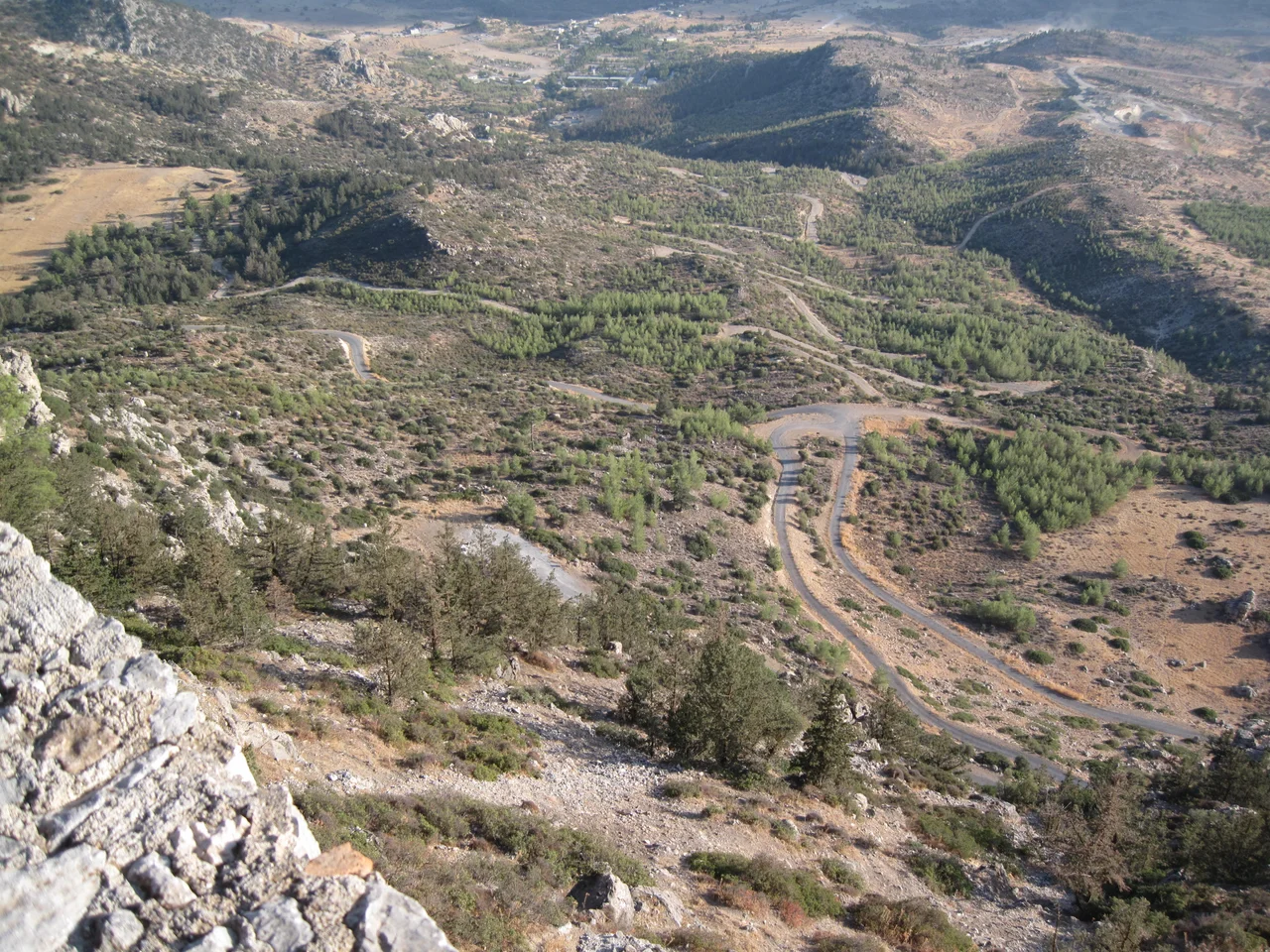

Buffavento Castle
Defier of the Winds. That is what the Italians named it, and after roughly six hundred steps of climbing through the Kyrenia range you understand the name without anyone having to translate it. At 960 meters above the Cypriot sea, on a peak so steep the north, east, and west faces simply fall away into nothing, Buffavento Castle does not so much sit on its mountain as cling to it. The wind moves through the broken vaults all day and most of the night. Whoever built this place was not building for comfort. They were building for what could be seen from up here, and for who could not get up here to take it.
A Question Without an Answer
Almost everything about Buffavento's beginning is contested. The most plausible date is sometime in the Byzantine period, but the historians offer a buffet of guesses: built in 965 after the Arabs were expelled from Cyprus, raised by the rebel Rhapsomates in 1091, ordered by the governor Eumathios Philokales between 1091 and 1094, or thrown up in the early 12th century to push back against the Crusader states. A Lusignan-era legend insists that a Cypriot noblewoman built it as a refuge from the Knights Templar in 1191, which is why one of the castle's old names is Leonne, the Lion's Castle, or simply the Queen's Castle. The name Buffavento itself may have been borrowed from a monastery in the nearby village of Koutzoventi. The historians can't agree, the legends contradict each other, and the wind on the summit is loud enough to drown the argument out.
The Mountain Spine
Buffavento was never alone. It stood as the middle link in a three-castle chain along the Kyrenia Mountains: Saint Hilarion to the west, Kantara to the east, and Buffavento between them, watching the mountain pass that climbed from Kythrea up to the north coast. The three together formed a kind of horizontal observatory across the spine of the island. From the upper ward you could see the sea on one side and the inland plain on the other, the entire coastline catalogued in a single sweep. Pirates approaching shore could be spotted while still hours from making landfall. That, more than fighting, was the castle's job. It was a watchtower, a place to count sails, a place to send word.
Richard, Then a Long List of Owners
In 1191, on his way to the Third Crusade, Richard the Lionheart conquered Cyprus from its self-styled emperor Isaac Komnenos. Saint Hilarion fell. Kantara fell. Buffavento, which had not seen any real fighting, surrendered after the others gave way. Richard then sold the entire island to the Knights Templar, whose harsh rule provoked a revolt in Nicosia and ended their tenure quickly. Cyprus was resold to Guy of Lusignan, and a French dynasty took root for nearly three centuries. When King Hugh I died in 1218, a vicious regency war broke out between the local House of Ibelin and the partisans of Emperor Frederick II, who arrived in Limassol in 1228. Between 1229 and 1233, Buffavento changed hands repeatedly. In 1232, Eschiva of Montbeliard held the place against the imperial faction. The Lusignans eventually prevailed, and from then on the castle settled into a quieter, sadder role.
A Prison in the Clouds
The Lusignan period turned Buffavento into a place to disappear people. In 1308, a knight named Anseau of Brie was held inside these walls when news reached him that his order, the Knights Templar, had been put on trial across Christendom. Imagine the climb to deliver that news. Imagine receiving it up here, with the entire Mediterranean visible and entirely out of reach. By the time the Republic of Venice took control of Cyprus in the late 14th century, the castle had outlived its purpose. The Venetians considered it strategically useless and deliberately destroyed the long staircase connecting the castle's upper and lower wards, ensuring that even if someone occupied it again, they could not move troops through it. The mountain itself did the rest of the demolition. Roofs fell in. Cisterns filled with rubble. In the early 19th century, a wandering Catalan calling himself Ali Bey el Abbassi stopped to look at the ruins on his way to Mecca.
Stones Without Decoration
What is left now is a working castle stripped to its essentials. The upper ward faced the sea. The lower ward looked out over the plain. Both were built of dressed limestone hauled from the coast and rough stones broken from the mountain itself. There are no carvings, no flourishes, no signs that anyone wanted this fortress to be beautiful. The gate hides inside a two-story rectangular tower with a Frankish pointed arch. Three barrel-vaulted Frankish chambers stand to the west. A Byzantine building of three large rooms sits along the main stairway. The upper ward has a Byzantine cistern interconnected with four water-collecting chambers, and a small groin-vaulted Frankish tower watching the eastern approach. The fact that there is no kitchen, no granary, no obvious food storage tells you what kind of castle this was. People stayed here briefly. Climbed up to look. Climbed back down. The wind kept blowing.
From the Air
Buffavento Castle perches at 35.2875 N, 33.41 E, on a sharp peak in the Kyrenia Mountains of Northern Cyprus, 960 m / 3,150 ft above sea level. From the air it shows as a small ruin clinging to a cliffside ridge between Saint Hilarion to the west and Kantara to the east. Best viewed at 5,000 to 7,000 ft AGL on a clear morning before the orographic clouds build over the range. The Mediterranean coast lies just a few miles north. Nearest airports: Ercan International (LCEN) about 10 nm south on the central plain, and Larnaca International (LCLK) about 35 nm southeast in the Republic of Cyprus.
Nearby Stories
- Larnaca District Archaeological Museum 8.7 km away
- Church of St. Nicholas of the Roof 14 km away
- Kykkos Monastery 40 km away
- Siege of Tripoli (1271) 170 km away
- Sahyun Castle 177 km away
- Taynal Mosque 182 km away
- Adana 228 km away
- Antalya 260 km away