
Larnaca District Archaeological Museum
A skeleton lies in Room I exactly as it was found at Choirokoitia 9,000 years ago - curled in the foetal position, with a heavy millstone placed deliberately on the chest and head. This was a normal Neolithic burial in Cyprus. Whether the stone was meant to honor the dead by weighting them down with something precious, or to keep them from rising, scholars cannot agree. The grave goods around the body - bone needles, flint knives, simple jewelry of green-blue picrolite - suggest care. The stone suggests something else, perhaps fear, perhaps respect, perhaps both. Either way, the people who buried this person did so with thought. The Larnaca District Archaeological Museum opened in 1969 to display exactly this kind of object: ordinary remains of extraordinary lives, dug up across the eastern part of Cyprus.
Choirokoitia and the First Cypriots
Room I is mostly Neolithic and Chalcolithic, drawn from Cyprus's deepest layers. Most of the finds came from Choirokoitia, the round-house village inhabited from about 7000 BC, which UNESCO recognized as a World Heritage Site in 1998. The villagers built circular stone houses with flat clay roofs, kept domesticated sheep and pigs, and made jewelry from picrolite - a soft, easily carved serpentine that occurs on Cyprus and almost nowhere else. Two deer antlers in a glass case provide evidence that fallow deer roamed Cyprus at the dawn of human occupation, before being hunted out. From later periods come stone vessels, comb-marked pottery from the Khirokitia culture, fragmentary idols from nearby Kalavasos-Tenta, and a limestone figurine roughly carved into the shape of a person. Eight thousand years of pre-classical Cypriot life are gathered into a few cases.
The Mycenaean Connection
Room II focuses on the Late Bronze Age, when Cyprus became a hub in the trade networks that connected Mycenaean Greece to Egypt and the Levant. Mycenaean pottery imported between 1230 and 1050 BC turns up at every major site in Larnaca district - Pyla, Kalavasos, Tersefanou, and the Hala Sultan Tekke necropolis at Alykes. The shapes are unmistakable: stemmed kylikes (drinking cups), three-handled amphorae, pyxides for cosmetics. There are also Horns of Consecration, the curving double-pronged altarpieces familiar from Minoan Crete - evidence of the religious vocabulary shared across the Aegean and Cyprus during the same centuries. One especially striking object is a faience scepter bearing the cartouche of Pharaoh Horemheb, who ruled Egypt around 1320-1292 BC. It found its way to Cyprus through royal gift exchange or trade. The room also displays an opium pipe - a quiet reminder that the eastern Mediterranean's psychoactive plant trade is much older than most visitors realize.
Kition, City of Phoenicians and Stoics
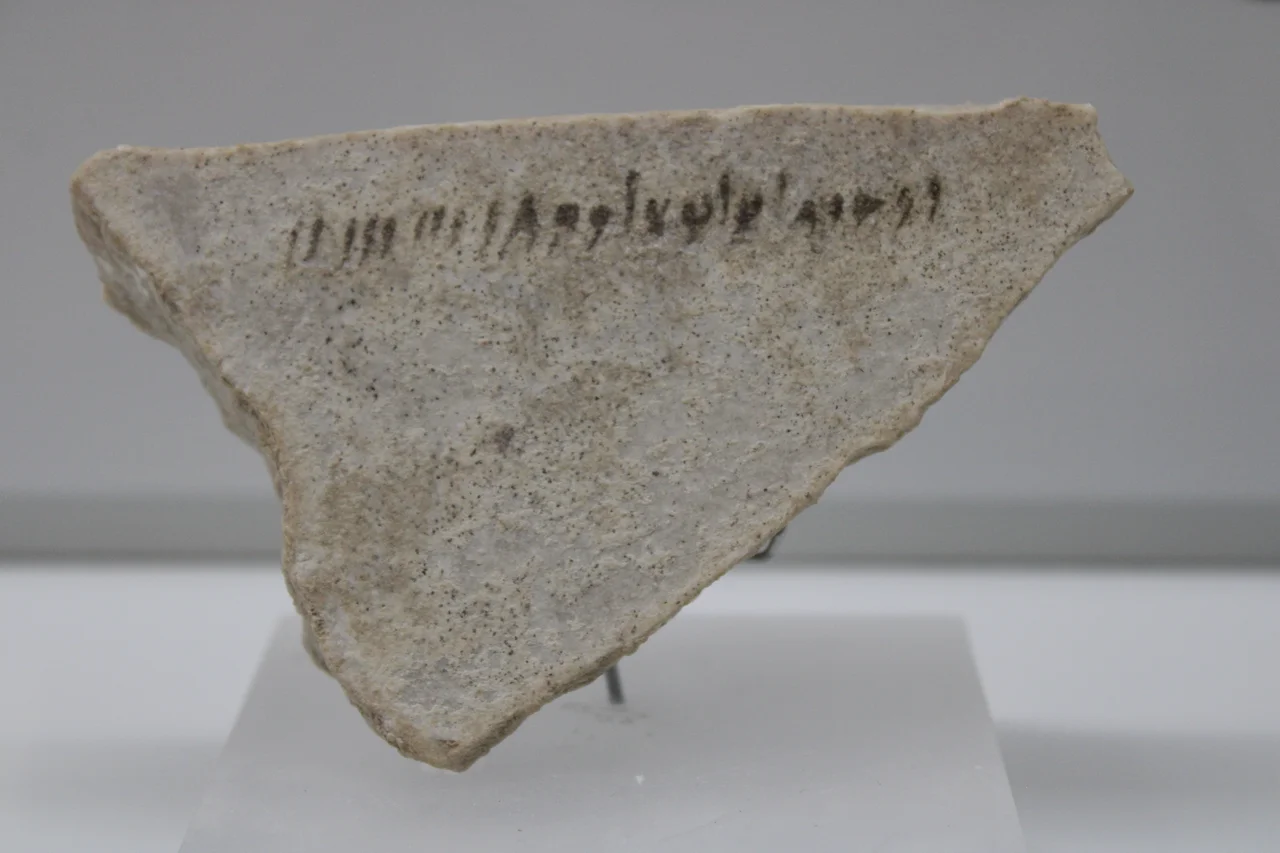
Most of what fills the museum's later rooms comes from ancient Kition - the city that lay directly beneath modern Larnaca and whose name survives in the Hebrew Bible as Kittim. Kition was founded by the Mycenaeans, taken over by Phoenicians from Tyre in the ninth century BC, and remained under Phoenician rule for about five centuries. The Phoenician kings of Kition struck their own silver coinage; a coin of King Azbaal, dated 449-425 BC, sits in Room IV. From Kition's necropolis at Larnaca-Mnemata come limestone heads of male worshippers wearing diadems decorated with rosettes, terracotta horse-and-rider figurines, and a great quantity of imported Attic Black-figure and Red-figure pottery: a krater showing a symposium scene, an oinochoe painted with female musicians, a cup with cypro-syllabic signs incised on its base. Kition is also where the philosopher Zeno was born around 334 BC - the founder of Stoicism, whose teachings in Athens shaped Greek and Roman thought for centuries. None of his writing survives, but the city he came from speaks through these objects.
The Larnaca Hoard
Room IV holds coins from what the exhibit labels call simply 'the Larnaca Hoard' - one of several treasure caches that have surfaced from the soil under modern Larnaca over the past century and a half. The earlier coinage of Kition is shown in copies because the originals are kept at the Cyprus Museum in Nicosia, where Cypriot national heritage gathers in one place. Around the coins, the room expands into Hellenistic and Roman material: shallow dishes from a tomb at Alykes that contained fishbones (offerings to the dead, since the deceased might still need to eat), perfume containers in alabaster and blown glass, oil lamps shaped like shells - a distinctively Cypriot form that appeared in the Geometric period and was reintroduced in glazed form during the medieval era. There is also a fragment of a clay mold used for relief work, and a Roman-period statuette of Priapos, the fertility god whose function ancient Cypriots found relevant enough to carve in domestic-scale terracotta.
Local Provenance, Layered Histories
What makes this museum distinctive among Cypriot archaeological collections is its tight focus on the Larnaca region - finds from local excavations, displayed near where they came out of the ground. Wall texts mention sites the visitor can drive to in twenty minutes: Maroni-Vournes (excavated jointly by the British Museum and the University of Cincinnati), Kalavasos-Tenta (the Neolithic village under its protective dome), and Hala Sultan Tekke (the Bronze Age city beside Larnaca's salt lake). The objects do not pretend to tell the story of all of Cyprus. They tell what life looked like in this corner of the island, century by century - Neolithic farmers with their carefully buried dead, Bronze Age traders with their imported Egyptian luxuries, Phoenician kings with their silver coins, Hellenistic mourners leaving fish bones in tombs. The museum is small. It rewards slow walking.
From the Air
Located at 34.9191°N, 33.6334°E in central Larnaca, near the seafront and the salt lake. Cruising 4,000-8,000 ft offers views of the Larnaca salt lake (often pink with flamingos in winter), the bay, and the Hala Sultan Tekke mosque. Nearest airport: Larnaca International (LCLK) just southwest of the city. The Mediterranean coast runs east-west here; trade winds tend westerly in summer.
Nearby Stories
- Church of St. Nicholas of the Roof 17 km away
- Bayraktar Mosque 19 km away
- 1983 US Embassy Bombing in Beirut 151 km away
- Siege of Tripoli (1271) 166 km away
- Sahyun Castle 184 km away
- Assassination of Rafic Hariri 194 km away
- Antalya 286 km away
- Sack of Damietta (853) 366 km away