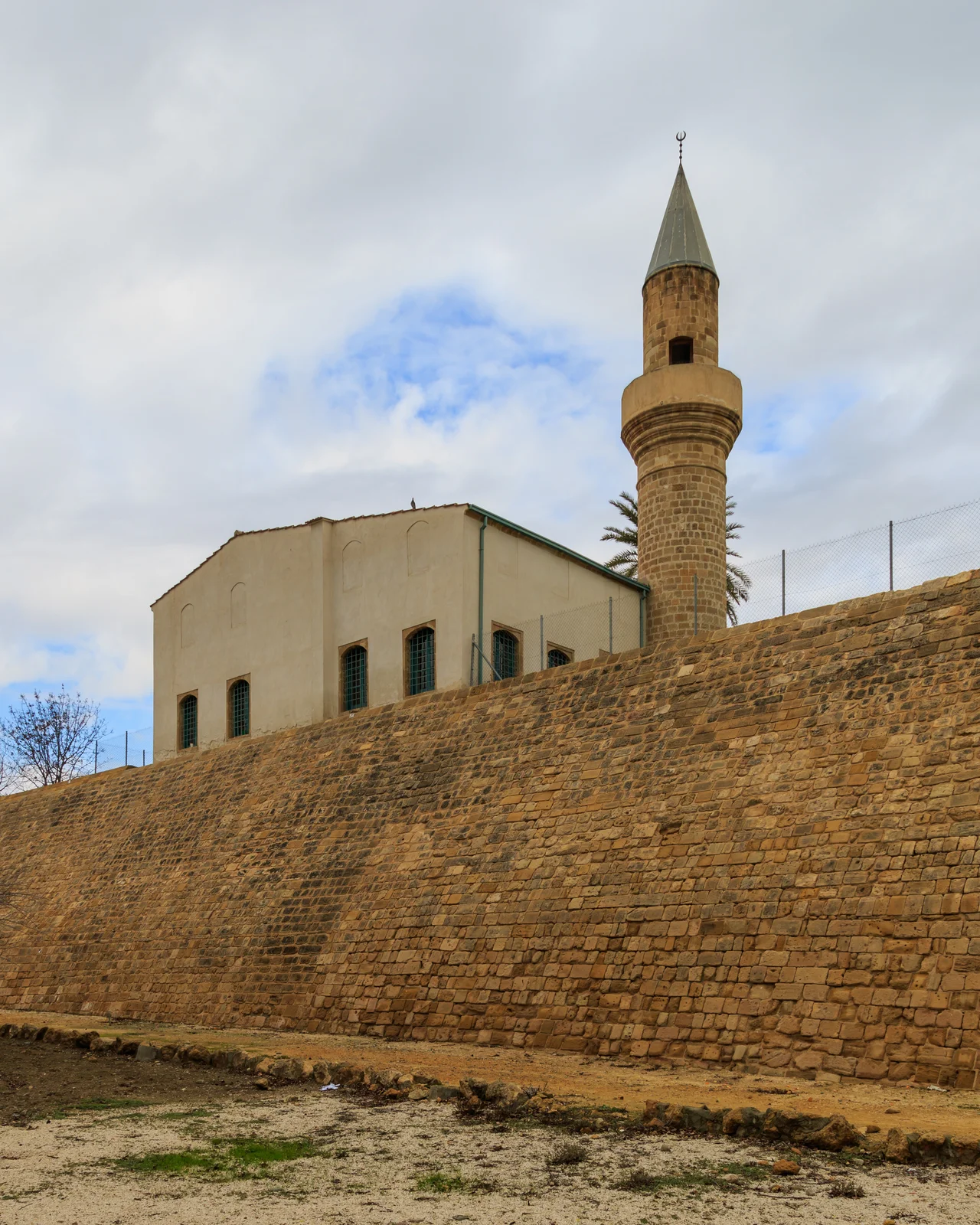

Bayraktar Mosque
Two journalists at the small Cypriot newspaper Cumhuriyet wrote in early 1962 that the bomb that had recently damaged the Bayraktar Mosque had been planted by Turkish Cypriot extremists trying to provoke a communal war. Their names were Ahmet Muzaffer Gurkan and Ayhan Hikmet. They had spoken to the Greek Cypriot Minister of the Interior, who appears to have confirmed it. They were both shot dead later that same day, 23 April 1962. Forty-eight years later a retired Turkish general named Sabri Yirmibesoglu told a Turkish newspaper that yes, his side had bombed a mosque in Cyprus to inflame inter-communal tensions. He did not name which mosque. The Turkish press believed he meant the Bayraktar.
The Flag-Bearer at the Bastion
On 9 September 1570, an Ottoman army that had been besieging Nicosia for forty-five days finally got over the walls. The first soldier to plant an Ottoman flag on the Constanza bastion - the southern point in the Venetian fortifications - was killed in the act. He has three competing names in the surviving records: Alemdar Kara Mustafa, Alemdar Mehmet Aga, and the locally-remembered Deli Cafer (Mad Cafer). The mosque that came to be built over his tomb adopted the title bayraktar, the flag-bearer. The bastion took the same name. The Venetian fortifications of Nicosia, designed in the 1560s by the Italian engineers Giulio Savorgnano and Francesco Barbaro as eleven precisely-spaced bastions in a perfect circle, are still the most visible feature of the city's old quarter; the southern point now sits on the line that, since 1974, has divided the island.
The Beard of the Prophet
Until 1930, the Bayraktar Mosque kept a relic that drew pilgrims from across the Ottoman world: a hair from the beard of the Prophet Muhammad. On certain feast days, Nicosian worshippers would kiss the relic three times and touch it to their foreheads. On 27 November 1930, the relic was stolen. It has never been recovered. The theft happened during a period when the British colonial administration in Cyprus was struggling to maintain order between the island's Greek Orthodox majority and the Turkish Muslim minority - both communities, in different ways, increasingly aware that the British would not stay forever. The mosque went on without the relic. The pilgrimages stopped.
The Fuse Years
Between 1955 and 1959 the Cypriot uprising against British rule, led by the Greek Cypriot EOKA movement and aimed at union with Greece, made the Turkish minority on the island acutely aware that whatever followed colonial rule would not necessarily protect them. The Turkish Resistance Organisation (TMT) emerged on the Turkish Cypriot side. Cyprus became independent in 1960, with a constitution designed to balance the two communities. By 1962 the constitution was breaking, and on the night of 24 March of that year a bomb damaged the Bayraktar Mosque. The journalists Gurkan and Hikmet, writing for the small left-wing Turkish Cypriot newspaper Cumhuriyet, said openly what others had suspected: that the bomb had been planted not by Greek Cypriots but by Turkish Cypriot hardliners trying to provoke the violence that would justify partition. They were killed within hours of publishing. On 26 January 1963 a second bomb damaged the minaret. After Bloody Christmas - the Turkish Cypriot massacres of December 1963 - a third bomb on 23 January 1964 brought the minaret down completely. The same night, the Omeriye Mosque was also bombed.
The Truth, Belatedly
In 2010, retired Turkish general Sabri Yirmibesoglu - who had been a young officer involved in TMT operations in the early 1960s - confirmed in print what Gurkan and Hikmet had been killed for printing. The Turkish military, he said, had bombed a mosque in Cyprus to inflame inter-communal tensions. He named no specific mosque, but Turkish journalists who knew the period concluded he meant the Bayraktar. The technique - destroying one's own holy places to enrage one's own community against the other - has a long and grim history in twentieth-century ethnic conflicts. The historian Samuel Hardy, who studies cultural-property destruction in war, lists the Bayraktar attacks among the documented cases of strategic damage to one's own heritage. The journalists who first published this hypothesis in 1962 had it right. They paid for being right with their lives.
Repair, Slowly
A UNESCO mission in February 1975 - five months after the Turkish invasion divided Nicosia along the same Constanza bastion where the flag-bearer had fallen four centuries earlier - found the Bayraktar Mosque totally vandalised, the minaret pulled down, the windows blocked, the roof collapsing. By September 1975 the building had been mostly restored, but the minaret was still being rebuilt; in 1985 the minaret was still not finished. A full restoration was completed in 1990. The mosque reopened for worship in 2003, four decades after the third bomb. Today it stands in the southern, Greek-administered sector of Nicosia, on the line that the bombs had been intended to draw and the war finished drawing in 1974. The simple rectangular building - sharp pointed-arch entrance, three-arched narthex, minaret at the corner - holds the tomb of a man whose name nobody is sure of, killed on the day the Ottoman empire took the city. He has been disturbed three times since.
From the Air
35.17N, 33.37E. Bayraktar Mosque sits in the southern (Greek-administered) sector of Nicosia, on or near the Constanza bastion of the Venetian walls, at the southern edge of the divided old city. From 3,000-5,000 ft, look for the unmistakable shape of Nicosia's Venetian walls: a perfect 11-pointed star bastion ring around the old town, divided north-to-south by the UN buffer zone. The mosque is a small structure with a single minaret near the southern bastion; the larger Selimiye Mosque (the converted Hagia Sophia of Nicosia) and Omeriye Mosque are visible elsewhere in the old city. Larnaca International (LCLK) is 38 km southeast - the main civil entry point to the Republic of Cyprus. Paphos International (LCPH) is 100 km southwest. Ercan (LCEN, in the Turkish-administered north) lies just 16 km east, but is unrecognised internationally. The whole island - 240 km long - is visible on a clear day from cruising altitude, with the Troodos Mountains rising 1,950 m to the south.
Nearby Stories
- Battle of Salamis (306 BC) 17 km away
- Stavrovouni Monastery 22 km away
- Agios Neophytos Monastery 27 km away
- Paphos Castle 61 km away
- 1983 US Embassy Bombing in Beirut 199 km away
- Sahyun Castle 209 km away
- Antalya 236 km away
- Adana 251 km away