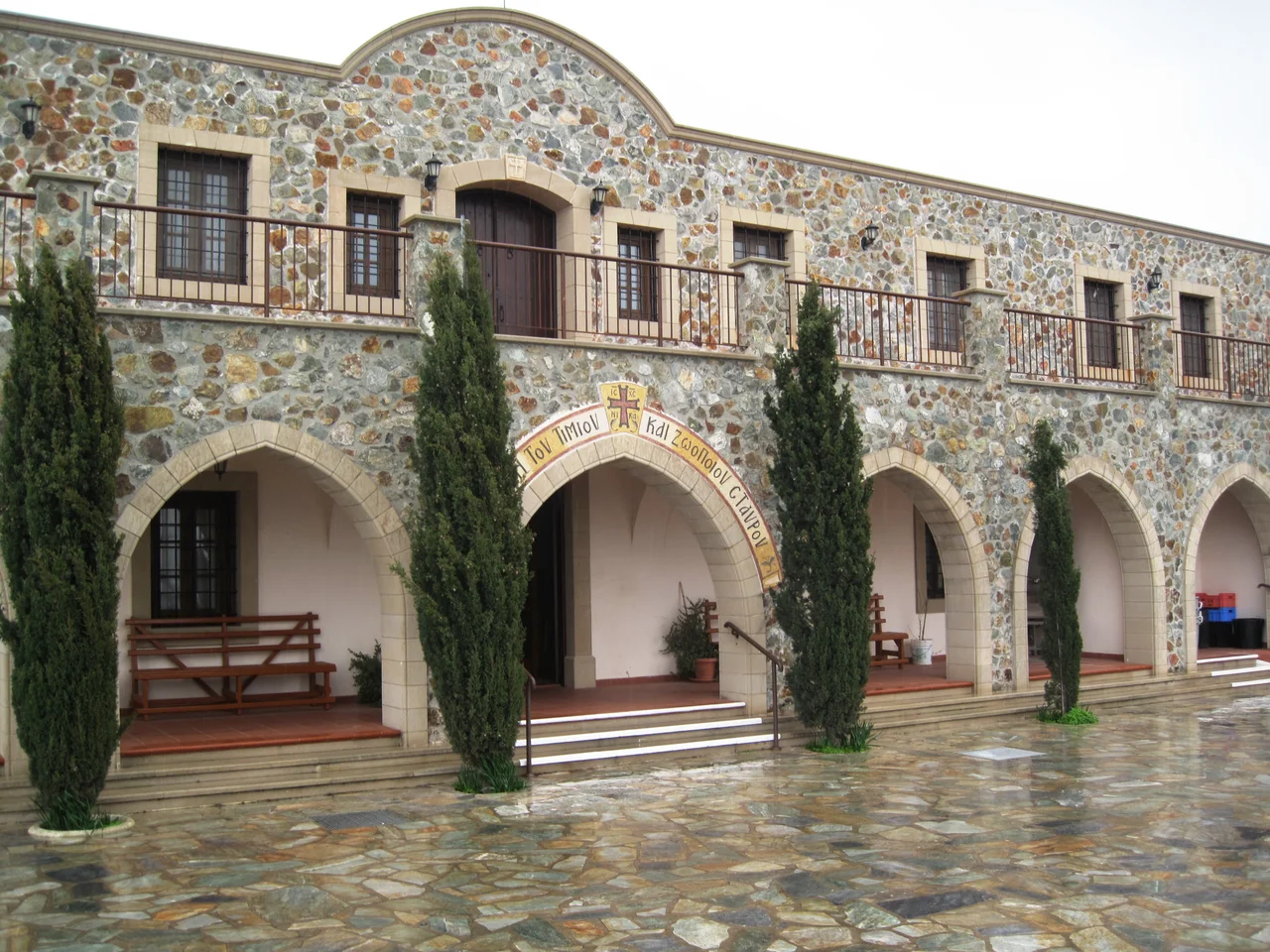

Stavrovouni Monastery
From the road south of Larnaca, Stavrovouni rises out of the plain like a fist closing on the sky. The hill is 690 metres high, isolated, conical, capped with a small cluster of white buildings catching whatever light the afternoon offers. The name means Mountain of the Cross. According to a tradition recorded by the fifteenth-century Cypriot chronicler Leontios Makhairas, the empress Helena, mother of Constantine the Great, was returning from her pilgrimage to Jerusalem in 327 when a storm drove her ship into a Cypriot harbour. She had with her three crosses she had recovered from beneath a Roman temple in the Holy Land. One of them, by the same tradition, she left behind on this peak. Whether the story is literal history or pious memory, the monastery on the summit has been there in one form or another for sixteen centuries.
A Pilgrim's Account
The earliest written description of Stavrovouni comes from a Russian traveller, Abbot Daniel of Chernigov, who visited in 1106. He recorded that the True Cross was kept on the mountain to ward off evil spirits and cure illness, and added a memorable detail: This cross is like a meteorite. It is not supported in the ground, because the Holy Ghost holds it in the empty space. I, unworthy man, knelt down before this holy, mysterious object and have seen with my own, sinful eyes the inherent holy grace present in this place. The relic Daniel saw was, by Cypriot tradition, the cross of the Penitent Thief, the criminal crucified beside Christ who recognized him as innocent. Helena had supposedly left it on the peak along with one of the Holy Nails and a piece of the rope that bound Jesus to the cross.
The Long Decline
The monastery suffered every fate Cyprus suffered. Arab raids in the seventh and eighth centuries took down what they could reach. The Lusignan kings rebuilt; the Venetians let it decline. After the Ottoman conquest of 1571, the Greek Orthodox communities of the island lived under restrictions that made monastic life difficult. By the late sixteenth century Stavrovouni had no permanent monks, only hermits clinging to the rock. The Bohemian nobleman Krystof Harant noted in 1598: Nobody knows what the Turks have done with the True Cross. The relic Helena had supposedly left there was simply gone. A great fire in 1888 destroyed almost everything that had survived: the church, the iconostasis, the monks' cells. What stands today is largely a late-nineteenth and twentieth-century rebuilding, on the foundations of the foundations of the foundations.
Dionysios from Mount Athos
In 1889 a Cypriot monk named Dionysios returned from Mount Athos, the great monastic peninsula in northern Greece, and settled at Stavrovouni with the intention of restoring it. The next year three more Cypriot monks joined him, also from Athos: Varnavas and his brothers Kallinikos and Gregorios. They imposed on the new community the strict Athonite rule of life. No women on the mountain, the rule called avato. Days structured around liturgy, vespers, and silence. Bread baked, icons painted, wine fermented, vegetables grown on the slopes below. The community grew through the twentieth century, restored its outlying chapels and dependencies, and eventually became one of the spiritual centres of Cypriot Orthodoxy. Today there are over thirty monks. The current abbot, Elder Dionysios III, took office in 2021.
What Remains
A small silver reliquary in the church holds what the monks say is a fragment of the True Cross, a survivor of the 1888 fire and possibly older. The wooden Cross of the Good Thief that Abbot Daniel described is gone. Two small chains worn by Saint Panaretos, an eighteenth-century bishop of Paphos, are kept among the monastery's relics. The most striking thing in the church now is the work of Father Kallinikos, the most famous icon painter of recent Cypriot Orthodoxy and himself a monk of Stavrovouni. He covered the small church with frescoes after the renovation: Helena in a brilliant red garment finding the True Cross in Jerusalem, the Deposition with the skull of Adam beneath the cross, and a hundred other scenes from the life of the empress and the Cross she sought. The frescoes look medieval. They were painted in the last fifty years.
The View from the Top
Stavrovouni is not the highest peak in Cyprus, despite a misinformed thirteenth-century pilgrim who insisted it was. That distinction belongs to Mount Olympus in the Troodos massif, sixty kilometres west. But Stavrovouni stands alone, the way Mont-Saint-Michel stands alone in its bay, and on a clear morning the view from the church terrace runs from the salt flats of Larnaca to the Pentadaktylos range in the north. Ludolph von Suchen, a fourteenth-century pilgrim, claimed you could see Lebanon from the summit. He was right, on the right day, with the right haze, and a willingness to look very hard. Most visitors do not see Lebanon. They see a small Greek Orthodox monastery on a stone cone in the middle of an island, doing what it has done for sixteen hundred years: keeping the early hours, painting icons, and waiting.
From the Air
Stavrovouni monastery sits on a 690-metre conical peak at 34.89 degrees north, 33.44 degrees east, between Larnaca and the central plain of Cyprus. Larnaca International Airport (LCLK) is 25 km southeast, with the most spectacular approach views; Paphos (LCPH) is 110 km west. The peak is unmistakable from cruise altitude as an isolated cone in otherwise gentle terrain. Visibility from the summit can reach the Lebanese coast on rare clear days; haze and dust from the Sahara periodically obscure long views. Spring and autumn offer the cleanest air.
Nearby Stories
- Church of St. Nicholas of the Roof 17 km away
- Bayraktar Mosque 19 km away
- 1983 US Embassy Bombing in Beirut 151 km away
- Siege of Tripoli (1271) 166 km away
- Sahyun Castle 184 km away
- Assassination of Rafic Hariri 194 km away
- Antalya 286 km away
- Sack of Damietta (853) 366 km away