
Church of St. Nicholas of the Roof
Stand in the courtyard of Agios Nikolaos tis Stegis and the first thing you notice is the roof. Or rather, the two roofs. A steep timber overlay of flat tiles sits like a hat pulled down over the original Byzantine domes underneath, hiding most of the cross-in-square form that medieval masons built in the eleventh century. The villagers who added that second roof, sometime in the twelfth century, were not making an architectural statement. They were trying to keep the Troodos rain and snow off six hundred years of fresco that they had inherited and did not want to lose. The church got its nickname from the fix: "of the Roof" - tis Stegis - because that is the part visitors saw first.
A Survivor in the Pines
The Troodos Mountains run down the spine of Cyprus, and in the eleventh century they were a refuge from the coastal raids that defined Mediterranean life. Monasteries went inland and uphill. Agios Nikolaos was built around 1100 near the village of Kakopetria, set in a clearing of pine and walnut along the Karyotis river. It is the only middle Byzantine katholikon - the principal church of a monastery - that still stands on Cyprus from that century. All sixty-five known Early Christian churches on the island had been three-aisled wooden-roofed basilicas, conservative in plan, slow to adopt the domes that Constantinople had been building for centuries. Architectural historian Charles Anthony Stewart attributes that conservatism to the independence of the Cypriot Church, which was self-governing and did not feel the need to copy fashions from the capital. Agios Nikolaos broke with that pattern. It is a domed cross-in-square, cousin to the great churches of Constantinople, planted in a Cypriot pine forest.
Six Hundred Years of Painters
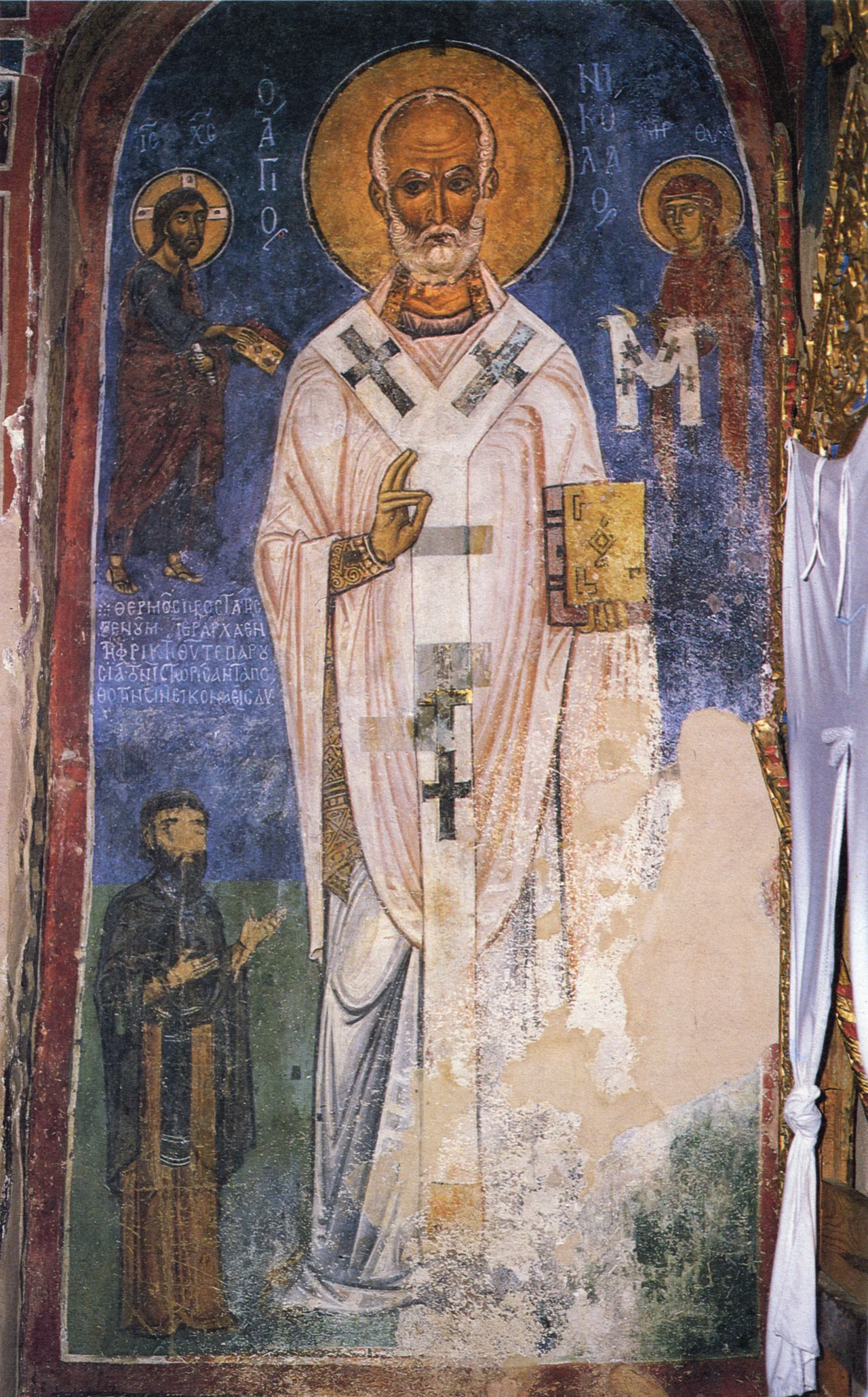
Walk inside and the walls argue with each other across centuries. The earliest surviving frescoes date to the eleventh century, painted soon after the church was built. The art historian A. H. S. Megaw saw in them "the deep-set staring eyes of the expressionist style" inherited from Byzantine miniaturists of the Macedonian Renaissance, the cultural revival that followed the end of iconoclasm in 843. A second campaign in the twelfth century, painted in the more sophisticated Comnenian style, suggests that masters trained outside the island, perhaps in Constantinople itself, had been brought in to refresh the walls. Most of what visitors see today, though, was painted in the fourteenth century. The Crucifixion and the Resurrection above the nave date to the late thirteenth or early fourteenth. Christ Pantocrator surveys the church from the dome. Sixteen prophets ring him at the drum. Four evangelists fill the pendentives. On the northwest pier, two enormous figures stand together: Saint Theodore and Saint George, both warrior saints, painted at life size.
The Painted Churches of Troodos
Agios Nikolaos is one of ten painted churches in the Troodos region that UNESCO inscribed as a single World Heritage site in 1985. The grouping makes sense: these mountain churches preserve the most important cycle of Byzantine and post-Byzantine painting on the island, ranging from the eleventh through the seventeenth centuries. Most are small, most are tucked into villages or remote valleys, and most spent the period of Frankish rule - which began on Cyprus in 1192 under Guy de Lusignan, after Richard the Lionheart sold the island to him - as parish churches rather than imperial monuments. Outside the walls, the Frankish nobility built Gothic cathedrals in cities like Famagusta and Nicosia, sun-bleached now amid minarets and palms. Inside the mountains, Greek-speaking communities kept commissioning Byzantine frescoes long after Constantinople had fallen. The continuity, hidden under improvised pitched roofs, is what UNESCO eventually came to recognize.
The Logic of the Cover
There is something practical and a little stubborn about the second roof. Originally, Agios Nikolaos had no narthex either. The entrance porch was added in the early twelfth century, covered by a small calotte and two transverse arches, and at the same moment the steep timber-and-tile cover was thrown over the whole building. Snow accumulates in the Troodos. Roofs leak. Frescoes dissolve. The villagers who paid for the new roof did so because the church mattered to them and because they understood that art on lime plaster does not survive direct weather. Some of the original exterior masonry was hidden in the process, and a few interior paintings were lost when the church's appearance was altered later. The trade was a fair one. The dome under the hat is still there, the prophets still circle Christ, and the warrior saints still keep watch on the pier where the medieval painters left them.
From the Air
Coordinates: 34.9773 N, 32.8895 E. Suggested viewing altitude 4,000-6,000 ft AGL over the central Troodos massif. The church sits in a wooded valley about 1 km southwest of Kakopetria village; look for the steep-pitched dark wooden roof in a clearing along the Karyotis river drainage, with Mount Olympus (Chionistra, 1,952 m / 6,404 ft) rising to the southwest. Nearest airports: Paphos International (LCPH) about 65 km southwest, Larnaca International (LCLK) about 70 km southeast. Mountain weather can produce orographic clouds and rotor turbulence; smoothest conditions are typically early morning.
Nearby Stories
- Stavrovouni Monastery 3.5 km away
- Buffavento Castle 15 km away
- Church of Cyprus 42 km away
- 1983 US Embassy Bombing in Beirut 208 km away
- Antalya 243 km away
- Assassination of Rafic Hariri 254 km away
- Antalya Museum 268 km away
- Sack of Damietta (853) 351 km away