
Church of Cyprus
Few church leaders anywhere in Christianity sign their letters in red ink made vermilion with cinnabar. Fewer still wear Tyrian purple under their vestments and carry a gilt silver staff topped with a gold globus cruciger instead of the regular bishop's crozier. The Archbishop of Cyprus, head of the autocephalous Greek Orthodox Church of Cyprus, has been doing all three since the 5th century. The privileges were granted personally by the Byzantine Emperor Zeno after the archbishop sent him a peculiar diplomatic gift: word that the relics of Barnabas, founder of the Cypriot church, had been found in a vision, with a copy of the Gospel of Matthew on his chest. Zeno, presented with this evidence, confirmed that the Church of Cyprus answered to no patriarch. It still doesn't.
The First Christian Country
Cyprus has a strong claim, recorded in the Acts of the Apostles, to being the first place ruled by a Christian leader. Paul the Apostle landed on the island during his first missionary journey and converted the Roman proconsul Sergius Paulus, making him a Christian governor of a Roman province at a time when Christianity itself was barely a generation old. The Bishop of Kition, the ancient name for modern Larnaca, was Lazarus, the same Lazarus whom Jesus had raised from the dead at Bethany. According to Cypriot tradition, Lazarus fled rumors of plots against his life and came to the island, where Paul and Barnabas appointed him bishop. He served thirty more years and was buried for the second and last time in Larnaca. Other early Cypriot bishops, Herakleidios of Tamasos, Avxivios of Soloi, Theodotos of Kyrenia, helped Christianity spread through the island long before it spread anywhere else in the Roman world.
Independence by Vision
By the 5th century, the Patriarch of Antioch claimed jurisdiction over Cyprus. The Cypriot clergy denounced the claim before the Council of Ephesus in 431, and the Council ruled in their favor with a careful conditional clause: if it has not been a continuous ancient custom for the bishop of Antioch to hold ordinations in Cyprus, the prelates of Cyprus shall enjoy, free from molestation and violence, their right to perform by themselves the ordination of bishops. Antioch never made the claim again. In 478, Archbishop Anthemius reportedly received a vision showing the burial site of Barnabas, the apostle who had brought Paul to Cyprus. He found the grave. He found the body. He found the Gospel of Matthew laid on the saint's chest. Emperor Zeno read the news, granted the three privileges, and the matter was settled. The Church of Cyprus had been independent in practice for centuries. Now it was independent in writing, in vermilion.
Exile and Return
Arab raids battered Cyprus for decades during the Byzantine-Arab wars. During the reign of Justinian II, the great cities of Constantia (the renamed Salamis), Kourion, and Paphos were sacked. The emperor advised the archbishop to flee, and the entire surviving Cypriot population was relocated to a new city near Cyzicus on the Dardanelles, called Nova Justiniana for the emperor. The Quinisext Council in 692 reconfirmed the archbishop's status in exile. In 698, when the Arabs were driven out of Cyprus, the archbishop returned home, but kept the awkward, beautiful title he carries to this day: Archbishop of Nova Justiniana and All Cyprus. A title for a city that no longer exists, attached to an island that does.
The Latin Centuries and the 13 Monks of Kantara
After Richard the Lionheart conquered Cyprus in 1191, the island fell under Frankish, then Venetian, Catholic rule for nearly four centuries. The Catholic kings reduced the number of Orthodox bishops from fourteen to four, exiled them from their towns, and placed each under the local Catholic bishop. Pressure was applied to make Orthodox clergy concede on doctrine and practice, sometimes with threats and sometimes with violence and torture. The most notorious case is that of the thirteen monks of Kantara Monastery, who were executed for refusing Catholic doctrine. Monastic properties were confiscated. The persecution was real, and it was brutal, and it failed. Greek Cypriots kept their faith. By the time the Venetians took over in 1489, the two churches had reached an awkward coexistence. In Famagusta, the Orthodox Cathedral of Saint George of the Greeks rose almost as tall as the Catholic Cathedral of Saint Nicholas next door, fusing Gothic and Byzantine architecture in a single facade.
Makarios, Then 1974
In 1950, Cyprus elected as its archbishop a 36-year-old man named Makarios III. He had founded the Apostle Varnavas Seminary the year before. He organized the 1950 referendum on enosis, the proposed union of Cyprus with Greece. From 1955 to 1959, while still wearing his vermilion ink and his purple robes, he was the political leader of EOKA, the militant movement against British rule. The British exiled him to the Seychelles. In 1960, he was elected the first president of the independent Republic of Cyprus. The coup d'etat of 15 July 1974, backed by the Greek junta, briefly removed him. Five days later, on 20 July 1974, Turkey invaded the northern third of the island. Hundreds of thousands of Greek Orthodox Cypriots were displaced. By 2001, only 421 Greek Orthodox Cypriots and 155 Maronites remained in the occupied north, where 514 churches, chapels, and monasteries stood. Many were converted to mosques or museums. Many simply abandoned. Byzantine icons, frescoes, and mosaics were stripped from the walls and sold on the black market in Munich, Geneva, and New York.
The Mosaics That Came Home
The most famous case of recovery involved the 6th century mosaics of the Panagia of Kanakaria church, plundered after 1974 and offered for sale in Indianapolis to an American art dealer. The Church of Cyprus sued. Federal courts in Indianapolis and Chicago ruled, in landmark cultural-property decisions, that the mosaics belonged to Cyprus. They came home. The legal precedent established in those rulings has been used in dozens of subsequent restitution cases worldwide. Makarios III died on 3 August 1977, and was succeeded by Chrysostomos I, then by Chrysostomos II in 2006, and after his death, by Archbishop George III in the 2022 election. The Holy Synod still meets the first week after Easter and in the first fortnights of February and September. The archbishop still signs in red. The relics of Barnabas, the gift to Zeno that won independence, still sit in the monastery near Famagusta on the wrong side of the line.
From the Air
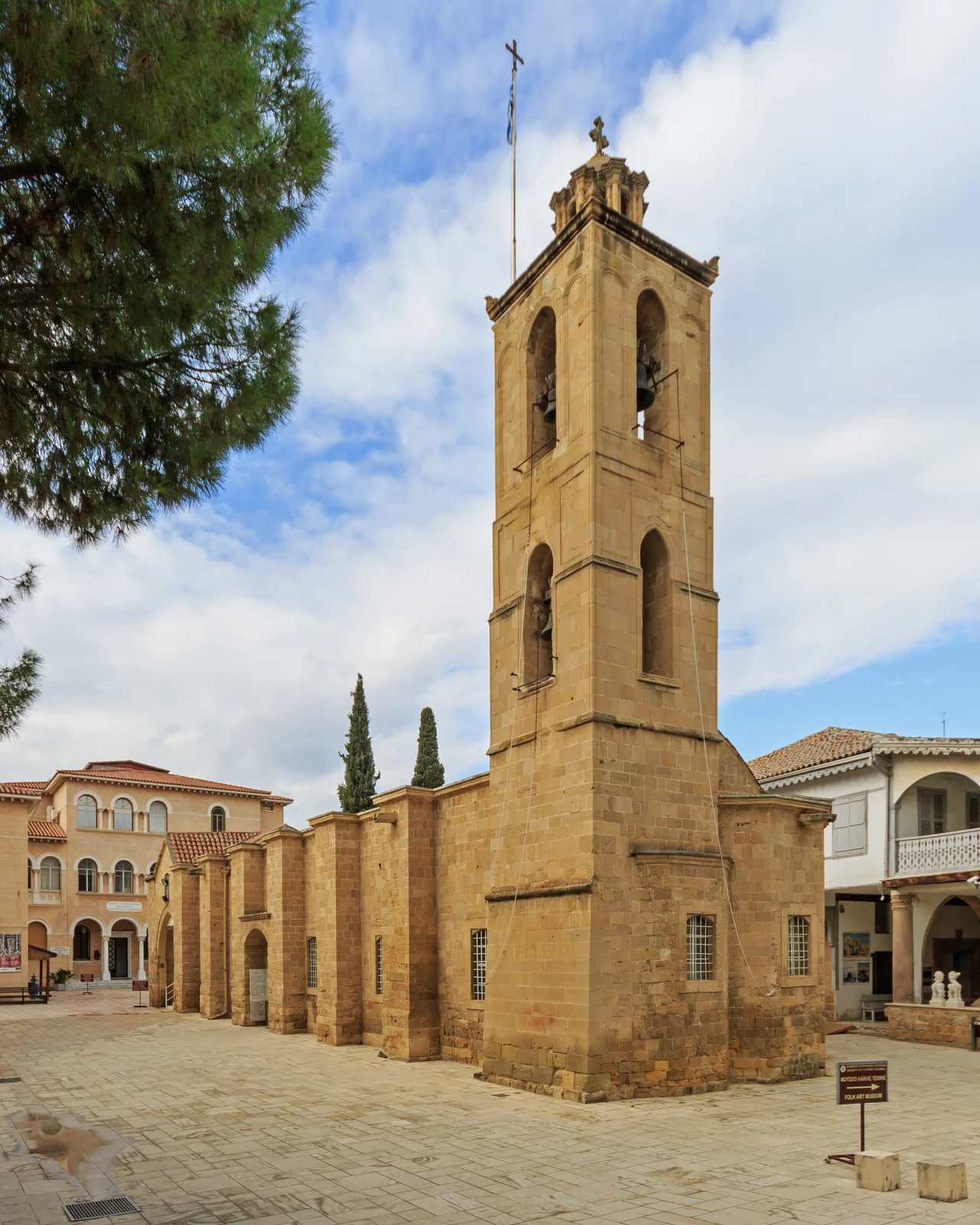
The Archbishopric of Cyprus is centered in Nicosia, the divided capital, at 35.1683 N, 33.3362 E, with the Archbishop's Palace and St. John's Cathedral as the main administrative complex. From the air central Nicosia is unmistakable, the only major city in the world still divided by a UN buffer zone, the Green Line, since 1974. Best viewed at 3,000 to 5,000 ft AGL, with the Kyrenia Mountains visible to the north and the Troodos massif to the southwest. Nearest airports: Larnaca International (LCLK) about 25 nm southeast for the Republic side, and Ercan International (LCEN) about 8 nm east for the northern side. Cyprus airspace divides at the Green Line, requiring careful pre-flight planning.
Nearby Stories
- Battle of Salamis (306 BC) 17 km away
- Stavrovouni Monastery 22 km away
- Agios Neophytos Monastery 27 km away
- Paphos Castle 61 km away
- 1983 US Embassy Bombing in Beirut 199 km away
- Sahyun Castle 209 km away
- Antalya 236 km away
- Adana 251 km away