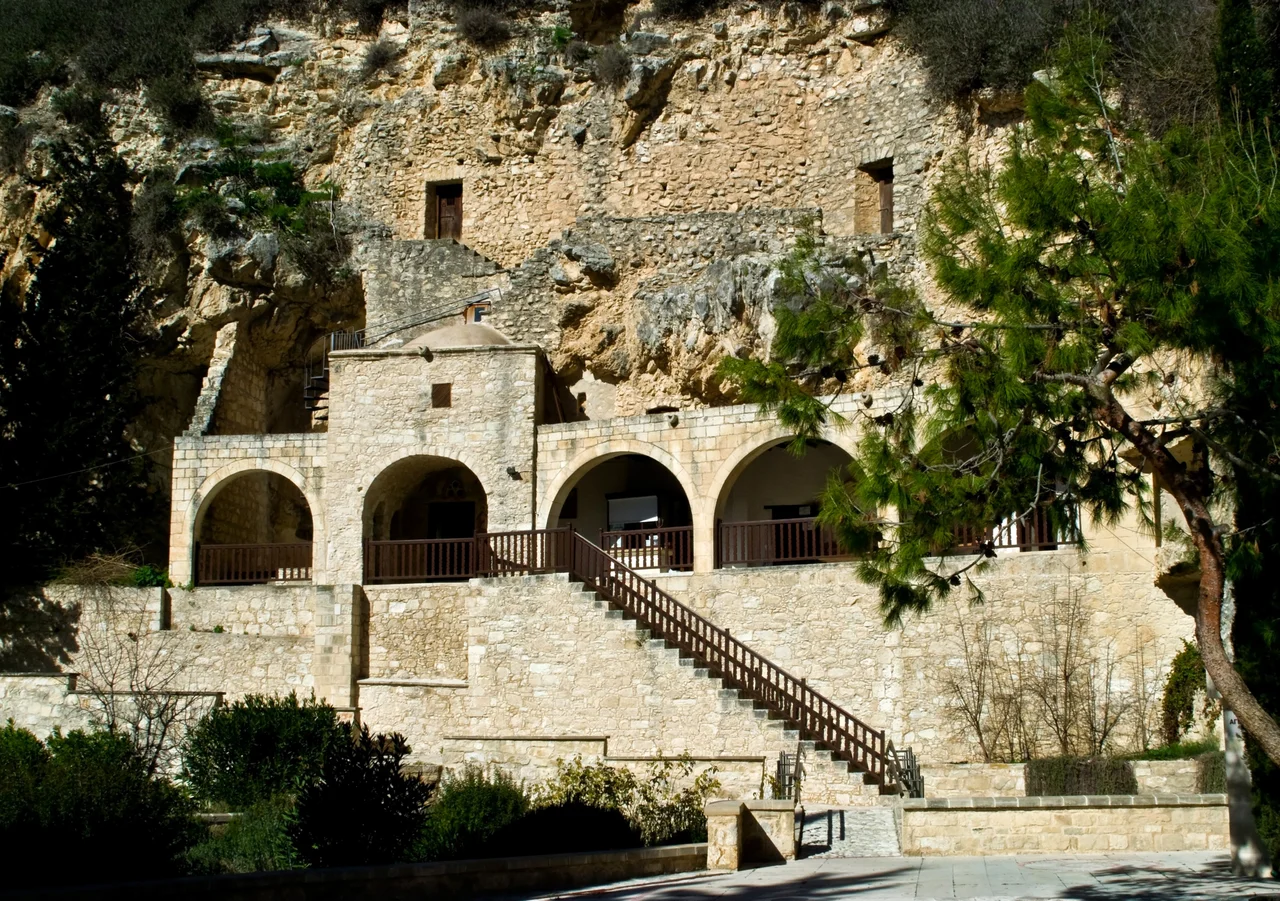

Agios Neophytos Monastery
Neophytos did not want company. After he escaped from a Cypriot jail in 1159, where authorities had locked him up for the crime of pursuing an ascetic life, he climbed into the hills north of Paphos and waited months in silence to make sure no one would find him. Then he picked a small natural cave in the limestone face above the Ezousas valley and began to enlarge it, by hand, into a hermitage. He carved a cell, a chapel, and his own tomb. He hoped to die there alone. Eleven years later, the Bishop of Paphos talked him into accepting a single pupil, and the monastic community he never wanted began.
The Engleistra
Neophytos called the place the Engleistra, the Place of Seclusion. It is still there, three rooms cut into the rock face, reached by stone steps from the valley path. A trapezoidal narthex opens into the church of the True Cross, with the saint's small cell to the south and the refectory to the north. Walking through it today, you understand the limit of what one human being could excavate alone with hand tools in stubborn limestone. The eastern wall once held a wooden cross containing a fragment of the True Cross, which Neophytos had somehow obtained, and a moderately sized cross-shaped niche still marks where it sat. The community he reluctantly accepted never grew large; in his second Ritual Ordinance, Neophytos counted around fifteen or eighteen monks. He preferred it that way.
Painted Walls
In 1183, while Neophytos was still living, the painter Theodore Apsuedes covered most of the Engleistra walls with frescoes. We know his name because Neophytos wrote it down and because Apsuedes left an inscription in the saint's cell. The Crucifixion, the Annunciation, and other standard Byzantine scenes line the chapel, but two paintings break the pattern. One shows Neophytos himself at the apex of the ceiling, flanked by the archangels Michael and Gabriel. The other, more startling, places the living monk inside the mandorla of Christ, attending divine service alongside the Lord. Modern viewers find it hard to read this as anything other than self-aggrandizing, and surviving descriptions of Neophytos call him vain. Later painters added at least four more phases of work over the centuries, using lapis lazuli, gold, and silver pigments imported across waters that were rarely safe.
The Katholikon Above the Cave
Outside the Engleistra and downhill, a Venetian-influenced basilica rises among the cypresses. This is the katholikon, the main church of the monastery, built in the early sixteenth century when Cyprus was under Venetian rule. Most of its original wall paintings are gone, lost to fire, time, or simple neglect, though enough survives to suggest the program. By 1631, the monastery had nearly dissolved twice from poverty and depopulation, and the abbot Leontios had to travel to Constantinople to argue for its survival. Patriarch Cyril Loukaris responded by declaring Agios Neophytos to have precedence over every other monastery on Cyprus. The decree did not multiply the monks, but it kept the lights on. In 1756, workmen cleaning the original cave found Neophytos's bones and moved them, with appropriate ceremony, to the katholikon. He has been there ever since.
What Endures
A scientific study in 2009 revealed that many of the pigments in the Engleistra contained high lead concentrations, which suggests the painters had trained on wooden icons rather than wall plaster. The icon technique on a stone surface explains why so much color has survived nine centuries in a damp limestone cave; it also explains the strange luminosity of the older frescoes, where the lead-based whites still catch lamplight in ways that frescoes painted with other recipes cannot. The monastery is still inhabited, still publishing the manuscripts that were copied within these walls, still offering the kind of quiet that Neophytos sought when he climbed up here in 1159. The bishops who pressed him into community building did him a favor he never quite admitted: they made his Engleistra last.
From the Air
Agios Neophytos Monastery at 34.8464°N, 32.4462°E, in the foothills north of Paphos, 1 km north of Tala village. Visual altitudes 2,500-4,500 ft from the southwest reveal the cave-cut Engleistra against the limestone bluff and the blue-roofed katholikon below. Paphos International (LCPH) lies 11 nm south. Cyprus weather is reliably clear most of the year; afternoon thermals build off the Troodos foothills inland in summer. The Ezousas valley drops dramatically east of the monastery toward the coast.
Nearby Stories
- Church of Cyprus 26 km away
- Stavrovouni Monastery 36 km away
- Battle of Ledra Palace 76 km away
- Antalya 225 km away
- 1983 US Embassy Bombing in Beirut 238 km away
- Antalya Museum 251 km away
- Assassination of Rafic Hariri 285 km away
- Sack of Damietta (853) 348 km away