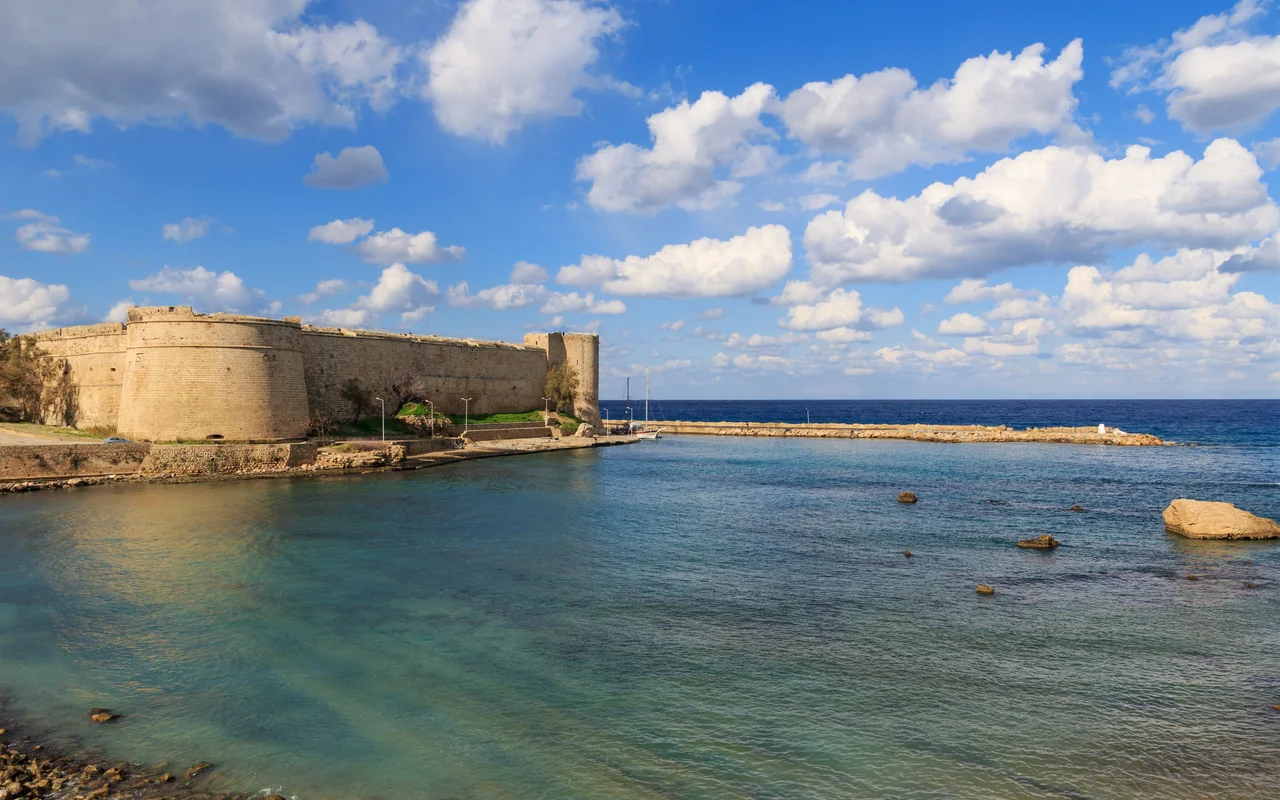

Paphos Castle
Sforza was a Spanish mercenary, fierce in temperament and unyielding in his post, and in August 1570 he refused to abandon the modest stone tower at the western end of Paphos harbor when most other Cypriot garrisons cut their losses and ran. The Ottoman forces had landed in their thousands. Sixteen days of artillery exchanges later, the Castle of Paphos lay in rubble, but Sforza had not surrendered it. The Ottomans took the wreckage and rebuilt it the way they had rebuilt every other castle on Cyprus, and in 1592 the Turkish governor Ahmed Pasha hung a white marble slab above the entrance recording the work. The slab is still there. So is the castle, smaller than its history would suggest, holding down one corner of a harbor that has seen Byzantines, Lusignans, Genoese, Mamluks, Venetians, Ottomans, British, and now the cruise tourists of the European Union.
The Older Castle
Paphos Castle is not the original castle of Paphos. The earlier and larger fortress stood about 600 meters west, at a site called Saranta Kolones, the place of forty columns, named for the Roman granite columns reused in its construction. The Byzantine engineers who built Saranta Kolones in the seventh century had been protecting the port from the same Arab raiders who would eventually pull down the Colossus of Rhodes. The earthquake of 1222 wrecked Saranta Kolones beyond repair, and the Lusignan rulers of Cyprus, recently arrived with the wave of Crusader-era nobility that had taken control of the island after Richard the Lionheart sold it to them, decided to build a smaller castle in a more defensible position at the harbor itself. They chose a Byzantine fortification already on the spot and rebuilt it as a Frankish tower. The smaller new castle is what we now call Paphos Castle.
The Genoese Towers
The Lusignans also built two smaller towers about 80 meters east of the castle, right at the entrance of the port. The towers, never directly connected to the main castle and probably operated as a separate defensive complex, came to be known as the Genoese Towers from their role in the war of 1373. The Republic of Genoa was a naval power, and Cyprus sat directly across the trade routes between Genoa and the Levant. When Genoese forces invaded the island in 1373, the towers' control of the harbor mouth slowed the Genoese advance. The towers played a similar role against the Mamluks in 1426, but the damage that battle inflicted was never fully repaired. The earthquake of 1491 finished the job. The ruins of the Genoese Towers still rise from the rocks at the harbor entrance, low and stubborn, three centuries past their last useful day.
Sforza's Stand
Cyprus was Venetian territory by 1489, when the last Lusignan queen, Caterina Cornaro, was persuaded to abdicate in favor of the Republic. The Venetians made some additions to the castle but never extensively rebuilt it, since by the sixteenth century artillery had made small medieval forts increasingly obsolete. When the Ottoman fleet arrived in 1570 to take the island, most Venetian garrisons in Cyprus were quickly overwhelmed. Famagusta held out for nearly a year, in one of the most savage sieges of the period. Paphos held for sixteen days under Sforza, the Spanish mercenary captain whose origin Wikipedia identifies but whose first name has been lost. The defenders fought from inside a structure that was already too small to be defended properly. They lost. The Ottomans repaired what was left, since the strong original construction had not been completely destroyed, and stationed a permanent garrison of 100 men with 12 cannons that remained until the British arrived in 1878.
Salt and Bombs
Britain took Cyprus from the Ottomans by treaty in 1878. The castle's military function ended that year, and for the next half century it served as a salt depot, the small ramparts and prison cells filled with imported sea salt waiting for distribution. In 1935 it was declared an ancient monument under the Antiquities Act and the salt was finally removed. Repairs to cracks in the walls and the breakwater followed in 1938 and 1939. The earthquake of 1953 wrecked most of the recent work, and full repairs took until 1969 to complete. Then on 21 July 1974, during the Turkish invasion of Cyprus, Turkish air and naval forces bombed the port of Paphos. The castle took hits but suffered no serious structural damage, the squat, thick-walled construction proving more resilient than any of its medieval defenders had managed. It was the third major military assault on the same building in 400 years, and the building was still there at the end.
What You See Now
Paphos Castle today is a single rectangular tower, 40 by 20 meters, with a closed inner courtyard and a smaller tower on top measuring 15 by 10. Twelve ramparts run around the upper perimeter, the platforms where the Ottoman cannons once stood. The ground floor holds rooms that served as prisons and barracks during Ottoman rule. The Paphos Outdoor Cultural Festival uses the castle as its setting every September, the floodlit walls and the harbor behind them making one of the better summer evening venues in Cyprus. Admission costs 2.50 euros. The ground floor is wheelchair accessible. The upper floor is not. Boats with red and blue paint bob in the harbor below, and you can stand on the small ramparts and see the same coastline that Sforza saw, the same hills where the Ottoman tents must have stretched, the same light off the same Mediterranean.
From the Air
Paphos Castle sits at 34.754 N, 32.407 E at the western end of Paphos harbor, on the southwest coast of Cyprus. The castle is a low, square structure visible on the breakwater. Best viewed from 1,500-3,000 ft AGL approaching from the south over the Mediterranean. The Tombs of the Kings necropolis (4 km north) and the Paphos Archaeological Park with its Roman mosaics (immediately east of the harbor) provide visual reference. Nearest airport: Paphos International Airport (LCPH / PFO), 11 km southeast. The Akamas Peninsula extends to the northwest.
Nearby Stories
- Kykkos Monastery 20 km away
- Church of Cyprus 34 km away
- Stavrovouni Monastery 40 km away
- 1983 US Embassy Bombing in Beirut 233 km away
- Antalya 242 km away
- Antalya Museum 269 km away
- Assassination of Rafic Hariri 280 km away
- Sack of Damietta (853) 329 km away