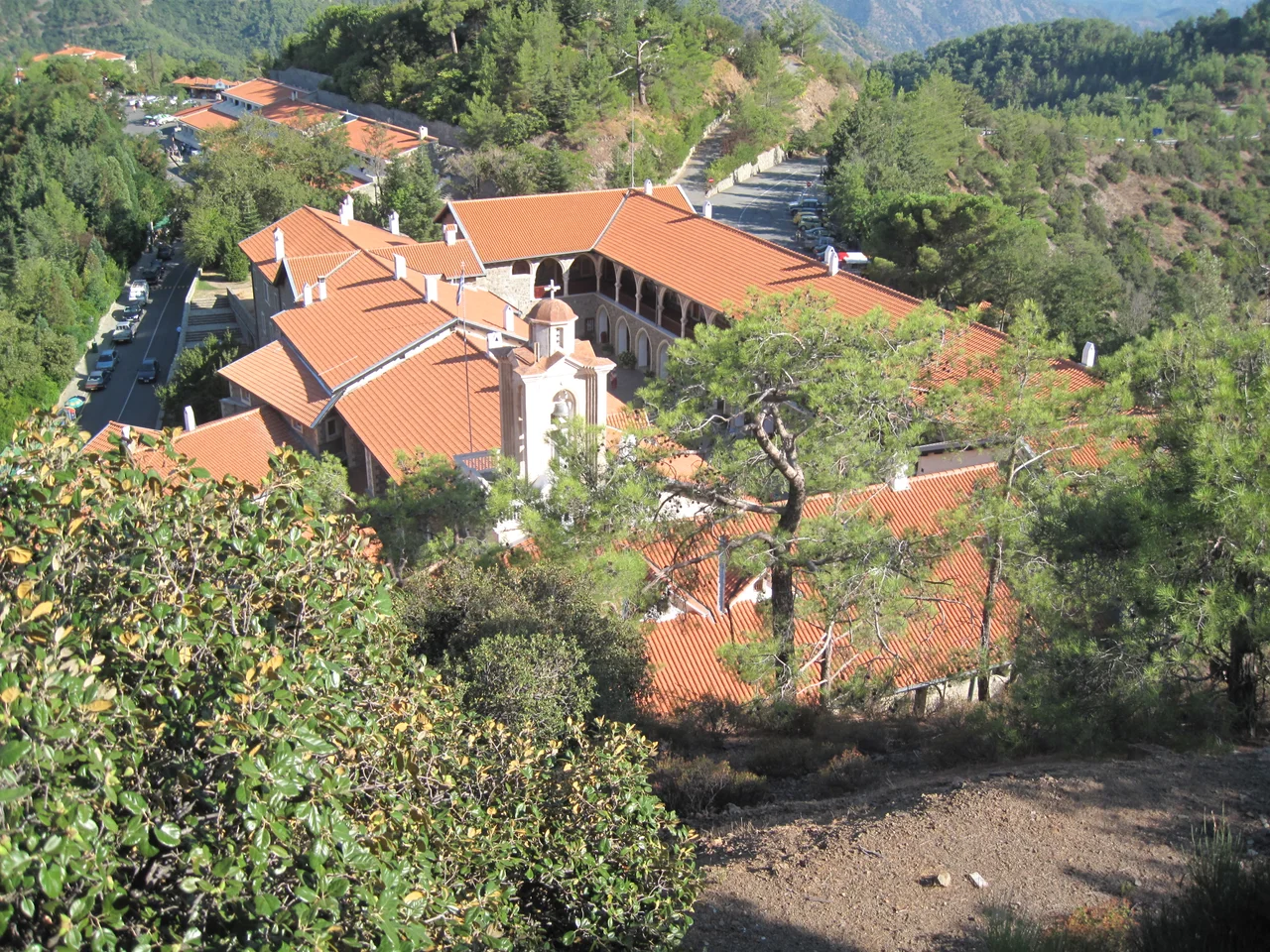

Kykkos Monastery
The icon is never seen. It hangs in the catholicon of Kykkos Monastery, 1,318 meters up in the Troodos Mountains of central Cyprus, but its top half remains permanently covered by an embroidered cloth and a silver riza. According to monastic tradition, anyone who looks directly at the image will be struck blind. The last person to lift the cover was Patriarch Gerasimos II of Alexandria, in 1669 - more than three and a half centuries ago. Even when the fathers carry the icon out in procession during severe droughts to pray for rain, they look away from her face as they uncover her. The icon is supposedly one of three painted from life by the Apostle Luke. The monastery is one of the wealthiest in Cyprus. The mountain road winds up to it through pine forests, and pilgrims have been coming since the eleventh century.
The Hermit and the Governor
The founding story comes through Vasil Grigorovich-Barsky, a Ukrainian pilgrim who walked across half the Eastern Mediterranean in the 1730s and recorded the traditions he heard. According to Barsky, a virtuous hermit named Esaias lived alone in a cave on the slopes of Mount Kykkos in the late eleventh century. The Byzantine governor of Cyprus, the doux Manuel Boutoumites, was hunting in the forest one summer when he became lost. He found Esaias and asked for directions. The hermit, who lived in contemplative withdrawal from worldly affairs, would not answer. Boutoumites lost his temper, shouted at the old monk, and even struck him. Soon afterward, back in Nicosia, the governor fell ill with a wasting disease the chronicler called 'lethargia' - a paralysis the doctors could not cure. Lying near death, Boutoumites remembered what he had done. He prayed for forgiveness and a chance to set it right.
The Icon from Constantinople
The hermit Esaias, prompted by a vision, told Boutoumites that the only thing that would heal him was to bring an icon of the Virgin from the imperial palace in Constantinople back to Cyprus - one of the three icons tradition said had been painted by Luke himself. The two of them traveled together to the capital. The Byzantine emperor Alexios I Komnenos, whose own daughter had fallen ill with the same paralysis, agreed to part with the icon only after the Virgin appeared to him in a dream and confirmed it was her wish. The icon traveled by ship from Constantinople to Cyprus and was carried up into the mountains in procession. According to legend, the trees along the path bowed their branches as it passed. With the emperor's patronage, a church and monastery were built in 1080-1090 to house her. The current church dates to 1745 - the original buildings have burned three times in nine centuries.
Locusts and Drought
The icon is credited with miracles still recounted on the island. In 1760, when locusts were devastating Cypriot crops - a recurring catastrophe in those centuries - the fathers carried the icon out in procession. The locusts dispersed. Locals attributed the deliverance to the Virgin. In recent years, when Cyprus has suffered some of its worst droughts in living memory, the icon has been carried to her stone throne at the highest point of the monastery grounds and special supplications for rain have been read while the fathers look away from her uncovered face. To the right of the icon, in the church, hangs a cast bronze arm - reminder of an incident in which a Turkish soldier tried to light a cigarette from one of the vigil lamps and supposedly suffered gangrene as a result. A swordfish saw is also displayed, brought as an offering by sailors who survived a storm.
Makarios and Independence
In 1926 a young Cypriot named Michalakis Mouskos arrived at Kykkos Monastery as a thirteen-year-old novice. He would grow up to become Archbishop Makarios III, the first president of independent Cyprus, and one of the most consequential figures in the island's modern history. Makarios led Cyprus to independence from Britain in 1960 and served as president through the bitter 1974 crisis, when a Greek-junta-backed coup attempted to overthrow him - and brought the Turkish invasion that divided the island. Makarios fled the presidential palace and took refuge briefly at Metochion Kykkou, the monastery's compound in Nicosia. Tank fire damaged the building. He survived and was eventually evacuated. When he died in 1977, he was buried at Throni, on a windswept ridge three kilometers west of Kykkos, looking out across the Troodos pines.
The Mountain Road
Kykkos is hard to reach. The drive from the coast climbs through Pedoulas and Prodromos, switchback by switchback, through forests of black pine and golden oak that thicken as you ascend. Visitors arrive at a complex larger than they expected - the monastery houses a museum of Byzantine icons, illuminated manuscripts, and silver liturgical objects whose value has accumulated over nine centuries of donations. The current abbot, Metropolitan Nikephoros, takes the bee as his personal symbol; the monastery's olive presses and beekeeping operations are among the oldest continuous industries in Cyprus. From the monastery walls you can see down across the foothills to the Mediterranean coast on a clear day. In winter, snow sometimes falls on the rooftops. The mountain itself is silent. The icon, never quite visible, presides.
From the Air
Located at 34.9839°N, 32.7411°E in the Troodos Mountains of central Cyprus, on the western flank of Mount Tripylos. Elevation 1,318 m. Cruising 6,000-10,000 ft above sea level offers views across the Troodos range, with Mount Olympus (Cyprus's highest peak at 1,952 m) to the east. Nearest airports: Paphos International (LCPH) about 50 km southwest, Larnaca International (LCLK) about 75 km southeast. Mountain weather can shift quickly; afternoon clouds often cap the higher peaks.
Nearby Stories
- Stavrovouni Monastery 21 km away
- Paphos Castle 43 km away
- 1983 US Embassy Bombing in Beirut 216 km away
- Antalya 227 km away
- Sahyun Castle 243 km away
- Antalya Museum 252 km away
- Mevlâna Museum 284 km away
- Sack of Damietta (853) 371 km away