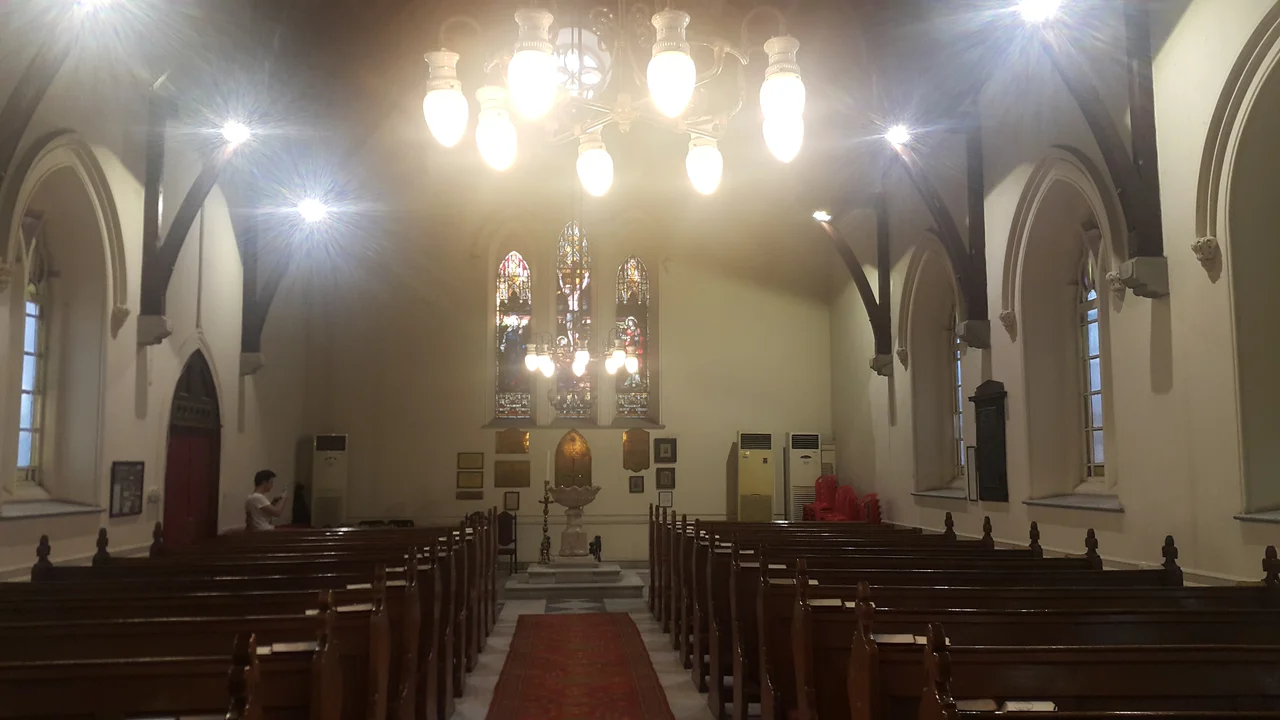

St. John the Evangelist's Anglican Church, Izmir
The floor of St. John's Anglican is supported, in the crypt below it, by short lengths of railway track stood vertically and packed with concrete. The architect was no professional ecclesiastical designer; he was Mr S. Watkins, an engineer of the Ottoman Railway Company, a British concern then laying track from Smyrna to Aydin. He had iron rail to spare and a parishioners' fund that could not stretch to Portland stone columns. So the church got a foundation engineered the way a railway viaduct is engineered, and a neo-Gothic shell built on top of it, and on 7 April 1902 it was consecrated by Charles Sandford, Bishop of Gibraltar. The first Anglican chaplain to Smyrna had arrived 266 years earlier, in 1636, and there had been one in the city continuously ever since.
Smyrna in Revelation
The Book of Revelation sends greetings to Smyrna in chapter 2 verse 8, and warns the church that some of its members will face martyrdom but encourages them to be faithful unto death. The most famous of those martyrs was Polycarp, by tradition a disciple of John the Evangelist, who became bishop of Smyrna and was burned at the stake there around 155. He appears in one of St. John the Evangelist's stained-glass windows, kissing the chains of Ignatius of Antioch as Ignatius is led through Smyrna on his way to execution in Rome. The window was designed by Charles Kempe, the great late-Victorian English glass designer, and installed in 1904. The west window came from Germany in 1895.
The Bishop Who Died at Sea
On 22 March 1911, William Edward Collins, Anglican Bishop of Gibraltar, died on board the steamship Saghalien while sailing from Constantinople to Smyrna for a visitation. His body was carried the rest of the way and buried inside St. John's, on the left of the entrance. His grave is still there, beside a baptismal font in the shape of a seashell, an ancient Christian symbol of pilgrimage. Two years later, in 1913, the Bishop Collins Memorial Hall was erected next door for the use of the parish, and a vicarage went up in 1911 between the church and the street. The vicarage is now leased to the British government as the Izmir consulate.
Charles Dobson and the Burning City
Charles Dobson, a New Zealand-born priest, was chaplain at St. John's in September 1922 when the Great Fire of Smyrna swept through the Greek and Armenian quarters of the city. Smyrna's old name had survived in foreign use longer than its Greek population would. The Greco-Turkish War had ended that month with the Turkish army's recapture of the city; in the days that followed, fires broke out in the Armenian quarter, spread through the Greek districts, and consumed most of the cosmopolitan waterfront. Estimates of the dead from the fire and the violence vary widely. Dobson escaped the burning city with his wife and two small daughters, made his way through the harbour where ships were taking off refugees, and survived. He later became a witness in the inquiry into the origins of the fire. He was thirty-six. He died in 1930.
The Building That Stayed
The Alsancak quarter where St. John's stands was on the north side of the cosmopolitan zone and survived the fire. The neo-Gothic church survived and so did the Anglican community, drastically smaller but continuous. The sanctuary kept its altar beneath three stained-glass windows; the rose window held above the west entrance; the pulpit and font remained where they had been placed by parishioners none of whom were still in the city. Anglo-Catholic in tradition, the parish kept its weekly communion, its vestments, its traditional hymnal. James Buxton, formerly Dean of Chapel of Corpus Christi College at Cambridge, became chaplain in September 2017 and serves dual roles as port chaplain to the Mission to Seafarers in Izmir and rector of St. John's.
What a Quiet Church Remembers
St. John the Evangelist sits two streets back from the Izmir corniche, hemmed by apartment buildings, the kind of building you walk past without noticing unless you know what it is. Inside, the railway-track foundation is invisible; the seashell font and the bishop's grave are not. The Kempe window keeps Polycarp and Ignatius greeting each other in stained glass while a city that was once Smyrna and is now Izmir does its modern business outside the door. Continuous chaplaincy since 1636 is a strange thing to record. It means that every shock that hit the city, the great fire, the population exchanges of 1923, the earthquakes of the seventies, the gradual departure of the Levantine families, was witnessed from this church by an Anglican priest writing back to his bishop in London or Gibraltar or Europe. The reports are still in the archives. The building is still in use.
From the Air
St. John the Evangelist's Anglican Church stands at 38.44 degrees north, 27.15 degrees east, in the Alsancak quarter of Izmir, two blocks back from the bay. Adnan Menderes Airport (LTBJ) is 22 km south of the city centre; Cigli (LTBL) is 9 km north. The church is invisible from cruise altitude. From the harbour approach the spire of St. Polycarp church a kilometre west is more prominent. Visibility along the Aegean coast peaks in March-May and October-November.
Nearby Stories
- Battle of Corycus 12 km away
- Battle of the Oinousses Islands 19 km away
- Eğlenhoca 20 km away
- Temple of Artemis at Ephesus 24 km away
- Akhisar Museum 28 km away
- Ottoman conquest of Lesbos 77 km away
- Hadrianotherae 134 km away
- Palace of the Grand Master of the Knights of Rhodes 193 km away