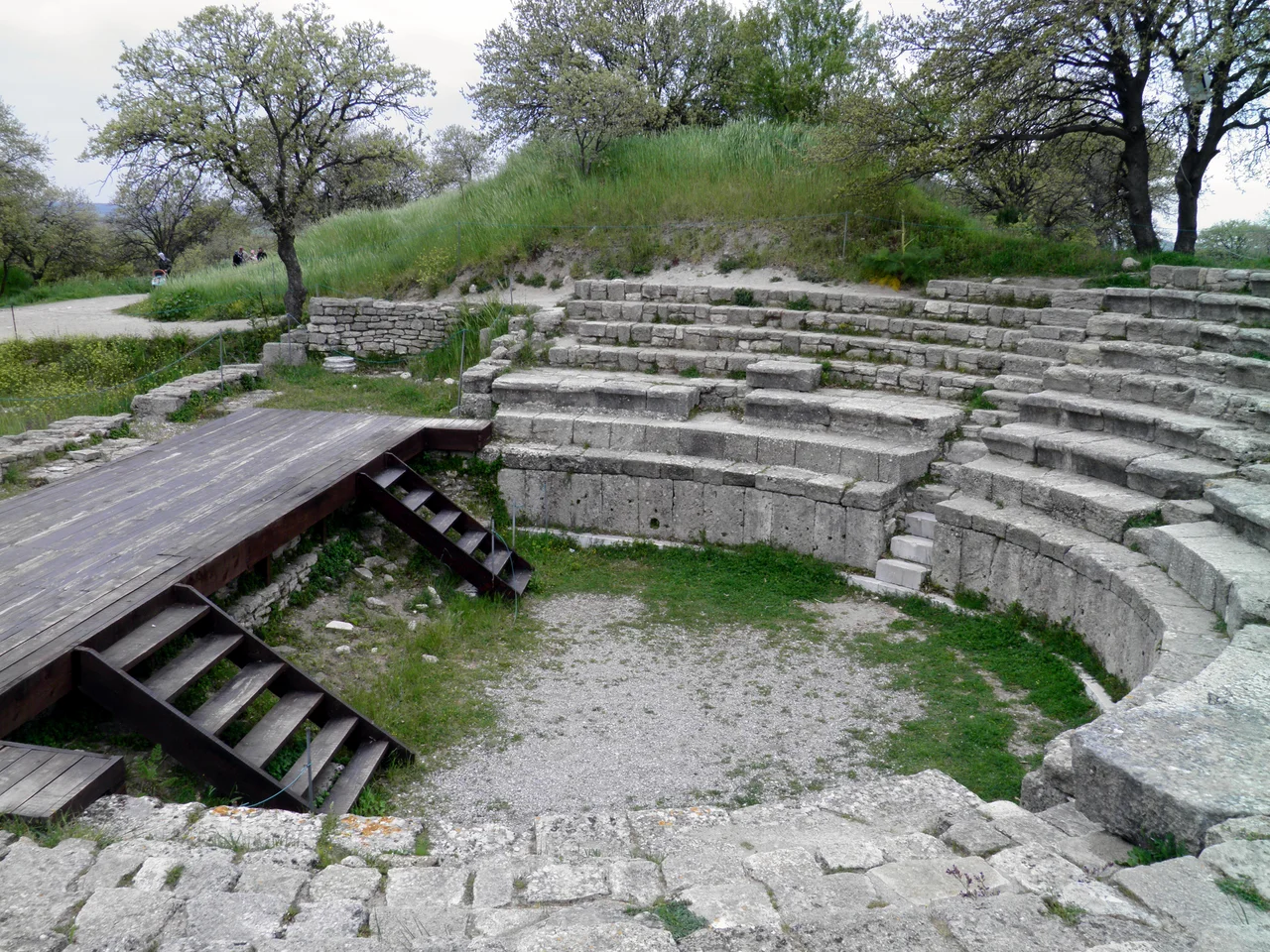
,_Turkey.jpg)
Troy
The mound is not impressive. Hisarlik rises only thirty-one metres above the surrounding plain in the Turkish province of Canakkale, near the mouth of the Dardanelles where the strait opens into the Aegean. From a distance it looks like a slightly raised piece of farmland. What makes it significant is what is underneath: nine successive cities stacked on top of one another, the earliest going back to around 3000 BC, the latest abandoned in the Byzantine era. One of those layers - probably Troy VI, possibly Troy VIIa - is the city the Hittites called Wilusa, the Greeks called Ilios, and Homer made immortal as Troy. Identifying which layer was which, and what really happened on this small hill in the Late Bronze Age, has occupied archaeologists for a century and a half.
The Man Who Was Right
Frank Calvert was a Turkish-born Levantine of English descent who owned a farm near Hisarlik. He was not a famous man. In 1865, on his own land and at his own expense, he began trial excavations on a mound he had become convinced was Troy - convinced enough to persuade Heinrich Schliemann, the German businessman who turned up in 1868 looking for fame. Calvert had identified the site correctly. He had grasped, before anyone else, that Homeric Troy lay beneath the visible classical-era ruins of Ilion, not in the more obvious mound at Pinarbasi south of here that scholars had favoured for almost a century. Schliemann took the credit, the funding, and the partnership. Calvert remained in his farmhouse and watched the world's attention sweep past his door. Nearly every modern account of Troy now begins by restoring his name to the story he started.
The Trench
Schliemann arrived in 1870 with permission to dig and a hurry that has shaped the archaeology of the site ever since. His first move was to drive a massive trench straight down through the centre of the mound to expose every layer at once - a gash today known as Schliemann's Trench, still visible in the ruins. Anything he considered insignificant in the upper layers, he removed without recording. The Bronze Age city he was actually looking for sat in the middle of the stack, but Schliemann fixated on Troy II, the second-oldest layer, where he found the gold that he triumphantly named Priam's Treasure. He smuggled most of it to Berlin (where the Soviet Red Army seized it in 1945; it is now in the Pushkin Museum in Moscow). Troy II turned out to be more than a thousand years too old to be Homeric. The layers Schliemann had cut through and discarded - Troy VI and VIIa - were almost certainly the right ones. His own assistant, Wilhelm Dorpfeld, came to suspect this in the 1890s. Schliemann himself privately agreed before his death in 1890, but never published the correction.
Nine Cities Stacked
Carl Blegen of the University of Cincinnati came back to Hisarlik in the 1930s with a more careful method. He worked through the trench Schliemann had left and confirmed that the mound contained at least nine major cities - and within those, forty-six distinct sublayers - representing more than three thousand years of occupation. Manfred Korfmann's Tubingen-Cincinnati team, working from 1988 to 2005, transformed the picture again by discovering that what everyone had taken for the entire city was really just the citadel. A wide defensive ditch and palisade ran around a much larger lower town that brought Troy VI-VII to roughly 200,000 square metres - a real Late Bronze Age city, not a tiny aristocratic outpost. Bronze arrowheads and fire-damaged human remains turned up in layers from the early twelfth century BC, the period traditionally associated with the Trojan War. Korfmann argued this counted as evidence of a real conflict here. The historian Frank Kolb argued, sometimes acrimoniously, that it did not. The argument has not been settled, and it may not be settleable.
Wilusa
What complicates the picture beautifully is that we know the city existed in non-Homeric records too. Hittite tablets from the Late Bronze Age refer to a place called Wilusa, ruled by kings with names like Kukkunni and Alaksandu, that lay on the western edge of Anatolia and was politically aligned with the Hittite empire. Wilusa was within reach of Mycenaean Greek power - the Hittites called the Greeks Ahhiyawa, a word that sits suggestively close to Homer's Achaeans. A Wilusan king may have been deposed in some kind of conflict around the time the Trojan War was traditionally placed. None of this proves Homer was writing history. It does suggest he was working from something. After Hisarlik fell out of major political life, the place still mattered. Alexander the Great visited in 334 BC, sacrificed at the supposed tombs of Achilles and Patroclus, and declared the city free of taxes. Augustus rebuilt the temple of Athena Ilias in 20 BC. The Romans believed they were Trojans descended through Aeneas, and the family of Julius Caesar claimed direct descent from Venus and the Trojan prince. The mound has always been a place where myth and politics meet, with archaeology arriving very late to a conversation already in progress.
From the Air
The Troy archaeological site sits at 39.96°N, 26.24°E on the Aegean coast of northwestern Turkey, about 5 km inland from the southern shore of the Dardanelles. From altitude, the Troad plain stretches between the Aegean and the Marmara, with the Gallipoli peninsula visible across the strait to the north. Nearest airport: Canakkale (LTBH) about 30 km northwest. The mound itself is small enough that a good visual ID requires lower altitude - 2,000-4,000 ft for the site, climbing to 8,000 ft for the wider context including Imbros and Tenedos to the west. UNESCO World Heritage Site #849.
Nearby Stories
- Battle of Hill 60 (Gallipoli) 8.9 km away
- Mount Ida (Turkey) 9.8 km away
- 2014 Aegean Sea Earthquake 19 km away
- SMS Kurfürst Friedrich Wilhelm / Barbaros Hayreddin 23 km away
- Altıkulaç Sarcophagus 38 km away
- Mithymna 40 km away
- Massacre of Samothrace (1821) 45 km away
- Destruction of Psara 129 km away