
Mithymna
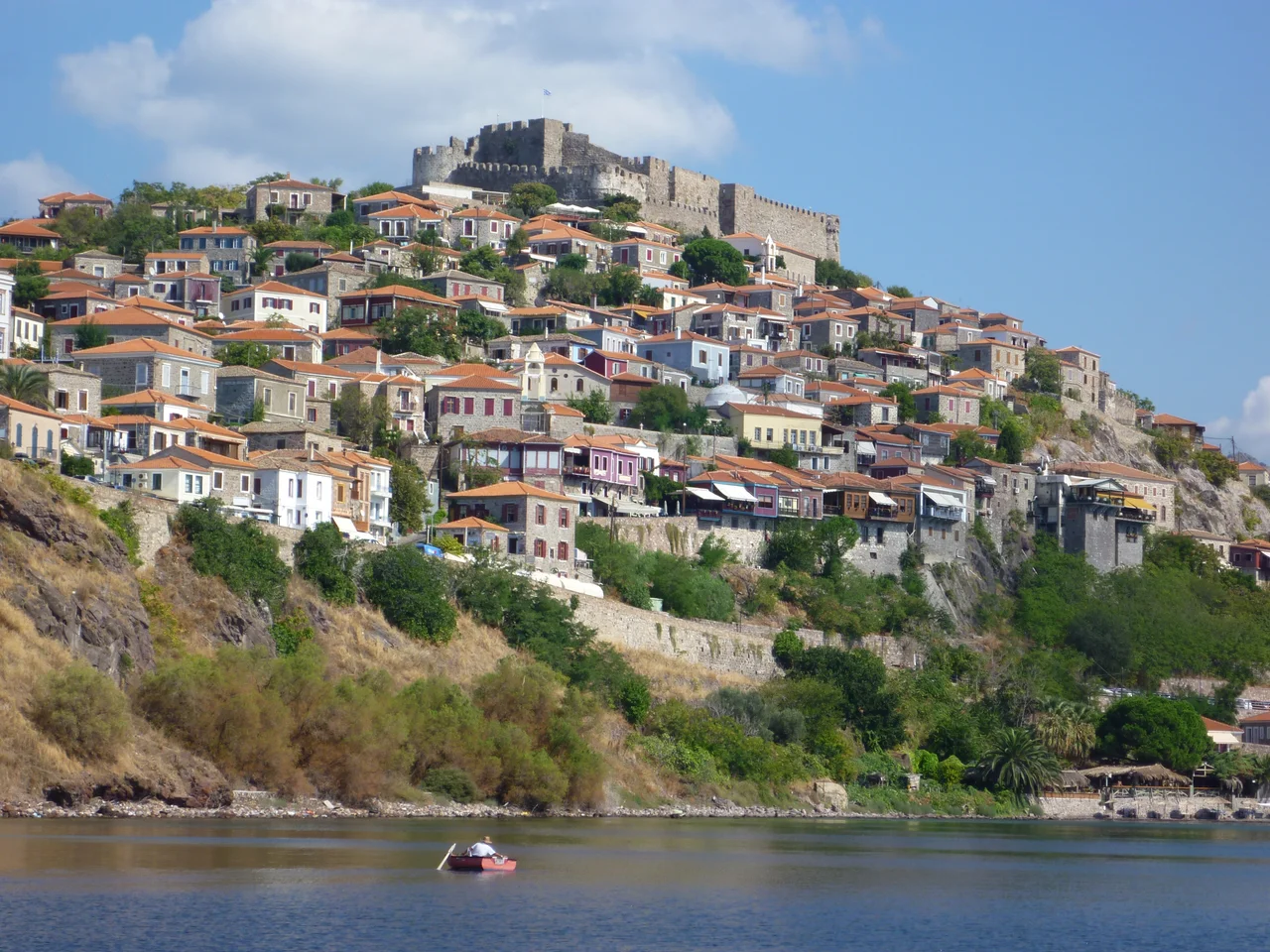
From the pebbled beach, look up. The town climbs the hillside in tiers of red-roofed stone houses, and at the very top, crowning the hill, sits a fortress the Genoese rebuilt more than six hundred years ago. Most people call this place Molyvos. The old name, Methymna, is older still, and the town has worn its history the way the hill wears its houses, layer above layer, each generation building on the one below. Roughly fourteen hundred people live here now, but for most of antiquity Methymna was the second city of Lesbos, rich enough and proud enough to spend centuries quarreling with its great rival in the south.
The Castle on the Hill
The fortress that defines the skyline has guarded this hill for a very long time. An acropolis stood here from the 5th century BC; the Byzantines raised a fortress over it; and in 1373 the Genoese lord Francesco I Gattilusio rebuilt it into much of what survives today. Gattilusio had won Lesbos in 1355, the reward for helping the Byzantine emperor John V Palaiologos retake Constantinople, sealed by marriage to the emperor's sister. For just over a century his family, the Gattilusi, ruled the island as Genoese lords from these walls. The castle is an irregular trapezoid of reddish-brown trachyte, its perimeter studded with square and round towers. When the Ottomans finally took it, they made it the last stronghold on Lesbos to fall, holding out in 1462 after fierce resistance before the island slipped fully under Ottoman control by that September.
Achilles at the Gates
Methymna's founding myth gave it a daughter of Macar, married to the personification of Lesbos itself. But its darkest old story belongs to the Trojan War. In the epic tradition, Achilles besieged the city, and a Methymnian princess named Pisidice fell in love with him from the walls. She opened the gates in exchange for a promise of marriage, and Achilles took the city. Then, the war won, he had his soldiers stone her to death for the treason that had handed it to him. It is a grim tale of betrayal punished by the betrayer, and the kind of story a proud city tells to explain its scars. Whatever the truth behind it, Methymna was clearly important early. The legend of Arion and the dolphin, set here around 600 BC, points to a city already rich in far-flung connections across the Greek world.
A Rivalry Across the Island
For centuries Methymna defined itself against Mytilene. During the Peloponnesian War, when Mytilene revolted against Athens in 428 BC, Methymna alone among the island's cities stayed loyal to Athens, and was rewarded for it: after Athens crushed the revolt, only Methymna kept its land and, with Chios, its self-government and freedom from tribute. The city minted its own silver and bronze coinage, prized for its quality. Its wine became legend. Virgil called the vines of Methymna the best and most numerous on Lesbos; Horace praised the vinegar pressed from its grapes alongside a fine eel; and the physician Galen, ranking the wines of the island, placed Methymna's first. To drink Methymnaean was, to a Roman, to drink very well indeed.
Mansions, Merchants, and the Sea
Under the Ottomans the town was called Molova, and the first centuries were hard, marked by heavy taxation and confiscations that pushed many families to the opposite coast in search of a better life. But after the reforms of the late 18th and 19th centuries, commerce returned to local hands. Molyvos merchants ran the shipping and trade with the coasts of Asia Minor, the Balkans, even Russia, dealing in olive oil, soap, wine, and salted fish. The wealth shows still in the stone mansions, the schools for boys and girls, the library of the Muse Fraternity, the athletic club named Arion for the old legend. Today the heart of all this is the agora, the cobbled bazaar street that winds uphill toward the castle, lined with historic shops and cafes shaded by vines. Below, Molyvos Beach earns its Blue Flag with pebbled shallows running out over soft sand, the fortress and town reflected in the water above it.
From the Air
Mithymna (Molyvos) sits at 39.37 degrees N, 26.18 degrees E on the north coast of Lesbos, about 6 km north of Petra. The most prominent landmark from the air is the trapezoidal Genoese fortress crowning the hill above the town, with the tiered settlement spilling down to the sea. Mount Lepetymnos rises to 968 m just to the southeast. Mytilene International Airport (ICAO: LGMT) is roughly 50 km south on the island's eastern coast. A viewing altitude of 3,000 to 5,000 feet frames the castle, harbor, and beach together; the Turkish coast lies close across the water to the north and east.
Nearby Stories
- Antandrus 6.8 km away
- Agios Isidoros, Lesbos 19 km away
- Adramyttium 30 km away
- Troy 45 km away
- Destruction of Psara 51 km away
- St. Helena Church 72 km away
- Psara 82 km away
- Battle of Athos 85 km away