
Adramyttium
Before Croesus became the byword for fabulous wealth, he was a provincial governor — and the province centred on Adramyttium. That detail catches something essential about this ancient Aegean city: it always seemed to be at the edges of someone else's story, and yet the great figures of antiquity kept passing through. Persians and Spartans argued over it. Romans built roads to it. St. Paul sailed from its harbour. And thirteen centuries of Byzantine emperors, Crusader knights, Genoese merchants, and Ottoman raiders all found it worth fighting for, sacking, or trading in. The city that began at the head of the Gulf of Adramyttium — where modern Ören beach now fills with summer swimmers — eventually relocated thirteen kilometres northeast to become today's Edremit. Its ancient name survives in the gulf's own name, and its history is buried beneath the sands of both sites.
Waves of Conquest
The site was first settled by Leleges, the indigenous people whom the Greeks considered aboriginal to the Aegean coast, and by Mysians from the interior. Lydians and Cimmerians followed, then Aeolian Greeks who gave the surrounding region its name, Aeolis. The city as such was founded in the 6th century BC, during an era when Lydia still dominated western Anatolia. When Lydia fell to Persia in 546 BC, Adramyttium passed to the Persian satrapy of Hellespontine Phrygia — one of many administrative handoffs to come.
The Classical period brought the city into the orbit of Athens, Sparta, and Persia by turns. In 366 BC, the satrap Autophradates and the Carian dynast Mausolus besieged Ariobarzanes here. The siege ended only when Agesilaus II of Sparta arrived in 365 BC — a detail that places Adramyttium squarely in the great-power politics of its age. After Alexander's death in 323 BC, the city passed through the hands of the Diadochi, the warring successors who divided his empire, changing rulers at least five times in two decades.
A City That Built Empires' Coffers
By the third century BC Adramyttium had constructed an artificial harbour, which allowed it to eclipse the neighbouring port of Cisthene. Prosperity followed. Under the Attalid kings of Pergamon, the city minted cistophori — the silver coinage that underpinned regional trade — and became a judicial centre whose authority stretched across the Troad and western Mysia. When the last Attalid king, Attalus III, bequeathed his kingdom to Rome in 133 BC, Adramyttium slid smoothly into Roman provincial life.
Roman governors rebuilt roads here. A famous school of oratory flourished in the city during the 1st century BC. The orator Xenocles of Adramyttium was prominent enough to travel to Rome on behalf of the city after the upheaval of the First Mithridatic War — a conflict in which the city council had been murdered by a local supporter of Mithridates VI, and Roman settlers had been driven into the sea and killed. Rome eventually stripped the city of its autonomy and imposed taxes as punishment, but the city's commercial life continued.
From Paul's Harbour to Reluctant Emperors
The Acts of the Apostles records that St. Paul, on his way to Rome as a prisoner, boarded a ship of Adramyttium at Caesarea Maritima and sailed to Myra in Lycia. It is a passing reference, but one that anchors the city in the early Christian world — and perhaps explains why its diocese, established by the Council of Nicaea in 325 AD, became a suffragan of the Archdiocese of Ephesus.
Byzantine history brought stranger moments. In 715, mutinous soldiers of the Opsikion theme arrived at Adramyttium and seized a local tax-collector named Theodosius. They proclaimed him emperor. He fled into the mountains. They found him and forced him to accept the throne at sword-point. The reluctant emperor Theodosius III would rule for two years before abdicating in favour of Leo III. It is a story that illuminates the violent instability of 8th-century Byzantium — and the strange gravitational pull this provincial city seemed to exert on history.
Crusaders, Genoese, and the City's Long Farewell
The Fourth Crusade of 1204 shattered Byzantium into competing successor states, and Adramyttium found itself on the front line of the wars that followed. Henry of Flanders, brother to the Latin Emperor Baldwin I, seized the city and used it as a base of operations. The Nicaean Empire — the principal Byzantine successor state — fought to reclaim it. The city changed hands several more times through 1224, when Latin rule in Anatolia finally collapsed.
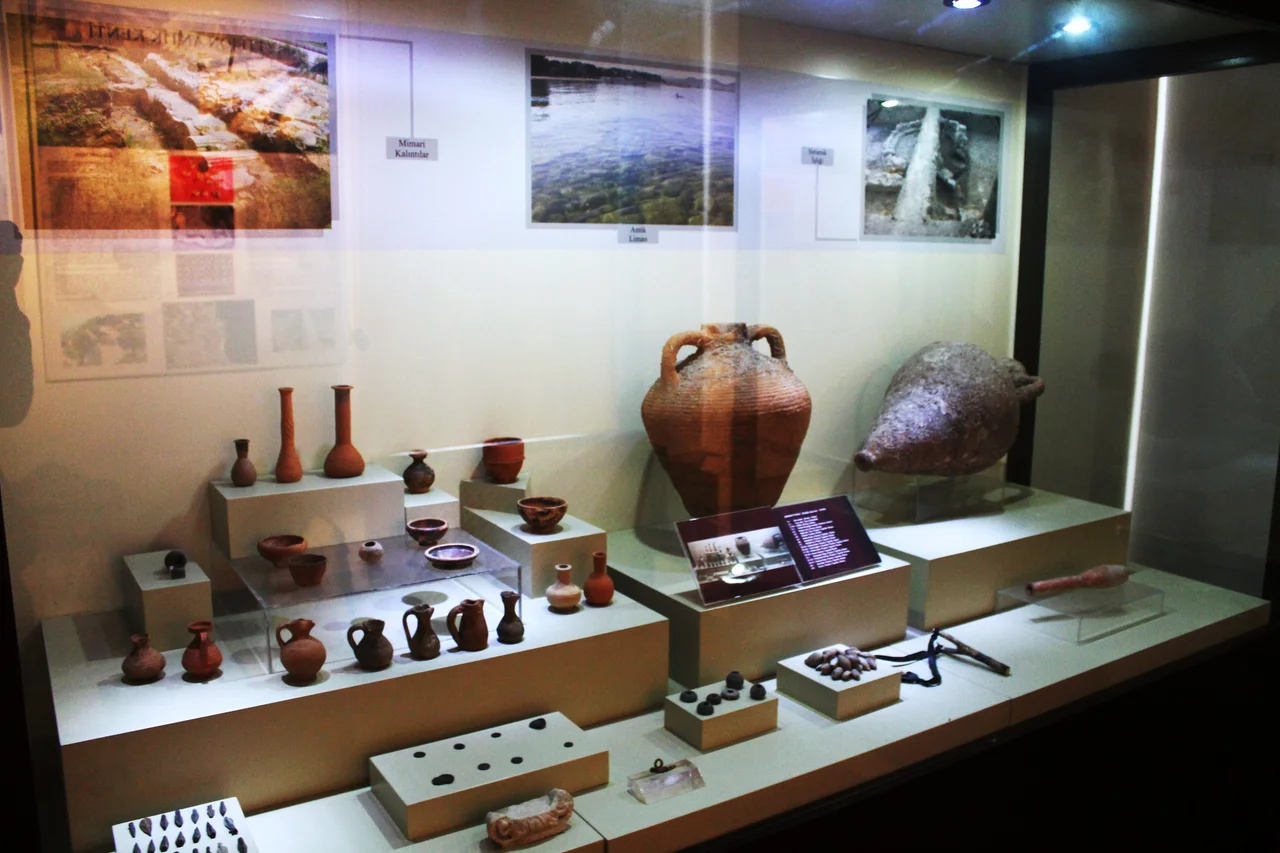
The later medieval centuries brought Genoese trading concessions in 1261, Venetian ones in 1268, and the raids of Osman I following his victory at the Battle of Bapheus in 1302. The Genoese of Phocaea, anxious about Ottoman expansion, seized the Venetian concession in 1304. By this point the old harbour site at Ören was silting up, and at some point — scholars debate whether it was under Trajan or as late as 1109 — the city relocated to the higher ground of modern Edremit. The original site passed from memory until archaeologists and beachgoers began to excavate it simultaneously.
What the Name Carries
Adramyttium never vanished entirely. Its diocese survived as a titular bishopric of the Roman Catholic Church from the mid-15th century onward. Its name persisted in the gulf that spreads south of it, the Gulf of Adramyttium — called the Gulf of Edremit today, but still carrying the ancient syllables in its older designation. And the modern city of Edremit, with its olive groves, resort beaches, and bus connections to Istanbul and Izmir, stands on what was once a relocated Roman-Byzantine town that had itself replaced an earlier Iron Age settlement.
To stand at Ören beach today — where a replica Pegasus statue marks the excavation site — is to stand at one end of a story that winds from Croesus to Crusaders to package holidays. Fifteen hundred years of documented history lie beneath the sand. The sea has been here all along.
From the Air
Adramyttium's original site lies at approximately 39.50°N, 26.94°E, on the Ören beach strip at the head of the Gulf of Edremit (Gulf of Adramyttium), about 4 km west of modern Burhaniye. The modern city of Edremit, where the ancient city relocated, sits at approximately 39.60°N, 27.02°E, a few kilometres inland from the gulf's tip. Flying southward along the Turkish Aegean coast at 5,000–8,000 ft, the gulf opens as a wide blue inlet below; Mount Ida (Kazdağı, 1,774 m) rises prominently to the north-northwest. Nearest airport: LTFD (Balıkesir Koca Seyit Airport, near Edremit), approximately 25 km east of the gulf's coast. Regional alternative: LTBG (Bandırma Airport), about 100 km north.
Nearby Stories
- Lesvos 4.6 km away
- Mithymna 19 km away
- Troy 28 km away
- Ottoman conquest of Lesbos 30 km away
- 1953 Yenice–Gönen Earthquake 34 km away
- Balıkesir 45 km away
- Altıkulaç Sarcophagus 46 km away
- Akhisar Museum 47 km away