
Psara
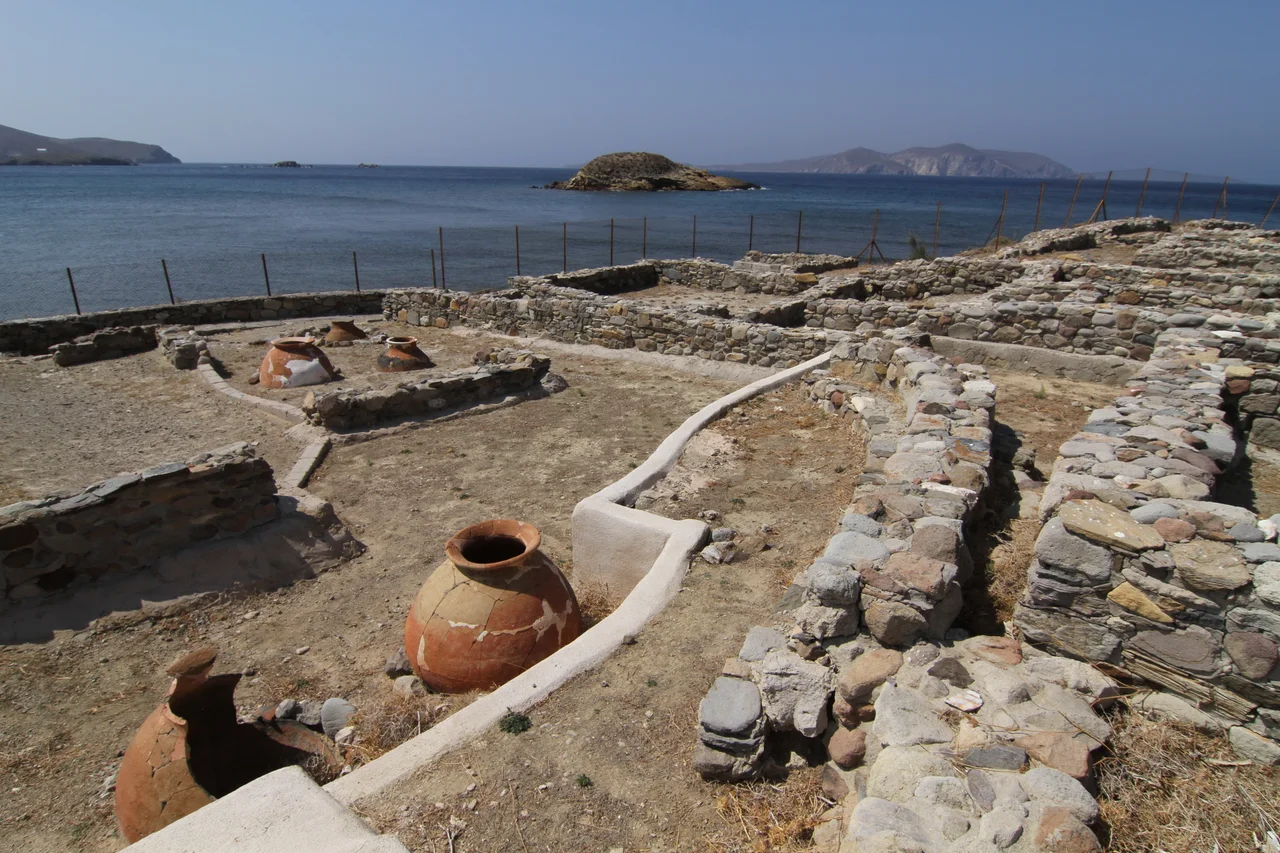
Homer knew this island by name. In the Odyssey he calls it Psyra, a windward rock off the coast of Chios that sailors steered past on their way home. Three thousand years later the name has barely changed and the rock is barely greener, treeless and bare, ringed by deep blue water. Fewer than five hundred people live here now. But for one extraordinary stretch of history, this small place built one of the most feared fleets in the Aegean, and then paid for it in full.
Living From the Sea
Psara offers almost nothing on land. It is rocky and dry, with little soil and fewer trees, so its people have always turned to the water. They fished, famously for the slipper lobsters that crowd the local seabed, and above all they sailed. Settlement here reaches back to the Mycenaean age, and ancient writers from Strabo to the Suda recorded the island under its old name. The Greek proverb Psyra celebrating Dionysos even made the place a byword for doing something on too small and shabby a scale. Profitis Ilias, the high point of the island, rises just over five hundred meters above the surrounding sea.
The Third Fleet
By the early nineteenth century, the Psariots had built the third largest merchant fleet in Greece, behind only Hydra and Spetses, some forty-five ships strong. When the revolution against Ottoman rule began in 1821, the island joined within weeks and turned its merchant captains into naval commanders. Konstantinos Kanaris, a future prime minister of Greece, learned here to guide blazing fire ships into the heart of the Ottoman navy. The island flew a flag of its own making, white bordered in red, bearing a cross, a serpent coiled on an anchor, and the words Freedom or Death. An original survives in the National Historical Museum in Athens.
The Year Everything Ended
In June 1824, the Ottoman fleet came for Psara. The island, by then crowded with refugees from earlier massacres, was overwhelmed in two days. Most of its people were killed or enslaved; the rest fled. The defenders' last act at the hilltop fort, blowing themselves and their attackers skyward rather than surrender, became one of the defining images of the Greek struggle. The island was left deserted and stayed in Ottoman hands until the Greek navy recovered it in 1912. Psara never recovered its old population. The full story of those days has its own telling, but its shadow falls across everything here.
Sons and Daughters
For a place so small, Psara sent remarkable people out into the world. Ioannis Varvakis made a fortune in caviar and became one of the great benefactors of the young Greek state. Kanaris and the admirals Nikolis Apostolis and Dimitrios Papanikolis carried the island's seamanship into legend. Among the island's lost children were Garafilia Mohalbi, a girl enslaved in the destruction and brought to America, who died there at thirteen, and George Sirian, who survived to become a United States Navy officer. Today the ferry from Chios still ties Psara to the wider world, as the sea always has, carrying a few hundred residents and the long memory they keep.
From the Air
Psara lies in the northeast Aegean at 38.55°N, 25.57°E, roughly 81 km northwest of Chios and 150 km east-northeast of Athens. It is ferry-only; the nearest airport is Chios Island National (LGHI). From the air the island reads as a bare, ridged landmass about 7 km across, its summit Profitis Ilias (512 m) the obvious landmark, with the smaller island of Antipsara off the southwest. The single harbor town sits on the southeast coast. Summer brings clear skies but the northerly meltemi can churn the surrounding water; the open crossing to Chios is exposed in strong winds.
Nearby Stories
- Panagia Krina, Chios 5.8 km away
- Chios 21 km away
- Agios Isidoros, Lesbos 35 km away
- Skyros 38 km away
- Mastichochoria 44 km away
- Battle of Andros (1790) 45 km away
- Sigri (village) 51 km away
- Oktonia 70 km away